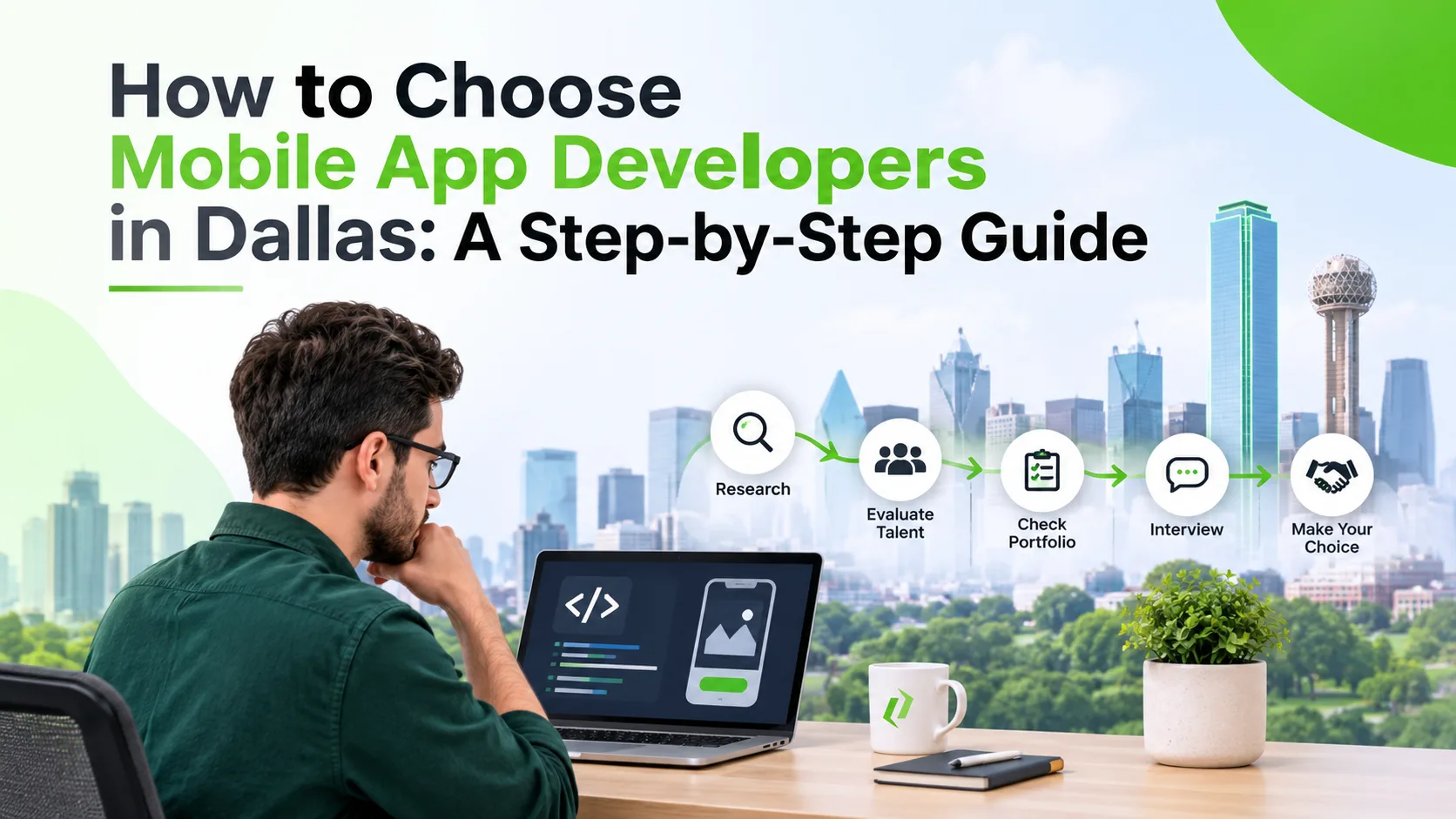
Choosing the right mobile app developers in Dallas is an important decision for any business planning to build a digital product in 2026. Whether you are a startup with a new app idea, an established company looking to improve customer engagement, or an enterprise planning to automate business operations, the development partner you choose can directly influence your project's success.
Dallas has become an attractive destination for technology development, with companies offering services ranging from custom mobile application development to artificial intelligence, cloud integration, and enterprise software solutions. However, with so many development companies available, finding the right team is not always straightforward.
Some developers focus on creating simple Android and iOS applications, while others offer complete digital product development, including business strategy, UI/UX design, backend engineering, AI integration, and long-term maintenance.
The challenge is not simply finding a company that can build an app. It is finding a development partner that understands your business goals, technical requirements, target audience, and future growth plans.
This guide explains how to choose mobile app developers in Dallas, what factors to evaluate, which questions to ask, and how to avoid common mistakes before starting your project.
Why this decision matters more than most people expect
Picking an app developer feels like a vendor decision. It is actually closer to choosing a business partner. The team you hire will shape your product, your budget, your launch date, and how your customers feel the first time they open your app.
Dallas makes the choice both easier and harder. The Dallas-Fort Worth area has a deep business base in finance, healthcare, logistics, real estate, energy, retail, and technology. That means plenty of capable app companies, and plenty of noise. Every agency says it is "full-service," "award-winning," and "results-driven." Very few explain how they actually work.
This guide walks through the process in plain steps, the same way you would if you were sitting down with a friend who had hired developers before and made a few expensive mistakes along the way.
Step 1: Get clear on what you are building (before you talk to anyone)
The biggest cause of failed app projects is not bad code. It is a vague idea. Before you contact a single developer, write down answers to these questions:
- What problem does the app solve?
- Say it in one sentence. "Helps dental clinics in Texas reduce no-shows" is a strong start. "A better booking app" is not.
- Who will use it?
- Customers, employees, drivers, patients, field technicians? Their habits decide your design.
- What must it do on day one?
- List the three to five features without which the app has no point. Everything else goes on a "later" list.
- How will you know it worked?
- Pick numbers: downloads, repeat usage, orders per week, hours saved, revenue.
- What is your budget range and deadline?
- An honest range gets you better advice than hiding it. Good developers use it to recommend a realistic scope.
If you cannot answer these yet, that is fine. Some Dallas teams offer a paid discovery or strategy phase to help. Just know that you are asking for help with the idea, not only with the build.
Step 2: Understand your options (agency, freelancer, in-house, or offshore)
You have four main routes, and each suits a different situation.
A local Dallas agency. Good if you want face-to-face workshops, the same time zone, and a team that understands the local market. Rates are usually higher, but communication is easier.
A freelancer. Good for small, well-defined tasks or a simple prototype. The risk is dependency: if one person gets sick, busy, or leaves, your project stalls.
An in-house team. Good if the app is your core product for years. It is also the slowest and most expensive way to start, because you must recruit, manage, and keep talent.
An offshore or hybrid company. Good for cost control and access to larger teams. Many established firms now run hybrid models, with a client-facing presence in the US and delivery teams in other regions. The quality range is wide, so vetting matters even more.
There is no universally right answer. A funded startup building an MVP, a hospital group needing a secure patient app, and a retailer adding loyalty features will all choose differently.
Step 3: Build a shortlist of 4 to 6 companies
Start broad, then narrow. Good places to look:
- Review platforms such as Clutch, GoodFirms, and similar directories. Read the detailed reviews, not just the star ratings.
- Referrals. Ask other founders, your local chamber of commerce, or business owners in Dallas who have launched an app.
- App stores. Find apps you admire, check who built them (often listed in the developer name or credits), and contact those teams.
- Search engines and AI assistants. Searching "mobile app developers in Dallas" is a fine starting point. Treat any ranked list as a lead, not a verdict. Rankings can reflect marketing budgets as much as quality.
- Local meetups and tech events. Dallas has an active startup and developer community. Meeting a team in person tells you a lot.
Aim for a mix: a couple of local agencies, and perhaps one or two larger or hybrid firms for comparison.
Step 4: Check their portfolio the right way
Everyone has a portfolio page. Few people look at it properly. Here is what to do:
- Download and use the apps. Do they feel fast? Are they easy to navigate? Do they crash?
- Look for relevance. An agency that has built five delivery apps understands order flows, live tracking, and payments far better than one that has only built games.
- Ask about your type of challenge. If you need payments, ask how they handled payment security. If you need maps, ask about location features. If you need healthcare data, ask about privacy.
- Check the dates. A great app from 2016 says little about how the team works today.
- Ask what they did, not just what they delivered. Some agencies show work that was partly done by partners or freelancers.
A portfolio shows what a company has made. The conversation about it shows how they think.
Step 5: Read reviews like a detective
Reviews are useful, but only if you read between the lines.
Look for patterns, not single comments. One angry review can be an outlier. Five reviews mentioning missed deadlines are a pattern.
Pay attention to the middle. Four-star reviews often contain the most honest detail, such as "great design, but communication slowed after launch."
Look at how the company responds. Calm, specific replies to criticism are a good sign.
Verify where you can. Ask for two or three client references, and actually call them. Good questions include:
- Did the project finish on time and on budget?
- How were changes and surprises handled?
- Would you hire them again?
- What would you do differently?
Step 6: Evaluate technical skill without being technical
You do not need to read code to judge technical quality. You need to ask good questions and listen for clear answers.
Platform choice. Should you build for iOS, Android, or both? Native (Swift for iPhone, Kotlin for Android) usually gives the best performance and access to device features. Cross-platform tools such as Flutter or React Native can reduce cost and time when you need both platforms. A good developer explains the trade-off for your case instead of pushing one answer.
Architecture and scalability. Ask: "What happens if we go from 1,000 users to 100,000?" A solid answer mentions cloud infrastructure, databases, caching, and monitoring in plain language.
Security. Ask how they handle user data, authentication, encryption, and compliance. If your app touches health information, financial data, or children's data, rules such as HIPAA, PCI DSS, or COPPA may apply. A trustworthy team raises these topics before you do.
Testing and quality. Ask how they test: manual testing, automated testing, devices tested on, beta releases. "We test everything" is not an answer. A process is.
Integrations. Most apps connect to payment gateways, CRMs, ERPs, maps, analytics, or third-party APIs. Ask about their experience with the ones you need.
Modern capabilities. If you plan to use AI features such as recommendations, chat assistants, or smart search, ask what they have built before and how they handle data and costs.
Step 7: Compare process and communication
Two companies with equal skill can deliver very different experiences. The difference is usually process.
Ask each shortlisted company:
- Who will I talk to every week?
- A dedicated project manager is a good sign.
- How do you work?
- Agile sprints with regular demos let you see progress early and adjust.
- How often will I see working software?
- Every one to two weeks is healthy.
- What tools do you use?
- Shared task boards, chat channels, and clear documentation reduce confusion.
- How do you handle changes?
- Scope changes are normal. A good team has a clear way to estimate and approve them.
- What happens if someone leaves the team?
- You want continuity, not a restart.
Pay attention during the sales process. If replies are slow or vague now, they will not improve once you have signed.
Step 8: Understand pricing (and what drives it)
App costs vary widely, and any company that quotes a precise number after one short call is guessing. As a rough, general guide (not a quote, and it varies by scope and region):
Type of project Typical range in the US market
Simple prototype or small MVP Roughly $25,000 to $60,000
Mid-complexity app (accounts, payments, admin panel) Roughly $60,000 to $150,000
Complex or enterprise app (multiple user roles, integrations, heavy security) $150,000 and above
Hourly rates also differ by model. Local US agencies commonly charge more per hour than hybrid or offshore teams, but hourly rate alone tells you little. A cheaper team that takes twice as long, or rebuilds work, costs more in the end.
What pushes cost up:
- Number of features and user roles
- Custom design and animations
- Both iOS and Android
- Backend and admin panel complexity
- Third-party integrations
- Security and compliance needs
- Ongoing maintenance and updates
Ask about the full picture:
- Is this a fixed price, time-and-materials, or a dedicated team model?
- What is included: design, testing, deployment, store submission?
- What does maintenance cost after launch? Budget roughly 15 to 20 percent of the build cost per year for updates, fixes, and hosting.
- Are there fees for cloud services, licenses, or app store accounts?
A practical tip: ask all shortlisted companies to quote the same defined scope. That is the only way to compare fairly.
Step 9: Look closely at the contract
Before you sign, read these parts carefully, or have a lawyer do it.
- Intellectual property. You should own the code, designs, and assets once you have paid. Be wary of contracts that keep ownership with the developer.
- Source code access. Make sure you get the full source code and repository access at handover.
- Milestones and payments. Tie payments to delivered milestones, not just calendar dates.
- Timeline and delays. Define what happens if deadlines slip, on either side.
- Acceptance criteria. Describe how "done" is measured for each milestone.
- Confidentiality. A non-disclosure agreement protects your idea and data.
- Warranty and bug fixing. Look for a free bug-fix period after launch.
- Support and maintenance. Agree on what happens after launch, and what it costs.
- Exit terms. You should be able to leave with your work if the relationship ends.
Step 10: Start small and test the relationship
If you are unsure, begin with a small paid engagement: a design sprint, a prototype, or a limited MVP. It costs less than committing to a full build, and you learn how the team really works. Think of it as a trial period for both sides.
Step 11: Plan for after launch
Launching is the starting line. Apps need ongoing attention:
- Updates for new iOS and Android versions
- Bug fixes and performance improvements
- Security patches
- Analytics review and feature improvements based on real user behavior
- Customer support tools
Ask every candidate: "What does support look like after launch?" The best teams stay involved and help you grow the product, not just ship it.
Red flags to watch for
- Guaranteed results. Nobody can guarantee downloads, rankings, or revenue.
- No questions about your business. A team that only talks about its own services does not yet understand your needs.
- Pressure to sign quickly. "This price expires tonight" is a sales tactic.
- Unclear ownership. If they will not confirm you own the code, walk away.
- No references. Good companies are proud of their clients.
- Extremely low quotes. If one price is far below the rest, scope is probably missing.
- Vague answers about who does the work. Know whether the people you meet are the people who will build.
Company brief: Code Brew Labs
When you build your shortlist, you may want to include firms with a global delivery model alongside purely local agencies. One such company is Code Brew Labs, and here is a short, fair overview you can use as a starting point for your own research.
Who they are. Code Brew Labs is a mobile and web application development company founded in 2013. Over the years, it has grown from a small mobile-focused team into a broader digital product development company, and it now describes itself as an AI-powered development firm. Public business directory listings place the team size in the hundreds, though the exact figure differs by source.
What they do. Services listed across their own profile and third-party directories include:
- Mobile app development for iOS and Android
- Custom web and software development
- UI/UX design and product ideation
- Blockchain development, including NFT marketplace work
- Cloud infrastructure and DevOps
- Data science and analytics
- Digital marketing and growth support
Types of projects reported by clients. Client reviews on Clutch describe work across food delivery apps, on-demand and delivery platforms, social and dating apps, marketplace apps, e-commerce apps with payment gateway integration, a booking engine for a mobility company, and a web and mobile platform for a medical loans company. Clutch also lists reviews from clients in Dallas, Texas, among other locations, alongside clients in the US, UAE, India, and elsewhere.
Strengths often mentioned by clients. Reviewers frequently highlight that the team can handle design and back-end development under one roof, understands feature requirements quickly, and delivers on schedule. Several mention smooth communication across long-running engagements.
Things to confirm for yourself. As with any provider, the points below should be verified directly:
- Hourly rates and pricing. Third-party listings show different hourly ranges (for example, roughly $25 to $49 on one site and $51 to $100 on another), so ask for a written quote for your exact scope.
- Team location and time zones. Their listed operations include offices outside the US, such as in the UAE and India. If you want on-site workshops in Dallas, ask what is possible and how overlap hours with US Central Time will work.
- Experience in your industry. Ask for case studies and references closest to your own project.
- Review recency. Some older reviews are from the mid-2010s. Look at more recent client feedback, and speak to recent references.
Where they may fit best. Startups and businesses that want a full-service team covering design, development, blockchain or AI features, and ongoing support, and that are comfortable working with a distributed or hybrid delivery model. If your priority is a fully local, in-person team in Dallas, compare them against local agencies on communication and availability.
How to evaluate them like anyone else. Run Code Brew Labs through the same steps in this guide: review live apps, speak to references, request a scoped quote, check the contract terms on code ownership, and ask about post-launch support. A good company will welcome those questions.
You can start with their website at code-brew.com and their Clutch profile for client reviews.
Final thoughts
Choosing the right mobile app developers in Dallas requires more than comparing company websites and development prices. Businesses should evaluate technical expertise, previous projects, design capabilities, AI integration experience, communication, security, and long-term support before making a decision.
Start by defining your application requirements, researching development companies, reviewing their portfolios, and arranging consultations. Ask detailed questions about their development process, pricing, timelines, and post-launch services.
Most importantly, look for a development partner that understands your business objectives and can translate them into a practical, scalable digital product.
Companies such as Code Brew Labs offer mobile app development, AI integration, and custom software capabilities for businesses looking to build modern digital solutions.
With the right development partner, your mobile application can become more than just a digital product. It can become an important part of your business strategy, customer experience, and long-term growth.
Frequently asked questions
How long does it take to build a mobile app?
A simple MVP often takes two to four months. A mid-complexity app commonly takes four to eight months. Complex enterprise apps can take longer. Design, testing, and store approval all add time.
Should I choose a Dallas-based developer or a company elsewhere?
Local developers offer easy meetings and local market knowledge. Companies elsewhere can offer larger teams and different pricing. Many businesses succeed with either. What matters is communication, proven work, and clear contracts.
Is it better to build for iOS, Android or both?
It depends on your audience. Start with the platform most of your users already use, then expand. If you need both from day one, cross-platform frameworks can reduce cost.
How much does app maintenance cost?
Plan on roughly 15 to 20 percent of the initial build cost per year, depending on complexity and how often you add features.
What should I ask in a first meeting?
Ask about similar projects, who will work on your app, how they handle changes, how they test, what post-launch support looks like, and how pricing is structured.