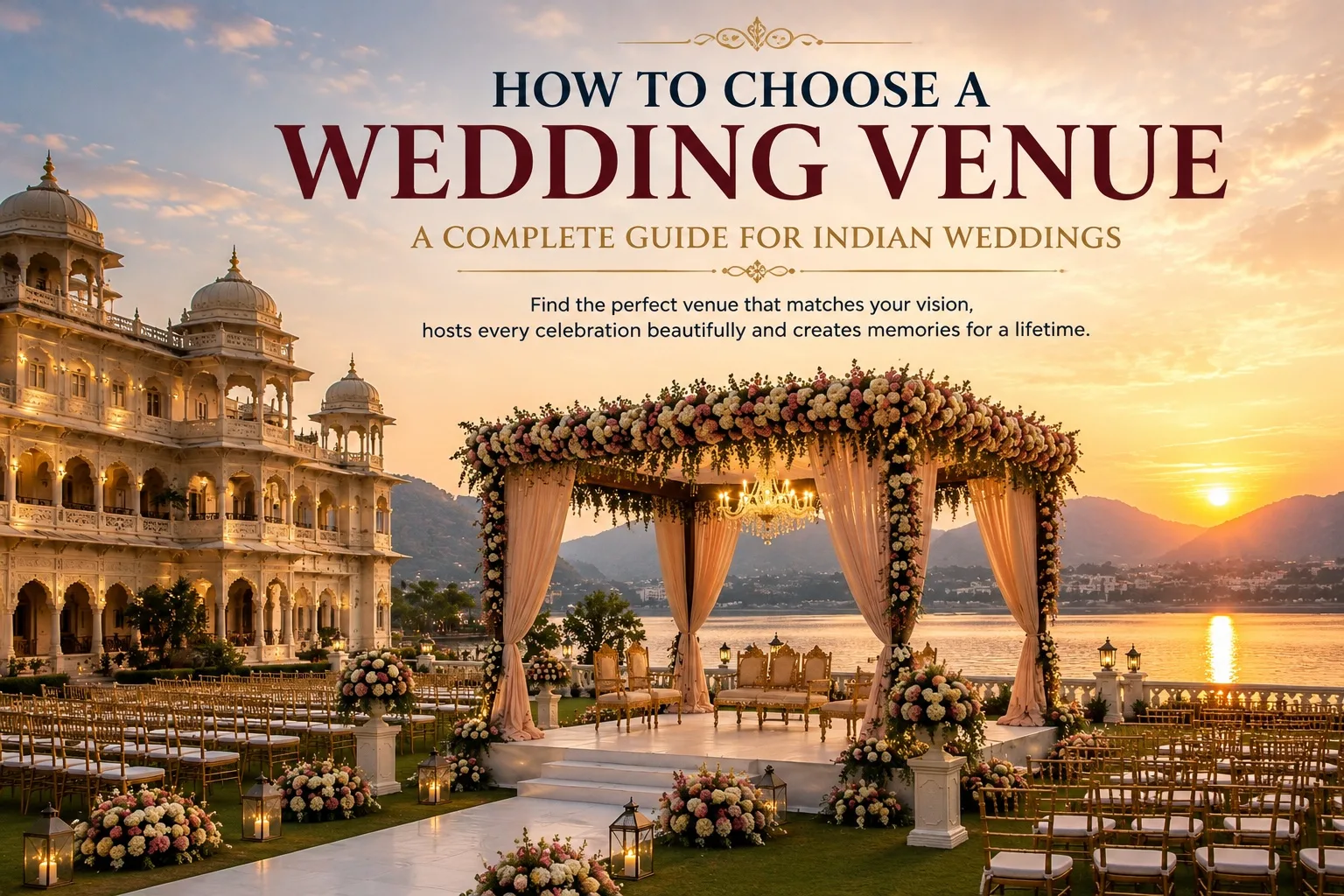
A wedding venue is where the different pieces of a celebration come together. It determines how comfortably guests can attend each function, whether your preferred décor can be executed, how vendors operate, and how easily the wedding party can move through a packed itinerary. For Indian weddings, venue selection deserves particular attention because ceremonies such as mehndi, haldi, sangeet, pheras, and receptions may all require different arrangements.
When learning How to Choose a Wedding Venue, start by thinking about the complete wedding experience instead of choosing a property based only on photographs or its overall appearance. A suitable venue should support your guest list, functions, accommodation requirements, preferred destination, event style, and practical arrangements. Careful comparison at this stage can prevent major planning complications later.
What Is the First Step in Choosing a Wedding Venue?
The first step is to create a clear picture of the celebration you want to host. Before contacting venues, identify the approximate number of guests, the type of wedding, the functions involved, and whether most attendees will stay at the property.
It is useful to divide your requirements into three categories:
Essential: Requirements the venue must satisfy.
Preferred: Features that would improve the celebration.
Optional: Details that would be nice to have but are not necessary.
This simple distinction prevents a visually attractive feature from distracting you from an important practical limitation.
What Information Should You Have Before Shortlisting Venues?
You should ideally know:
- Approximate guest count
- Wedding date or preferred date range
- Number of functions
- Preferred destination
- Accommodation requirements
- Indoor or outdoor preferences
- Desired wedding atmosphere
- Catering expectations
- Vendor preferences
You do not need every wedding detail finalized. You simply need enough information to determine whether a venue is compatible with the overall celebration.
How Do You Decide What Type of Wedding Venue You Need?
Start with the atmosphere and format of the wedding. A couple planning an intimate heritage ceremony may have very different requirements from a family organizing several large-scale events.
Which Types of Wedding Venues Can You Consider?
Depending on the destination and wedding style, options can include:
- Palace properties
- Heritage hotels
- Luxury resorts
- Boutique hotels
- Beach resorts
- Garden venues
- Banquet hotels
- Havelis
- Nature resorts
- Contemporary event properties
Each type offers different advantages. Heritage properties may provide architectural character, while modern hotels may offer flexible indoor spaces and extensive accommodation.
Should the Venue Reflect the Wedding Theme?
Ideally, yes. The venue should complement the visual direction of the celebration.
A royal wedding may naturally suit a palace or heritage property. A relaxed destination celebration could work better at a resort. A nature-inspired wedding might benefit from gardens, forest surroundings, or a hill setting.
Choosing the venue first and attempting to force an unrelated theme onto it can create unnecessary design challenges.
How Do You Calculate the Space Required for a Wedding?
Instead of asking only how many guests a venue can hold, consider how the entire event will be arranged.
A wedding requires space for guests, furniture, food service, entertainment, photography, décor, and event staff. The usable capacity therefore depends on the event format.
What Should You Include When Assessing Venue Capacity?
Think about:
- Guest seating
- Dining tables
- Buffet stations
- Stage
- Dance floor
- Mandap
- Entertainment equipment
- Photography positions
- Service corridors
- Guest entrances
- Family areas
Ask the venue to show you layouts for the actual functions you plan to host. This provides a much more realistic understanding of whether the property can accommodate the celebration comfortably.
How Should You Plan Spaces for Multiple Wedding Functions?
Indian weddings rarely consist of one event. The venue should therefore be examined for how well it can handle an entire sequence of celebrations.
Can One Property Handle Mehndi, Haldi, Sangeet and the Wedding?
Yes, provided it has suitable spaces and sufficient operational flexibility.
Different functions can be distributed across gardens, courtyards, ballrooms, terraces, lawns, restaurants, or other dedicated areas.
This creates a natural change of atmosphere throughout the wedding and reduces the need to repeatedly transform one location.
Why Is Venue Flow Important for Multi-Day Weddings?
The distance between functions matters. If guests have to travel from one side of a large property to another several times a day, the schedule can become tiring.
Try to create a logical flow where:
Accommodation → Event Area → Dining → Entertainment
can be accessed without unnecessary movement.
What Should You Know About Guest Accommodation Before Choosing a Venue?
Accommodation is especially important when the wedding involves travelling guests. A property that can host a large portion of the guest list can simplify transportation and make participation easier.
How Do You Assess Hotel Rooms for Wedding Guests?
Do not simply ask how many rooms the property has. Find out how many rooms can actually be allocated to your wedding party during the required dates.
Consider:
- Number of available rooms
- Room categories
- Family room options
- Location of rooms
- Accessibility
- Guest check-in process
- Nearby accommodation
- Distance to event spaces
You should also determine whether rooms can be grouped conveniently so that family members and close guests are not unnecessarily separated.
What If the Venue Cannot Accommodate Everyone?
Nearby hotels can provide an alternative, but transportation becomes an additional logistical consideration.
Ask about the distance between properties and how guests would travel to the main wedding venue. For a multi-day celebration, repeated transfers can affect punctuality and guest comfort.
What Should You Ask a Wedding Venue About Food and Catering?
Catering arrangements can influence both the guest experience and the way the event spaces are used.
What Catering Questions Should Couples Ask?
Before selecting a venue, ask:
- Is catering handled by the venue?
- Are external caterers permitted?
- Can menus be customized?
- Is menu tasting available?
- Can different cuisines be served?
- Can dietary requirements be accommodated?
- Are live counters permitted?
- How is food service handled during outdoor events?
Indian weddings can involve different menus for different functions, so flexibility is particularly useful.
Why Should Catering Policies Be Checked Before Booking?
If your preferred catering arrangement is incompatible with the venue's rules, it can affect the entire wedding plan. Understanding these policies early gives you time to choose a property that matches your expectations.
How Important Are Venue Rules for Wedding Decor?
Décor can transform a wedding space, but not every property allows every type of installation.
What Décor Restrictions Should You Ask About?
Clarify rules concerning:
- Hanging décor
- Floral installations
- Lighting rigs
- Stage structures
- Rigging
- Open flames
- Electrical equipment
- Adhesives
- Furniture movement
- Setup and dismantling
Historic properties may have stricter rules designed to protect architectural features, while hotels and resorts may have their own safety and operational requirements.
Should Your Decorator Visit the Venue?
If the décor concept is elaborate, involving your decorator or production team during a venue inspection can be extremely useful. They can identify structural, access, electrical, or installation limitations that may not be obvious to the couple.
How Does the Venue's Vendor Policy Affect Your Wedding?
Your preferred wedding professionals can influence the final look and execution of the celebration, so venue policies should be understood before you commit.
Can You Choose Your Own Wedding Vendors?
Ask whether the venue permits outside professionals for:
- Décor
- Photography
- Videography
- Entertainment
- Makeup
- Mehndi
- Catering
- Production
Some properties may maintain preferred vendor lists or impose specific requirements on external teams.
Why Is Vendor Access Important?
Wedding vendors often need access before guests arrive. If setup hours are restricted, loading areas are difficult to access, or the venue has complicated approval procedures, the event schedule may need additional planning.
Ask about setup windows, storage, loading access, power supply, and teardown procedures.
Should You Choose a Venue With Outdoor Event Spaces?
Outdoor spaces can add character to wedding functions, but they also introduce weather-related considerations.
What Makes an Outdoor Wedding Space Practical?
Look for:
- Easy guest access
- Suitable flooring
- Adequate lighting
- Nearby restrooms
- Power availability
- Service access
- Comfortable seating areas
- Weather contingency
The surroundings should also be inspected at the time of day when the event is expected to occur. An area that looks attractive during an afternoon site visit may have a very different atmosphere in the evening.
What Should an Indoor Backup Plan Include?
A genuine backup should be able to support the event rather than simply provide shelter.
Check whether the alternative space can accommodate the planned guest arrangement, décor, dining, entertainment, and technical requirements.
How Does the Destination Influence the Venue Decision?
The venue and destination should be evaluated together. The surrounding location influences travel, accommodation, climate, activities, and the overall character of the wedding.
Which Indian Destinations Offer Distinct Wedding Experiences?
India has destinations suited to a wide variety of celebrations.
Udaipur is known for lake views, palaces, and heritage properties.
Jaipur offers historic architecture, royal settings, and luxury hotels.
Goa provides coastal venues and resort environments.
Jodhpur brings together fort and palace heritage with a distinctive desert setting.
Jaisalmer offers golden sandstone architecture and desert surroundings.
Jim Corbett provides a nature-focused alternative for couples seeking a different destination experience.
The best destination depends on the wedding atmosphere as well as the practical needs of the guests.
What Makes a Destination Convenient for Wedding Guests?
Consider the complete journey, including:
- Flights or trains
- Road transfers
- Local transportation
- Hotel access
- Distance between venues
- Travel time
- Accessibility
- Nearby attractions
Guest convenience should remain part of the decision even when the wedding is primarily focused on the couple's vision.
How Can You Check a Venue During a Site Visit?
A site visit should be treated like an inspection rather than a sightseeing trip.
What Should You Physically Inspect?
Walk through:
- Main entrance
- Guest rooms
- Ceremony areas
- Reception areas
- Dining spaces
- Outdoor locations
- Indoor alternatives
- Parking
- Vendor access points
- Guest routes
Pay attention to details that photographs cannot communicate, such as noise, walking distances, ceiling heights, lighting, accessibility, and the relationship between different spaces.
What Questions Should You Ask the Venue Team?
Ask the same core questions at every shortlisted property. This makes the answers easier to compare and exposes differences in policies and operational support.
What Are the Most Common Wedding Venue Red Flags?
Some warning signs may not become obvious until couples start asking detailed questions.
Which Problems Should You Investigate Further?
Take extra care when:
- Policies are only given verbally
- Vendor restrictions are unclear
- The venue cannot explain its backup arrangements
- Room availability is uncertain
- Event timings are not clearly defined
- Setup access is restricted without explanation
- Different venue representatives provide conflicting information
- Reviews repeatedly mention coordination problems
- The property is unable to explain who will manage the event on the wedding day
Clear communication is a valuable indicator of how smoothly future planning may proceed.
How Do You Compare Your Final Wedding Venue Shortlist?
Once you have narrowed your options, compare each property using the same criteria.
CriteriaWhat to CompareVenue settingDoes it match the desired wedding atmosphere?Guest capacityIs the space comfortable for the planned setup?Function spacesCan all events be accommodated effectively?RoomsCan guests stay conveniently?LocationIs the destination practical for attendees?CateringDoes the food arrangement suit your requirements?Vendor accessCan your preferred professionals work there?DécorAre your planned installations permitted?Weather backupIs there a usable alternative space?CoordinationDoes the venue provide reliable event support?Should You Choose the Most Beautiful Venue?
Not necessarily. Visual appeal is important, but it is only one part of the decision.
A slightly less dramatic property may provide a significantly better guest experience if it has a more practical layout, better accommodation, stronger venue support, and greater flexibility.
What Should You Confirm Before Finalizing the Wedding Venue?
Before making the final decision, revisit your original requirements and verify every important point with the venue.
Confirm the event spaces, guest accommodation, catering arrangements, vendor rules, décor permissions, event timings, accessibility, weather contingency, and venue coordination.
Most importantly, consider whether the property can handle the entire wedding journey, rather than only the main ceremony.
A successful venue selection balances atmosphere with practicality. The right property should give you the setting you envision while also making it possible for guests, vendors, planners, and the wedding party to move through the celebration comfortably.
When the venue works equally well on paper, during the site visit, and from the perspective of an actual wedding guest, you have a much stronger foundation for the celebration ahead.