
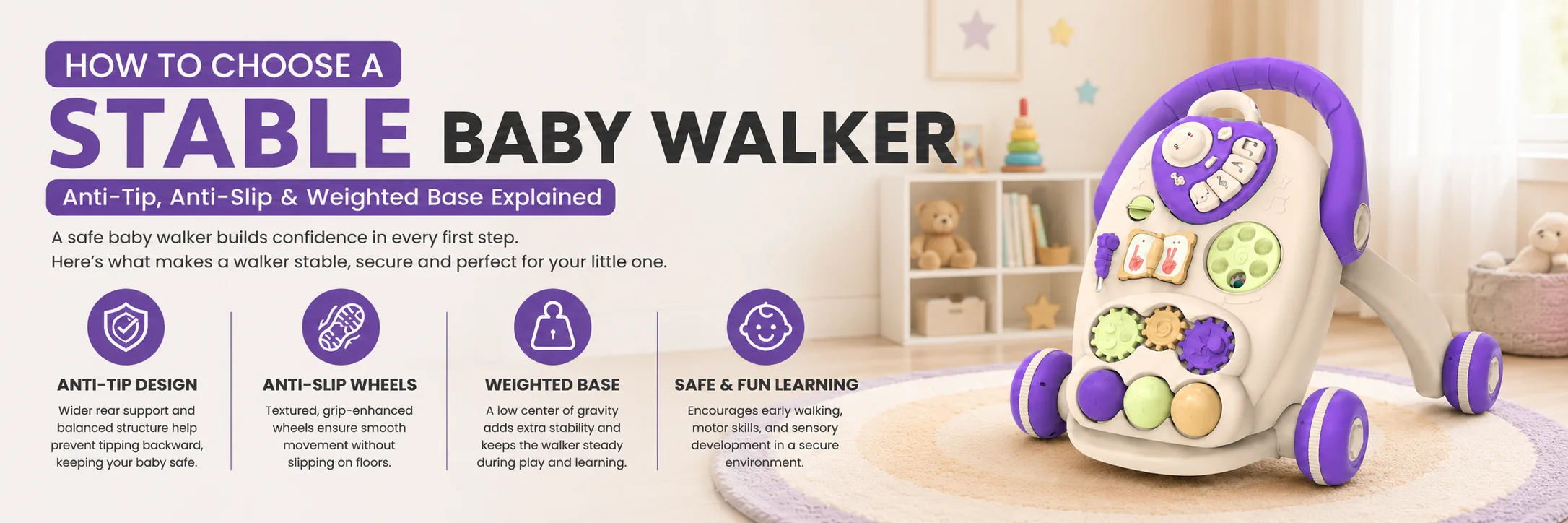
How to Choose a Stable Baby Walker (Anti-Tip, Anti-Slip & Weighted Base Explained)
Watching a baby take their first wobbly steps is one of those moments parents wait for. A baby walker is supposed to make that stretch a little easier — something to hold onto, lean into, push around the living room. But not every walker on the market is actually built to keep up with a baby who's still figuring out balance. Some tip over the moment a hand grabs the edge. Some slide across tile floors faster than a baby can react to. The difference usually comes down to three things: how the walker resists tipping, how well it grips the floor, and how its weight is distributed — and it's exactly what Chanak designs its baby walkers around.
This guide breaks down what those three features actually mean, why they matter more than colour or sound effects, and how to shop for a baby walker that's genuinely stable rather than just good-looking in photos.
Why Stability Matters More Than Features
It's easy to get pulled in by a walker with five activity panels, a piano, and flashing lights. None of that matters much if the walker tips the first time your baby leans on the tray to reach for a toy. A baby at this stage doesn't yet have the reflexes to catch a fall — their weight, their grip strength, their sense of balance are all still developing. The walker is doing a lot of the stabilising work that the baby can't yet do on their own.
That's really the whole point of this article: before comparing musical features or price tags, check whether the walker is built to stay upright and stay put. Everything else is secondary.
Anti-Tip Design: What It Actually Means
"Anti-tip" isn't a single feature — it's really about the shape and geometry of the base. A stable baby walker has a wide wheelbase relative to its height, so the center of gravity sits low and the base extends well beyond where a baby's hands or weight would land. Picture a walker shaped like a wide tripod versus one shaped like a tall narrow box — the wide one resists tipping even when a baby pulls sideways or leans hard on one edge.
A few practical things to check:
- Base width versus seat height. If the wheel base looks noticeably narrower than the walker's overall height, that's a warning sign. A well-designed walker's base should visibly extend beyond the seat or tray on all sides.
- Weight distribution at the bottom, not the top. Walkers with batteries, activity panels, or heavier components mounted low tend to resist tipping far better than ones that are top-heavy.
- Behaviour on uneven ground. A walker that stays level when one wheel hits a rug edge or a slight dip in the floor is doing its job. One that rocks or lifts on one side isn't.
Chanak's Happy Feet Baby Walker, for instance, is built with a wide, low base and a water-fillable tank underneath — parents can add water to the base to weigh it down further, which noticeably improves resistance to tipping once the baby starts pulling up and pushing against the tray.
Anti-Slip Wheels: Why Grip Matters as Much as Stability
A baby walker can have a perfectly wide base and still be dangerous if the wheels skid instead of rolling in a controlled way. This matters a lot on Indian flooring — marble, polished tiles, and vitrified floors are common in homes, and they're exactly the surfaces where an ungripped walker can shoot forward the second a baby pushes off.
Anti-slip wheels are usually a combination of a rubberised or textured wheel surface and a design that resists free-spinning. Some walkers also include adjustable speed settings or wheel locks, which let parents slow the walker down on smooth flooring and speed it up slightly on carpet, where friction is naturally higher. Chanak builds its Happy Feet Walker with exactly this kind of anti-slip wheel design, so it holds up across the mixed flooring most Indian homes actually have.
When checking a baby walker for this, look for:
- Textured or rubber-coated wheel edges, not bare hard plastic
- Any adjustable speed or resistance setting, since one setting rarely suits every floor type in an Indian home
- Wheels that don't spin loosely when the walker is tilted slightly by hand — a simple test you can do before buying
Weighted Base: The Quiet Feature That Does the Most Work
A weighted base is exactly what it sounds like — added weight, usually at the bottom of the walker, that lowers the centre of gravity and makes the whole unit harder to tip or drag off balance. It's one of the least talked-about features in baby walker marketing, but it often matters more than anti-tip shaping alone.
Some walkers achieve this with heavier internal components; others, like the water-tank base in Chanak's Happy Feet Baby Walker, let parents fill the base with water so the weight can be adjusted depending on the baby's size and strength. This is a genuinely useful design choice, since a 9-month-old and a 14-month-old put very different amounts of force into pulling or pushing a walker.
A weighted base helps in two specific situations: when a baby yanks sideways to grab a toy off the tray, and when a baby leans their full body weight forward while pushing the walker across the room. Both are common, and both are exactly when a lightweight walker is most likely to tip.
Other Safety Details Worth Checking
Beyond the three core features, a few smaller details are worth a quick check before buying any baby walker:
- BIS approval. In India, this confirms the toy has cleared mandatory safety testing on materials and construction. It's a baseline requirement, not a bonus feature. Every Chanak baby walker carries this certification.
- BPA-free plastic. Especially relevant since babies at this age tend to chew on anything within reach, including the walker's tray edge.
- Smooth edges and no small detachable parts. A baby walker gets handled roughly, and small pieces that pop off are a genuine choking risk.
- Recommended age range. Most stable walkers are designed for babies 9 months and up, once a baby can sit unassisted and bear some weight on their legs. Introducing a walker too early works against the very stability features described above.
A Quick Way to Test Stability Before You Buy
If you're buying in person, there's a simple test that takes about ten seconds: place the walker on a flat surface, push down gently on one side of the tray, and watch what happens. A stable baby walker barely shifts. One that lifts on the opposite side, rocks noticeably, or slides sideways is telling you something important before your baby ever gets near it.
If you're buying online, look for product listings that specifically mention wheelbase width, wheel material, and whether the base is weighted or weight-adjustable. Chanak's product pages, for example, spell out details like the wide anti-slip wheel design and the water-tank base directly in the listing, which makes this kind of comparison easier without needing to see the walker in person first.
Making the Right Choice
A baby walker isn't just a toy — for a few months, it's one of the main tools a baby uses to build leg strength, balance, and confidence in moving independently. That makes stability the one feature worth prioritising over everything else on the box. A wide, low base that resists tipping, wheels that grip rather than slide, and a base that's weighted (or can be weighted) to match your baby's size will do far more for safety than an extra activity panel ever will.
Chanak's Happy Feet Baby Walker brings all three of these together — a wide anti-tip base, anti-slip wheels, and a water-fillable weighted base — along with BIS approval and BPA-free construction, at chanak.co. It's worth checking directly on the Baby Walker collection if you're shopping for one right now.
Frequently Asked Questions
At what age should a baby start using a baby walker? Most pediatric guidance and manufacturer recommendations point to around 9 months, once a baby can sit unassisted and bear some weight through their legs. Introducing a walker earlier can work against the baby's natural balance development.
Are baby walkers safe to use on tile or marble floors? Yes, provided the walker has anti-slip wheels and ideally an adjustable speed setting. Smooth Indian flooring is exactly where wheel grip matters most, since a walker without it can skid rather than roll. This is one of the reasons Chanak builds its Happy Feet Walker with textured, anti-slip wheels as standard.
What does a "weighted base" mean on a baby walker? It refers to extra weight positioned low in the walker's frame, which lowers the center of gravity and makes the walker harder to tip. Some walkers, like Chanak's Happy Feet model, use a water-fillable tank so the weight can be adjusted as the baby grows.
Is a wooden baby walker or a plastic one safer? Both can be safe if built correctly — what matters more is the base width, wheel grip, and weight distribution rather than the material alone. Wooden walkers, such as Chanak's push-pull design, tend to be heavier by default, which naturally helps with stability.
How can I tell if a baby walker is stable before buying it online? Check the product description for details on wheelbase width, wheel material, and whether the base is weighted or adjustable. Listings that specify these details clearly are generally a safer bet than ones that only describe activity features — Chanak's listings, for example, spell all three out directly.