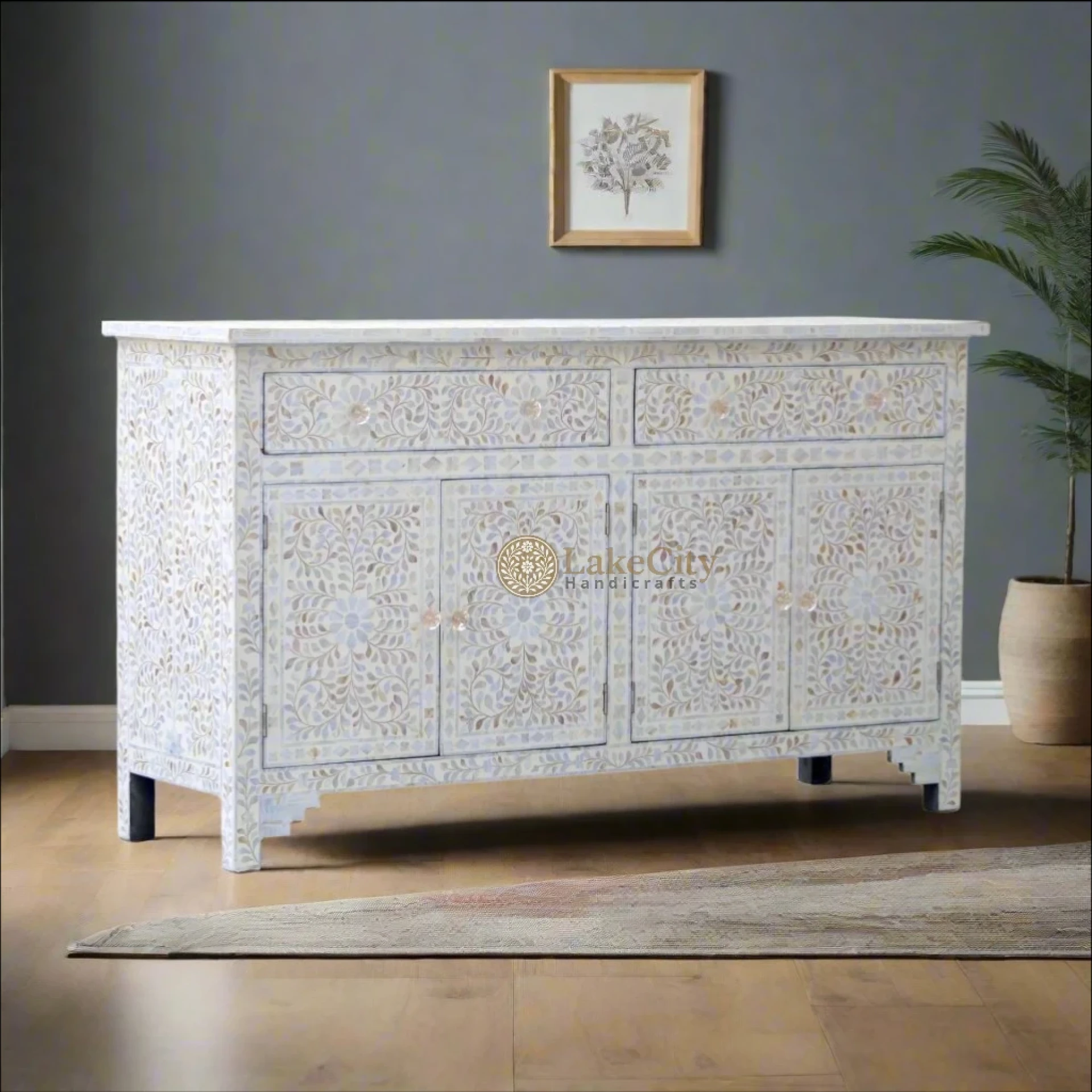
I wasn’t actually planning to buy a statement piece. I was just browsing, comparing cabinets, looking for something “nice enough” for my dining area. But then I came across a mother of pearl inlay sideboard, and honestly, it stopped me.
Not because it was flashy. But because it didn’t look mass-produced. It looked like someone had actually worked on it.
After spending time researching, inspecting close-up images, reading details, and eventually seeing one in person, I realized this type of furniture is very different from what most people buy today. So I thought I’d share what I learned , especially if you’re considering investing in one.
What Exactly Is a Mother of Pearl Inlay Sideboard?
If you’re new to this, mother of pearl inlay is a decorative technique where small pieces of natural shell are hand-cut and set into carved wooden surfaces. Each tiny fragment is shaped and placed manually into grooves in the wood.
That means:
- No printed patterns
- No sticker finishes
- No machine shortcuts
Every piece has small variations , and that’s actually the beauty of it.
A mother of pearl inlay sideboard combines this artistic detailing with practical storage. So you get drawers and cabinets, but with surfaces that shimmer softly when light hits them. It’s subtle, not loud.
My First Impression (Up Close)
When I finally saw one in person, I did what I always do with furniture , I touched everything.
Here’s what stood out to me:
- The surface felt smooth, not uneven.
- The shell pieces were flush with the wood.
- The patterns aligned across drawers.
- The structure felt heavy and solid.
One thing I noticed is that good inlay work has balance. The floral or geometric patterns aren’t randomly placed. They’re measured. Thought through. That’s something you don’t really appreciate until you look closely.
And the drawers? They opened smoothly. No sticking. No wobbling.
It didn’t feel delicate. It felt strong.
How to Style It Without Overdoing It?
One concern I had was: will this look too decorative?
But actually, it blends surprisingly well if you style it correctly.
In the Dining Room
If you’re pairing it with a bone inlay round dining table, try keeping the rest of the room neutral. Soft wall colors, simple chairs, minimal accessories.
The key is balance. Let one or two pieces be detailed , not everything.
Add:
- A tall mirror above it
- Two ceramic lamps
- A simple tray for serving pieces
Done right, it doesn’t look crowded. It looks curated.
In the Living Room
Some people use a mother of pearl inlay sideboard as a media console. That works too.
Just don’t overload the top with décor. A few books, a sculptural object, maybe a plant. The inlay itself already acts as visual interest.
In Entryways
This is actually one of my favorite placements. It creates an instant first impression when someone walks in. And practically speaking, it’s useful for storing small items you don’t want visible.
Things You Should Check Before Buying
Not all inlay furniture is equal. I learned that quickly.
Here’s what I’d recommend checking:
1. The Wood Base
Make sure it’s solid wood. Some lower-quality pieces use engineered boards underneath, which reduces longevity.
2. The Inlay Detailing
Look closely at images. Are there gaps between shell pieces? Are patterns aligned across drawers?
If the detailing looks rushed, it probably is.
3. Surface Finish
Run your hand across it if possible. It should feel smooth. No sharp edges or raised pieces.
4. Weight
Heavier usually means better structural quality. A proper sideboard shouldn’t feel flimsy.
Maintenance: It’s Easier Than People Think
A lot of people assume inlay furniture is high-maintenance. That wasn’t my experience.
Here’s what works:
- Dust regularly with a soft cloth
- Use a slightly damp cloth for deeper cleaning
- Dry immediately after wiping
- Avoid chemical sprays
Also important:
- Keep it out of direct sunlight
- Don’t place very wet objects directly on it
- Use coasters
That’s really it. Basic care goes a long way.
I’ve seen older pieces that still look beautiful after years. The key is consistency, not complicated cleaning routines.
Why Handmade Furniture Feels Different?
There’s something about owning furniture that wasn’t rushed through a factory line.
You can see small variations in the shell pieces. You can sense that someone placed them one by one. It’s not perfect in a machine way , it’s precise in a human way.
And honestly, that matters.
When you invest in premium handmade furniture, you’re not just buying storage. You’re buying time, skill, and heritage. That’s not something flat-pack furniture can replicate.
Is It Worth the Investment?
In my opinion, yes , if you genuinely appreciate craftsmanship.
A mother of pearl inlay sideboard isn’t the cheapest option. But it’s not meant to be disposable furniture either. It’s something you keep for years. Possibly decades.
It works in:
- Modern homes
- Traditional interiors
- Transitional spaces
It adapts surprisingly well, especially if you keep the surrounding décor simple.
Final Thoughts
After going through the process , researching, comparing, inspecting , I realized this isn’t just decorative furniture. It’s functional art.
If you’re considering adding one to your home, take your time. Look at the details. Ask questions about materials. Check finishing quality.
During my search, I explored collections from Lakecity Handicrafts and appreciated how clearly they showcase craftsmanship and detailing. It helped me understand what quality inlay work should actually look like.
At the end of the day, a mother of pearl inlay sideboard isn’t about trends. It’s about choosing something that feels intentional. Something that doesn’t look like everyone else’s cabinet.
And sometimes, that small decision changes the entire feel of a room.