
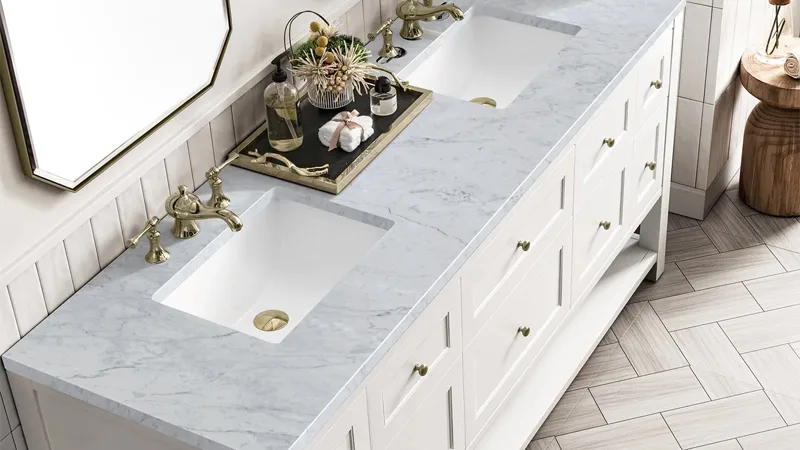
A bathroom vanity does more than hold a sink. It is usually the biggest piece of furniture in the room, it provides most of your storage, and it sets the style for everything around it. Pick the right one and your bathroom feels organised and comfortable. Pick the wrong one and you end up with a cramped walkway, a cluttered counter or a top that stains within a year.
This guide walks through the four decisions that matter most: size, number of sinks, cabinet construction and countertop material.
Start With the Right Bathroom Vanity Size
The first step is to measure the wall where the vanity will go. Then check how much clear floor space remains in front of it. Designers generally recommend at least 21 inches (about 53 cm) of walkway, and closer to 30 inches (about 76 cm) is more comfortable. Also note where the drain and water supply lines come out of the wall, because they limit which sizes and cabinet layouts will work.
Once you know your wall space, the usual widths fall into a simple pattern. Vanities of 24 to 31 inches suit powder rooms and compact bathrooms. A 36-inch vanity is the go-to choice for guest bathrooms and small to medium rooms, since it gives you a useful drawer or cabinet without crowding the space. At 48 inches, you can choose between a roomy single sink or a narrow double, which works well in a shared family bathroom. Sizes of 60 and 72 inches are best for larger bathrooms and master suites, where you have the wall space and want generous counter room.
Standard vanity depth is around 18 to 22 inches, and standard height is 32 to 36 inches. Many adults prefer the taller “comfort height” of 34 to 36 inches, as it means less bending at the sink.
If you want to compare how each width looks in practice, you can browse single and double sink vanities in sizes from 31 to 72 inches and match them against your own measurements.
Single Sink or Double Sink Vanity?
For most homes, a single sink vanity is the sensible answer. It leaves more usable counter space and more storage underneath, and it usually costs less. If your bathroom is used by one or two people at different times, or the vanity is under 48 inches wide, a single sink is the better fit.
A double sink vanity makes sense when two people regularly get ready at the same time. Morning routines go faster and nobody waits. The catch is space. As a rule of thumb, allow about 30 inches of width per sink, which makes 60 inches the practical minimum for a double vanity and 72 inches the comfortable option. Keep roughly 15 inches between the centre of each sink and the nearest side wall so you are not leaning into a corner.
Fitting a double sink into a space that is too small is a common mistake. You lose the counter between the basins, and neither user has room to put anything down. In that situation, a larger single sink on a 60-inch vanity is often the better choice.
Look at How the Cabinet Is Built
Two vanities can look identical in photos and perform very differently after a few years in a humid room. The materials and construction are what separate them.
Solid wood frames with plywood panels stand up to bathroom moisture far better than cheaper particleboard, which can swell and break down when water gets in. Drawers with dovetail joints are a sign of careful construction and will keep working smoothly under daily use. Soft-close hinges and drawer slides are a small upgrade you will notice every day, since they protect the cabinet and keep the room quiet.
When it comes to style, shaker doors with a flat-panel front are a safe, timeless choice that suits both modern and traditional bathrooms. Colour is a matter of taste, but white and grey are consistently popular because they pair easily with most tiles, fixtures and wall colours. If you want a bolder look, a deep navy or royal blue adds real character and still looks good with brushed nickel hardware.
Choose a Durable Vanity Top Material
The countertop takes the most abuse. It deals with water, soap, toothpaste, hair products and cosmetics every day, so it needs to resist stains and be easy to clean.
Natural marble is beautiful, but it is porous. It can stain and etch from everyday products and needs regular sealing. Granite is tougher and handles heat well, but it also needs periodic sealing, and the colour choices are more limited. Solid surface and cultured marble are budget-friendly options, though they scratch more easily and can be harder to repair.
For most households, a quartz vanity top is the best balance of looks, durability and low upkeep. Quartz is an engineered stone made from crushed natural quartz bound with resin. Because it is non-porous, it resists stains and bacteria, it does not need sealing, and a damp cloth with mild soap is usually all it needs. It also comes in marble-look patterns such as Carrara, so you get the classic veined appearance without the maintenance that natural marble demands. The one thing to avoid is placing very hot styling tools directly on the surface, since sudden high heat can damage any engineered stone.
A Simple Checklist Before You Buy
Before you order, run through these points. Measure the wall width and the walkway clearance. Mark the position of the plumbing. Decide between one sink or two. Check that the cabinet is solid wood or plywood with dovetail drawers. Choose a top material that matches how much upkeep you are willing to do. Finally, confirm whether the top and sink are included in the price or sold separately, since this varies a lot between suppliers.
Seeing finished combinations of cabinet colour and stone top can make the last decision easier. This bathroom vanity collection shows how different sizes and finishes come together, which is helpful when you are trying to picture the result in your own space.
Final Thoughts
The best bathroom vanity is the one that fits your space, suits the number of people using it and holds up to daily moisture. Get the size right first, choose a well-built cabinet, and pair it with a top that does not need constant care. Do that and you will have a vanity that looks good and works well for many years.