Why 785nm
If you've built a Raman system before, you already know the trade-offs: 532nm gives you way too much fluorescence on organic samples. 1064nm kills the fluorescence, but the signal is so weak you're waiting seconds for a usable spectrum. 785nm sits in the middle — roughly an order of magnitude less fluorescence than 532nm, and nearly 4× stronger Raman signal than 1064nm (based on the 1/λ⁴ relationship). Detectors at 785nm are also cheap and mature. That's why it's one of the most widely used choices for handheld systems.
Things people get wrong
Linewidth
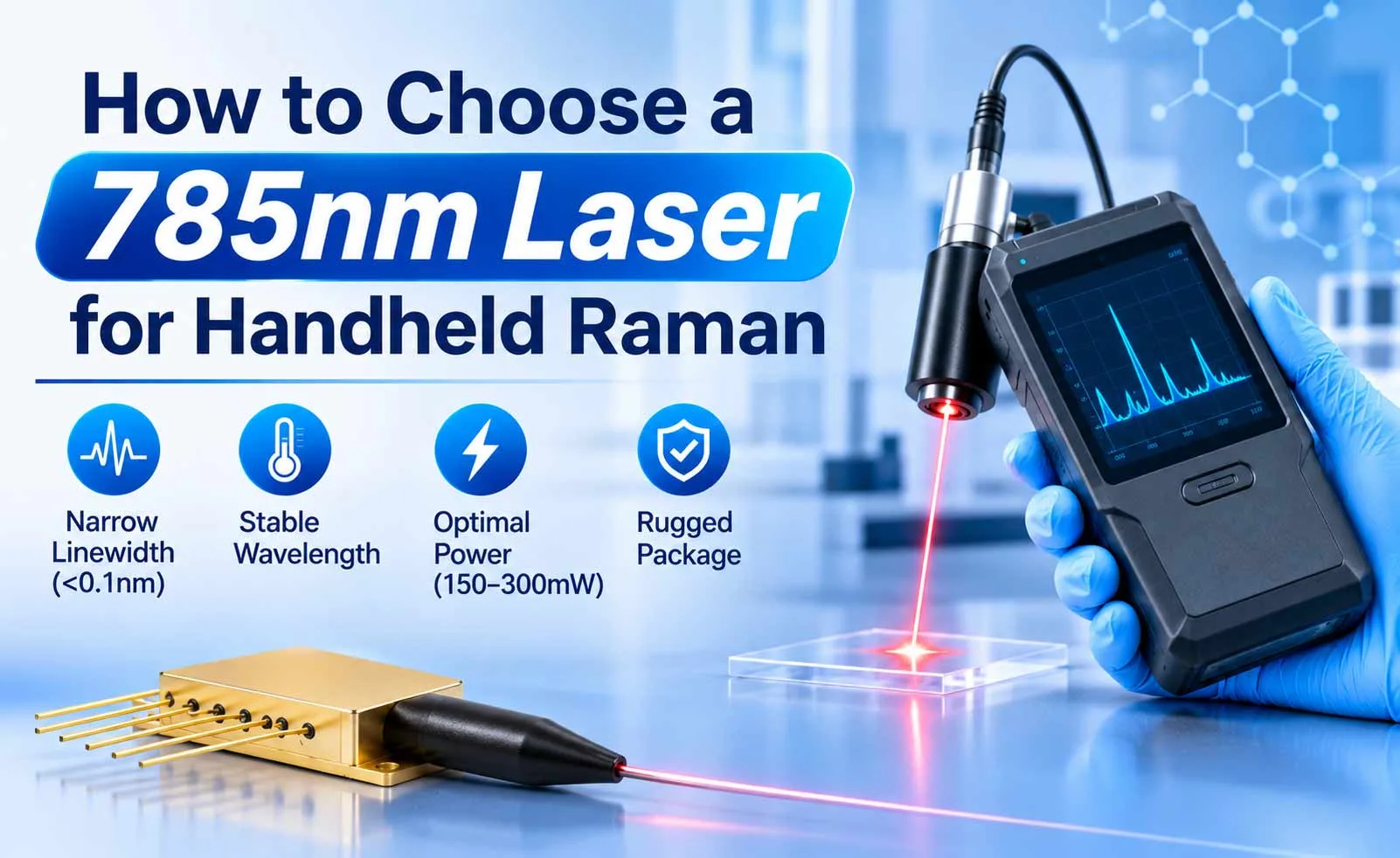
This is what determines how close two peaks you can tell apart. Above 0.2nm, peaks from complex samples start merging and your library matching is basically shot. RealLight's 785nm diodes use VBG locking and get below 0.1nm — enough for identification-grade instruments.
Wavelength drift
This is where handheld projects usually fall apart. You calibrate in the lab, everything looks fine, then you take the unit outside and the temperature shifts. The laser drifts 0.1nm, the Raman peaks move with it, and your match rate drops. Make sure the module has TEC temperature control and a monitor photodiode. And ask the supplier directly: over the full operating temperature range, how much does the wavelength drift? If they can't tell you, walk away.
Power
150–300mW at the sample is plenty. Go higher and you're just burning battery and adding heat. Acquisition speed depends more on your detector and grating than on how much laser power you throw at it.
Noise
RIN is another one suppliers rarely put on the datasheet. Ask for it. If it's too high, your baseline is noisy and you're stuck integrating longer.
Package and thermal
Space is tight in a handheld. Get a module that already integrates the TEC, thermistor, and driver — don't design a separate driver board yourself. Hermetic packaging also holds up much better to drops and vibration than non-hermetic.
Handheld vs. bench-top
Bench-top setups have it easy: fan cooling, wall power, constant lab temperature. Handheld units don't. You're battery-limited, stuck with conductive cooling, and the device has to work from -10°C to +50°C without falling apart. Don't just take a laser that works on your bench and drop it into a handheld enclosure — it'll overheat or drift.
RealLight's 785nm options
783–785nm, VBG-locked below 0.1nm, 100–600mW CW. TO-can or butterfly with fiber output, TEC and PD built in. This is the range most handheld Raman instrument makers use — wavelength and power can be adjusted for your project.
One thing to be clear about: these are optical source components. You integrate them into your own spectrometer. They're not finished instruments.
Questions people actually ask
Q:We're already building prototypes. Can we just buy off-the-shelf modules?
A:Yes. RealLight has standard 785nm narrow-linewidth modules ready. Get a sample, test it in your setup. If you need a custom wavelength or package, that's negotiable.
Q:Is VBG locking worth the extra cost?
A:If you're building an identification-grade product, yes. Without it, wavelength drifts with temperature and your on-site reproducibility is bad.
Q:How much power should we pick?
A:Start at 150–300mW. If your spectrometer has good throughput, 100mW might be enough. Don't jump straight to 500mW — the handheld's thermal design won't handle it.
References
Narrow Linewidth Diode Laser Components
Disclaimer: Part of the content in this document is sourced online, intended solely for technical-research exchange and reference purposes. Feedback is welcome for factual or academic errors. Should any copyright concerns arise, please contact us for prompt verification and removal.