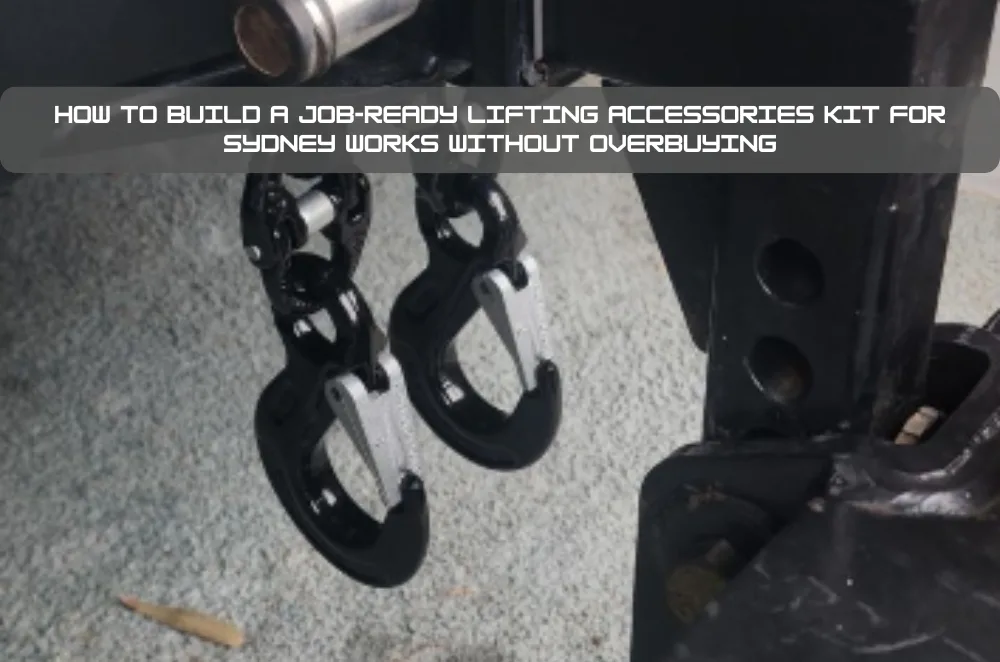
Every site ends up with “that box” of lifting bits: a few shackles, a couple of slings of unknown history, a hook that’s been around forever, and a tag that’s either unreadable or missing entirely.
That’s not just untidy—it slows work down, increases re-handling, and puts supervisors in a constant loop of “Is this the right item for this lift?” before anyone even thinks about the lift plan.
A job-ready lifting accessories kit isn’t about owning everything; it’s about having the right categories, the right compatibility, and the right checks in place to support a lifting equipment range for trade, so the crew can work confidently and stop improvising.
The goal here is a practical way to standardise what gets ordered and what gets checked, so the lifting setup is repeatable across jobs in Sydney’s very mixed world of construction, warehousing, and industrial maintenance.
What “job-ready” really means for lifting accessories
“Job-ready” usually means the kit supports the lifts that actually happen on the job, not the lifts people imagine might happen someday.
It also means the gear is identifiable, traceable, and routinely checked—because in lifting, “we think it’s fine” isn’t a process.
In practice, a job-ready kit has three qualities: clear selection, consistent compatibility, and fast verification on site.
Clear selection is having enough variety to suit typical lift points and load shapes without encouraging ad-hoc substitutions.
Consistent compatibility is where most teams get tripped up: components look like they fit together, but the way they connect can change the effective rating, the lift geometry, or the way load is introduced into hardware.
Fast verification is your tags, markings, and records being good enough that a leading hand doesn’t have to guess—and doesn’t have to hunt around for “the one decent shackle”.
The core categories most crews actually need
A useful way to think about accessories is by function rather than brand or individual item.
If the kit can cover these functions well, most day-to-day lifts stop being a scramble.
Connecting hardware: shackles and connectors
This is where most “it’ll do” decisions happen.
The practical target is to keep enough of the common sizes and types used on your work so crews aren’t mixing odd items just to make a connection.
When teams have to improvise with mismatched connectors, it usually shows up as poor fit, side loading, or hard-to-inspect setups.
Attachment points: lifting points, eye bolts, and load interfaces
Loads don’t lift themselves—you need a reliable interface.
Where possible, standardising the types of lifting points you commonly use (and ensuring they’re appropriate for how the load will be lifted) reduces last-minute “How do we pick this?” moments.
If lifts regularly involve fabricated items, plant, or temporary assemblies, this category is also where you’ll want a documented rule for who signs off the attachment method.
Slings: chain, wire, and synthetic options (and their trade-offs)
Different slings tolerate different abuse, environments, and handling practices.
Synthetic slings can be great for protecting finishes but demand discipline around edge protection and inspection.
Chain options can be robust but bring their own inspection expectations and limitations if misused.
Wire can work well in the right environment but can be mishandled when crews treat it like a general-purpose rope.
The key is not “which sling is best,” but “which sling is consistently used correctly by this crew, in these conditions.”
Protection and control: edge protection, shortening, and load control
This is the category that often gets left out of the purchasing list, then becomes an on-site problem.
Edge protection is a downtime killer when it’s missing, because it’s hard to substitute safely.
Load control tools (like taglines and the basics that stop loads spinning into scaff or racking) are usually cheap compared to the cost of a single re-lift.
If the work involves repetitive lifts, don’t ignore the “boring” control items—those are what make lifts smooth.
Storage, identification, and inspection basics
If accessories are stored in a way that scrapes tags off or buries items under each other, you’re paying twice: once when you buy it, and again when you discard it early.
Job-ready storage is simple: segregated, labelled, and set up so missing tags are obvious.
Inspection doesn’t need to be bureaucratic, but it does need to be consistent enough that people know what “good” looks like.
Decision factors that prevent mismatched gear
Buying lifting accessories by “what looks like it will work” is how you end up with drawers of hardware that nobody trusts.
These decision factors help keep purchasing aligned with real work and reduce the risk of incompatible assemblies.
Match the kit to lift types, not to jobsites
Start by listing the 10–15 most common lift scenarios the crew performs.
Include the annoying ones: awkward shapes, low headroom, lifts over plant, or lifts that require unusual attachment points.
Once you have those scenarios, you can map each scenario to the accessory functions required (connect, attach, sling, protect, control).
If you’re standardising what gets ordered across projects, it helps to start from a single, organised category view like the Conveying & Hoisting Solutions lifting accessories range and map each item to the lift types your crew actually performs.
Compatibility: the “it fits” trap
A connection that fits physically isn’t automatically a good connection.
In practice, compatibility is about the intended loading direction, how the hardware seats, and whether the assembly can be inspected once it’s built.
When you standardise, standardise “pairings” as well as individual items—so common assemblies are repeatable.
Environment and handling reality
Sydney work can swing between wet outdoor sites, dusty demolition environments, and controlled warehouses.
Accessories should be chosen for the environment they’ll actually live in, including how they’ll be stored and how they’ll be cleaned.
If a crew will drag synthetic slings across concrete edges because edge protection is never within reach, the “best” sling type on paper won’t stay best for long.
Inspection and traceability requirements
A good purchasing choice makes inspection easier, not harder.
When the kit becomes a mix of unlabelled items and faded tags, supervisors either stop using the items or keep using them with uncertainty—neither outcome is good.
Choose accessories that can be identified and checked consistently on site, and build a routine that makes missing identification a “stop and fix” moment.
Who is accountable for what
Some lifts are routine; some lifts are high-consequence.
A job-ready kit includes a clear rule of thumb for when a qualified person must review the setup, especially if lifts are unusual, loads are custom, or attachment points are improvised.
This isn’t about slowing work down—it’s about keeping lift planning matched to risk.
Common mistakes that create downtime and rework
Most lifting accessory issues aren’t dramatic failures; they’re the slow-drip problems that eat hours.
These are the ones that show up repeatedly across trade environments.
Mistake 1: Stocking “random variety” instead of standard assemblies
Buying a broad variety feels safe, but it often produces gear that rarely gets used.
A smaller set of well-matched assemblies tends to work better, because everyone knows what goes with what.
Mistake 2: Ignoring edge protection until it’s too late
Edge protection is easy to skip because it doesn’t look like “lifting gear”.
Then the first time a lift needs it, the team improvises with rags, timber offcuts, or nothing at all.
The easiest fix is to treat edge protection as part of the sling system, not an optional add-on.
Mistake 3: Letting tags and IDs disappear
If tags vanish, the gear effectively becomes unusable—or worse, it stays in use without confidence.
Make “missing ID” visible by using storage and segregation that highlights it quickly.
Mistake 4: Over-relying on the most experienced person
Every crew has someone who “knows lifting,” and everything routes through them.
That works until they’re not on site, and then people improvise or delay work.
A job-ready kit plus a basic decision guide reduces single-person dependency.
Mistake 5: Treating inspection as a paperwork exercise
Inspection needs to be a practical habit that changes behaviour.
If the process doesn’t lead to quarantining questionable items and replacing them quickly, it becomes a checkbox that nobody trusts.
Operator Experience Moment
On many sites, the real friction isn’t the lift itself—it’s the ten minutes before it, when the crew circles a pile of accessories trying to build something that “looks right.”
I’ve seen jobs lose momentum because a perfectly routine lift turned into a debate about whether a connector was the correct type for the way it was being loaded.
When the kit is standardised and clearly stored, that debate disappears, and the lift planning conversation becomes about the load and the method—not the scavenger hunt.
A simple first-actions plan for the next 7–14 days
This plan is designed to be doable without a major procurement overhaul.
It focuses on stabilising what’s already happening and building a repeatable buying pattern.
Days 1–2: List the real lift scenarios
Write down the most common lift situations that happen on your jobs.
Include what typically gets lifted, where it gets lifted, and how it’s usually attached.
If multiple crews operate differently, capture the differences—those differences are often where mismatches start.
Days 3–5: Audit the existing kit by function
Sort current accessories into the functional categories: connect, attach, sling, protect, control, store/ID.
Quarantine anything with missing ID, unreadable markings, or obvious issues, based on your site procedures and competent-person guidance.
Note the gaps that force improvisation (edge protection gaps are usually obvious here).
Days 6–9: Standardise the top 5 assemblies
Identify the five most common “assemblies” the crew builds.
Document what parts make each assembly and what they’re used for at a high level, without turning it into training material.
If there are multiple versions in circulation, pick one and retire the rest where appropriate.
Days 10–14: Set up storage + a replenishment trigger
Set storage so missing IDs and damaged items are visible.
Add a simple replenishment trigger: if the kit drops below the minimum for any assembly, it gets reordered before it becomes an emergency.
Tie the trigger to the person who already manages consumables or tools, so it isn’t “everyone’s job” (which becomes nobody’s job).
Local SMB mini-walkthrough: a Sydney trade business example
A small steel fabrication shop in Western Sydney is doing frequent forklift-assisted lifts and occasional onsite installs.
They list their common lifts: frames, beams, and machinery skids, mostly short-duration lifts with tight access.
They audit their accessories and find mismatched connectors, missing tags, and no edge protection.
They standardise three assemblies for the workshop and two for onsite work, with clear storage bins.
They add edge protection and load-control basics to stop damage and reduce re-lifts.
They set a reorder minimum so the “good gear” doesn’t quietly disappear over time.
Practical opinions
Standardise assemblies before expanding variety.
Buy for inspection and traceability, not just for strength.
If the lift is unusual, slow down and get qualified input.
Key Takeaways
- A job-ready lifting accessories kit is defined by repeatable assemblies, not a random collection of hardware.
- Compatibility and inspectability matter as much as having enough capacity on paper.
- Edge protection and load-control basics prevent the most common time-wasting re-lifts.
- A 7–14 day plan can stabilise lifting accessories without a full procurement rebuild.
Common questions we get from Aussie business owners
Q1) How do we decide what to standardise first without buying a whole new kit?
In most cases, start with the five assemblies built most often and make those consistent across crews. The next step is to audit what’s already on hand by function and quarantine anything with missing identification under your existing procedures. In Sydney, where crews often move between tight-access sites and workshop lifts, consistency across environments is where the time savings usually show up first.
Q2) Should we keep multiple sling types, or pick one and stick to it?
It depends on the environments and the crew’s handling habits. The next step is to list where lifts happen (outdoors, wet, abrasive surfaces, near sharp edges) and match sling types to those realities, then train internally on the inspection expectations already required by your system. In most Aussie metro jobs, the mix of site conditions often justifies more than one option, but only if edge protection and storage are treated as part of the system.
Q3) What’s the simplest way to improve inspection and traceability without adding paperwork?
Usually, improving storage and making missing IDs obvious does more than adding forms. The next step is to segregate accessories into labelled bins and introduce a quick visual check routine at the start of the week, with a clear quarantine process for questionable items. In most cases on Sydney sites, the practical challenge is gear getting tossed into shared tool areas—so physical organisation is the easiest lever.
Q4) When should we stop and bring in a qualified person for review?
Usually, when the lift is unusual, attachment points are improvised, consequences are high, or the method changes from what’s routine for the crew. The next step is to define a simple internal rule that triggers escalation—like “non-standard attachment” or “critical lift conditions”—and make sure supervisors know the pathway. In most cases, metro projects around Sydney have enough moving parts (access constraints, nearby trades, overhead work) that a conservative trigger prevents rushed decisions.