- How TA DA Automation Software Streamlines FMCG Sales & Distribution
Let's start with a story. It's made up, but if you work in FMCG sales, you'll probably recognize it.
The Last Day of the Month
Rahul is a sales executive in a mid-size FMCG company. All month he has been riding his bike from shop to shop, taking orders and checking stock. Today is the 30th. Instead of visiting shops, he's sitting at home with a notebook, a phone, and a pile of petrol bills.
His job today is to prepare his TA DA claim. He has to remember which towns he visited on which days, work out the kilometers, decide whether each day was HQ, Ex-HQ, or outstation, and fill it all in a form. It takes him most of the day. That's a day he could have spent selling.
A few days later, the claim lands on Meena's desk at head office. Meena handles MIS. She opens Rahul's route on a map, compares it with his claim, and sees that one day looks 15 km too long. She sends it back with a question. Rahul feels she doesn't trust him. Meena feels she's only doing her job. Neither is wrong.
Now multiply this by every rep in the company. That's the monthly TA DA cycle in many FMCG businesses. It's slow, it's tiring, and it creates small fights between people who need to work together.
TA DA automation software tries to remove this cycle. Let's see how, and why it matters for sales and distribution, not only for expenses.
First, What Is TA DA Automation?
TA is travel allowance. DA is daily allowance. Together, they're the money a company pays a field employee for travel and daily costs.
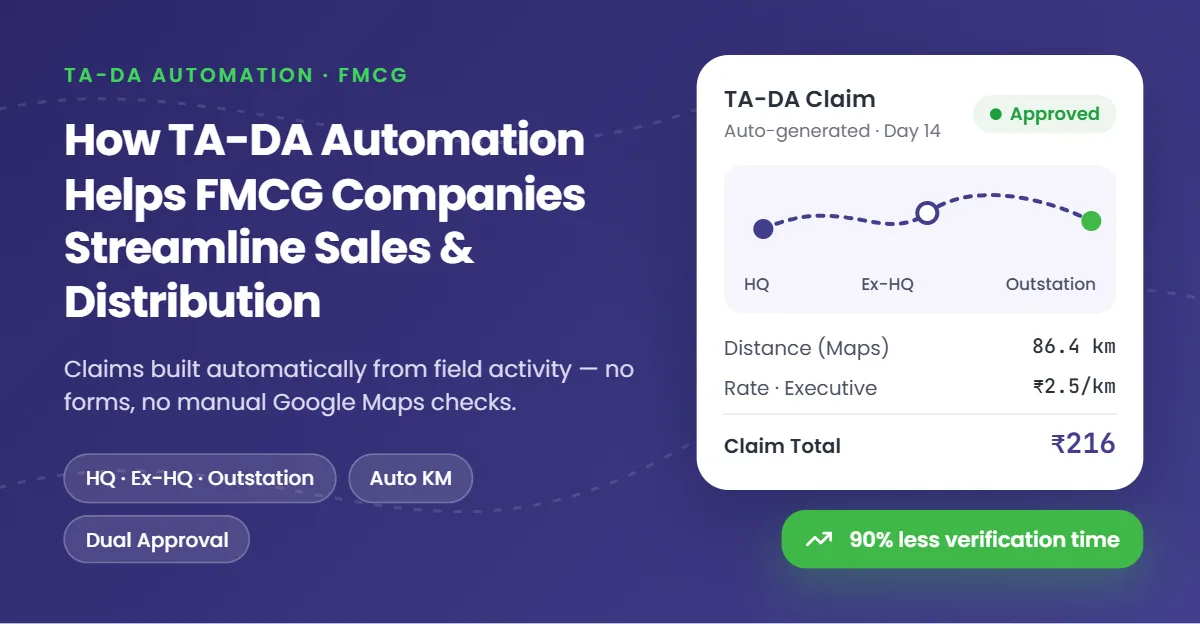
TA DA automation means the software does the calculating and checking, so people don't have to. A good system doesn't just move the claim form to a phone. It builds the claim from what the rep actually did in the field, and applies the company's rules automatically.
That's the difference between a digital form and real automation. With a digital form, Rahul still sits down on the 30th and fills it in. With real automation, there's nothing for him to fill.
The Same Month, With Automation
Let's replay the month.
Rahul does his work as usual. He visits shops, takes orders, and marks his visits in the field sales app. He doesn't think about TA DA. At the end of the month, his claim is already there, built from his routes, visits, and the company's rules. He checks it, and that's it. The half day he used to lose is now spent in the market.
On Meena's side, the claim comes with the route, the kilometers, and the visits already attached. She doesn't need a separate map. She can see the rep's whole day on one screen. If something looks strange, she has proof in front of her instead of a feeling. Most claims take a few minutes, not a few days.
The same story looks different from every chair. So let's look at it from each one.
What Changes for the Sales Rep
The rep gets his time back. No more preparing claims, no more worrying that the office will cut his kilometers without explaining why. He knows the claim is based on what he actually did.
It also changes how he feels about the system. When claims are fair and clear, reps stop arguing about every kilometer and start thinking about the next shop. Anyone who has managed a field team knows how much energy goes into those arguments.
What Changes for the Sales Manager
A manager's day usually goes into targets, coaching, and solving problems in the market. Approving claims often eats into that time.
With automation, the manager sees a claim that already matches the rep's work. They approve or question it quickly. And because TA DA sits in the same system as visits and orders, the manager can link them. Did this rep travel a lot but sell little? Is one area costing more than it brings in? These questions become easy to answer.
What Changes for MIS, HR, and Accounts
This is where the biggest time saving usually is. In a company with a large field team, checking claims by hand can take several people a good part of every month. They're matching routes on maps, chasing missing details, and sending claims back and forth.
Automation moves most of that work into the software. The rules are applied the same way for every rep. Fake or doubtful entries are easier to catch. Bills are stored in one place, and every approval is recorded. When the auditor comes, the answers are already there.
The team doesn't disappear. Their work shifts from calculating to reviewing the few claims that really need attention.
What Changes for the Owner or Sales Head
For the person running the business, TA DA is a big cost that's hard to see clearly. Field travel is one of the biggest expenses in FMCG, but many companies only know the total at month-end.
With automation, you can see the cost as it happens, by area, by team, and by manager. And because it's tied to sales data, you can ask better questions. Which beats cost a lot to cover but give little in return? Where is travel well spent? That's useful for planning, not only for accounting.
Where Sales and Distribution Actually Get Better
Here's the part people sometimes miss. TA DA automation is not just an HR or finance tool. When it's connected to your field sales system, it helps sales and distribution in very practical ways.
More selling time. Every hour a rep doesn't spend on claims is an hour he can spend with a retailer.
Better route discipline. When travel is tracked and paid from real routes, it's easier to see where beats are badly planned, or where reps are doing unnecessary distance.
Fairer rules, better mood. When everyone is paid by the same rules, there is less suspicion between the field and the office. That helps teamwork and reduces people leaving over small disputes.
Allowance linked to real work. Many companies want TA DA to depend on activity, like a minimum number of visits, orders, or working hours. Automation can apply that rule without anyone checking by hand.
Clearer cost of serving each area. When you can see what it costs to cover a town or a distributor's territory, it's easier to decide where to add coverage and where to rethink it.
In short, TA DA stops being a month-end chore and becomes one more source of useful information about how your market is being worked.
What the Software Needs to Handle
Not every tool will do this well, so it's worth knowing the hard parts. FMCG TA DA is rarely simple. A good system should be able to handle things like:
● Different rates and travel modes for different designations.
● Special rules for metro cities or hill areas.
● HQ, Ex-HQ, and outstation trips, with your own distance limits.
● Different ways of counting kilometers: the shortest route, or the actual route travelled.
● Fake GPS and other tricks.
● Approval steps from manager to HR to accounts.
● Storing bills for audits.
If a vendor can't show you your own rules working in a demo, be careful.
How Rupyz Does It
Rupyz is a B2B SaaS platform for FMCG brands and distribution businesses. Its TA DA automation is built inside the same platform the field team already uses, so claims come from real field work.
The Rupyz team says it studied the TA DA rules of more than 50 companies while building it, and every scenario can be set up. In simple terms:
● The rep doesn't submit a claim. His field activity and your rules create it.
● Kilometers can be calculated on the rep's actual route using Google Maps two-wheeler routing, including detours and U-turns, or on the shortest HQ to town to HQ route, depending on your policy.
● Fake GPS, modified apps, and developer mode are blocked, and a device log shows the checker things like internet on or off, battery, and login times.
● Claims go through manager, then HR or MIS, then accounts, by default.
● Bills are stored for seven years, as per government requirements.
● There are dashboards for claim status, for the checker with filters by area, manager, and journey type, for each rep's day in detail, and for management, including cost analysis linked to targets.
The Rupyz team also says checking and audit time fell by 90 percent at one live client. That's the result of one customer, so treat it as an example, not a promise, and ask for a reference call from a company like yours.
If you only want a stand-alone expense tool with no field sales system, Rupyz may not be what you need. It works best when TA DA and field sales live in one place.
Want to See Your Own Month-End Story Change?
Bring your TA DA rules to a Rupyz demo. Even the messy version, with all the exceptions, is fine. Tell us your hardest case, the one that always starts an argument between the field and the office. We'll show you how it would be set up, and what Rahul's and Meena's month would look like.
Quick Answers
What is TA DA automation software?
It's software that works out, checks, and approves travel and daily allowance claims for field staff. A good one builds the claim from the rep's real field work and applies your rules.
Does it only help the finance team?
No. Reps save time, managers approve faster, and owners see travel costs clearly. When it's connected to your field sales data, it also helps you plan routes and coverage better.
Can it follow our company's own TA DA rules?
It should. Ask the vendor to show your own rates, HQ and outstation limits, and eligibility conditions working in a demo before you decide.
How does it stop wrong or fake claims?
By building the claim from recorded routes and visits, and blocking tricks like fake GPS. A device log and a clear approval trail help the checker too.
Does Rupyz offer TA DA automation?
Yes. Rupyz offers TA DA automation inside its field sales platform, with claims created from field activity, configurable rules, Google Maps-based kilometre calculation, fake GPS blocking, approvals, and dashboards. Book a demo to see it with your own rules.
Book demo today with Rupyz, and give your team back the last day of the month.
How TA DA Automation Software Helps FMCG Companies Streamline Sales and Distribution