
Overview of Software Development
It is a process of designing, building, and maintaining software to use resources efficiently. IT helps a software deliver improved performance.
Software runs on servers, networks, and data centers and consumes electricity. Here, inefficient code or poor design increases the energy requirement significantly.
Sustainable IT strategy focuses on improving efficiency at every stage of the software lifecycle. This approach benefits both the environment and the business. Sustainable systems provide software that is faster and easier to improve over time.
Let’s quickly go through the 7 best principles for software development.
Seven Best Principles of Development
Developing sustainable software doesn’t require starting the entire process from the beginning. Rather, it requires following certain practical principles about how to design and maintain systems for long-term efficiency.
Design Software for Long-Term Use
Most applications are designed and aimed to launch quickly. In sustainable software development, the system evolves without the requirement of constant rebuilding. It consists of modular architecture, a scalable framework, and well-documented code.
Flexible software design makes it easier to add new features without disrupting the entire application.
Efficient and Optimized Coding
Poorly optimized code makes server processing harder. It generally results in increased energy consumption and more infrastructure costs. By cutting down on unnecessary processing and optimizing database queries, the systems can run smoothly without breaking down.
In short, a small improvement in code efficiency can make a significant difference in overall system performance.
Use Cloud Infrastructure Responsibly
Software runs on cloud platforms because they make scaling easier. Improper management of a cloud platform often leads to resource wastage. Idle servers, oversized instances, and inefficient deployment processes can increase the expense and the energy usage.
Implementing sustainable software development strategies focuses on using cloud infrastructure smartly through auto-scan and workload monitoring.
Performance Monitoring
System monitoring in the sustainable development process is useful for evaluating the performance and resource consumption. Performance metrics, including CPU, memory, and infrastructure utilization, reveal the outcome of software operations.
Monitoring helps development teams identify insufficiencies before they become a large concern.
Lightweight and Efficient User-Experience
A clean, lightweight user interface reduces the load time and system power requirements. When pages include too many heavy elements or scripts, they take longer to load and can slow down the entire system. Keeping the design simple not only improves performance but also makes the experience smoother for users.
A simple yet efficient design leads to better usability and efficiency.
Integrate Sustainability into the Development Process
Sustainability is more than just a technical decision. It should be part of the entire development culture. Development teams can include sustainability considerations during code reviews, architecture planning, and testing. When sustainability becomes part of the workflow, teams naturally make smarter development choices.
Update Systems
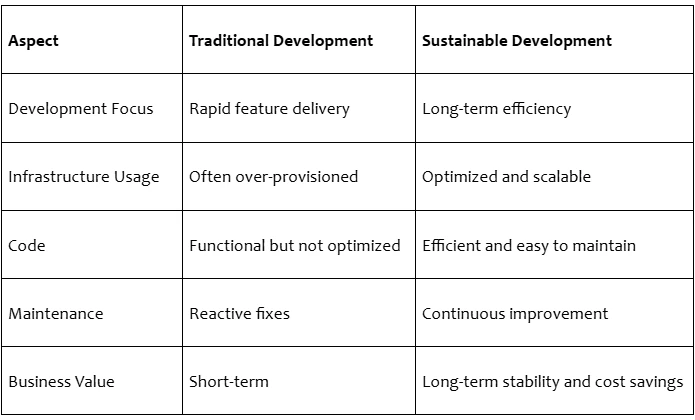
Regular optimization is essential for software to run without interruptions. Sustainable development promotes continuous improvement through modernization and infrastructure updates. Regular updates keep applications reliable and prevent frequent technical maintenance. Here is a brief comparison table of traditional software development and sustainable development.
Traditional Development vs Sustainable Software Development
Traditional software development allows the team to make the application ready to use soon. On the other side, sustainable development helps teams build systems that are reliable and cost-effective in the long run.
You should consult a reputable software development company to learn more about a sustainable IT strategy. Here, we mention some use cases where we can use sustainable development.
Where Sustainable Development Strategies Can Be Useful
Early-Stage Startups
Early-stage startups often require scaling up their business fast with the aim of keeping operational costs low. Here, efficient architecture and infrastructure can provide the flexibility to scale without exceeding their expenses.
Enterprises Looking for Simplified Systems
Large organizations frequently operate their business using complex systems that are expensive to maintain. In this case, sustainable development simplifies the systems gradually, without disrupting the existing operations.
SaaS Platforms
In SaaS, efficiency in infrastructure and architecture directly affects profitability. Getting optimized software can help reduce the hosting costs and improve performance. Eventually, it enhances customer experience without compromising quality.
Let’s see how companies can start implementing sustainable development into their software development process.
How Companies Can Start Implementing Sustainable Development Strategies
Sustainable development practices do not require a complete system overhaul. Businesses and companies can start with small improvements that gradually build momentum.
Step 1: Evaluate Software
Begin the process by identifying insufficiencies of code, architecture, and infrastructure.
Step 2: Start Improvements
Work on the areas that have the biggest effect on the software's performance and cost.
Step 3: Optimize Architecture and Infrastructure
Use scalable architecture, good coding practices, and better cloud management.
Step 4: Monitor Performance and Maintain
Utilize performance metrics to monitor the software’s performance and make changes whenever needed.
Conclusion
Sustainable software development focuses more on building software that is more compatible with future upgrades, as well as works efficiently. It is now an important part of modern technology strategy. As digital systems get bigger, businesses will need software that works well and is easy to maintain.
With simple practices like code optimization, efficient infrastructure, and architecture, companies can build systems that deliver long-term value. Eventually, it results in reduced operational costs and resource consumption.