For a local business, Google can be one of the first places customers go when they need a product or service nearby. They may search for a plumber near them, a dentist in their city, a roofing company they can trust, or a restaurant open tonight.
The challenge is that paid ads can become expensive when you rely on them for every new customer. A small business may not have the budget to keep increasing bids just to maintain visibility.
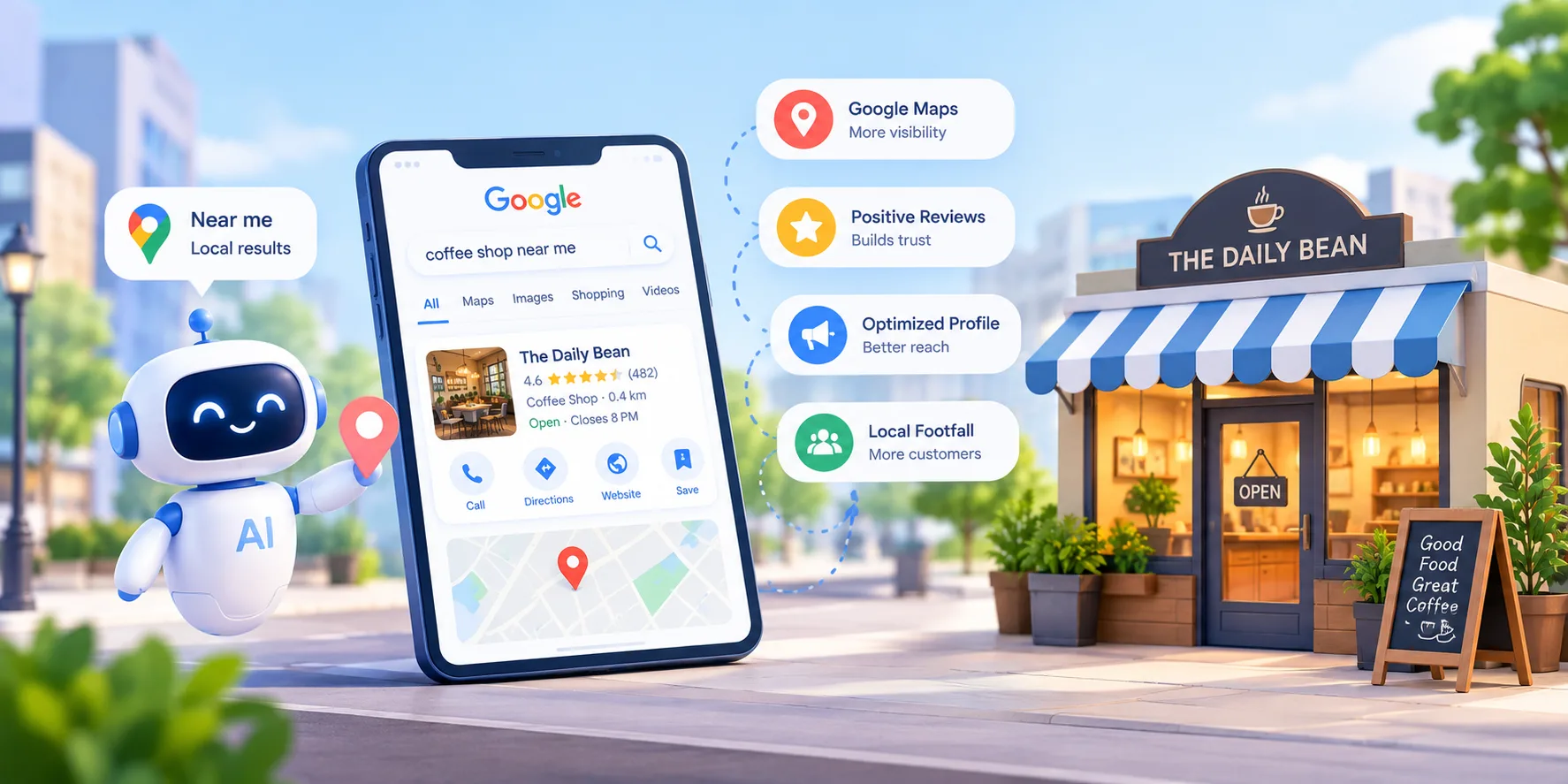
Organic local search offers another way to build visibility. With the right local SEO services for small business, you can improve how your business appears in Google Search and Maps, make your services easier to understand, and give nearby customers more reasons to choose you.
The goal is not simply to rank higher. It is to show up when local customers are looking for what you sell and make it easy for them to contact or visit you.
How Can Small Businesses Find More Customers Through Google Search?
Start with the searches your customers already use when they need your product or service.
A customer looking for a local business might search:
- "HVAC repair near me"
- "family dentist in Austin"
- "roof replacement company near me"
- "Italian restaurant in Chicago"
- "auto repair shop near me"
These searches are different from broad searches such as "HVAC" or "dentist." They include a local signal and often indicate that the person is looking for a business they can actually contact or visit.
Look at your own Search Console and Google Business Profile data to find the local searches already bringing people to your business.
Then ask:
Which searches are producing calls, bookings, quote requests, visits, or sales?
Those searches deserve more attention than keywords that simply generate impressions.
Is Your Google Business Profile Ready to Bring in Local Customers?
When someone searches for a nearby business, your Google Business Profile may be one of the first things they see.
That means the profile needs to answer basic questions quickly.
Is this the right business?
Do they provide the service I need?
Are they located near me?
Are they open?
Can I call or visit them?
Review your profile and make sure the information is accurate, including:
- Business name
- Primary category
- Relevant additional categories
- Address or service area
- Phone number
- Website
- Business hours
- Services
- Products, where relevant
- Photos
Google says local results are mainly based on relevance, distance, and prominence. Complete and accurate business information helps Google understand when a business is relevant to a local search.
Do not try to manipulate the profile by stuffing keywords into the business name. Use the real-world business name and provide accurate information about what you actually offer.
Which Local Searches Are Most Likely to Turn Into Customers?
Not every local keyword has the same value.
Someone searching "how often should I replace my roof" may be researching.
Someone searching "roof replacement contractor near me" is much closer to hiring.
Both searches can be useful, but they belong to different stages of the buying process.
Look for searches that combine:
Service + location
Examples:
- "emergency plumber Dallas"
- "pediatric dentist Miami"
- "personal injury lawyer Phoenix"
Also look at searches that describe an immediate problem:
- "AC stopped working near me"
- "car won't start mechanic"
- "water heater leaking repair"
These searches can reveal stronger commercial intent because the person has a specific problem and is looking for a business that can solve it.
Your SEO priorities should reflect the services that are both in demand locally and valuable to your business.
Can Your Website Help You Show Up for More Local Searches?
Your Google Business Profile is important, but your website needs to support the same local message.
A visitor who clicks through from Google should immediately understand:
- What you offer
- Where you serve customers
- What problems you solve
- Why the service is relevant to them
- How they can contact you
For example, an HVAC company serving Phoenix should not rely on a homepage that simply says "HVAC Services."
A stronger site structure might include pages for:
- AC repair
- AC installation
- Heating repair
- Emergency HVAC service
- Commercial HVAC
- Residential HVAC
The important location and service information should be clear without repeating the city name unnaturally throughout the page.
Do You Need Separate Pages for Every Service and Location?
Not always.
This is where some small businesses end up creating dozens of pages that add little value.
If you genuinely provide several services across several locations, separate pages can make sense when each page gives customers useful, specific information.
For example, a plumbing company could have a meaningful page about emergency plumbing in a particular service area if it actually serves that area and can explain what customers there can expect.
But creating 30 pages that contain almost identical text with different city names does not give customers a better experience.
Before creating a location page, ask:
Would a customer in this location find something genuinely useful here?
If the answer is no, another page may not be necessary.
How Can Customer Reviews Help You Win More Local Business?
A customer comparing several local businesses will often look at reviews before deciding who to contact.
That makes reviews an important part of the local customer journey.
Instead of trying to collect reviews in bursts, create a simple process for requesting genuine feedback after a completed service or purchase.
For example:
Service completed → Customer follow-up → Review request → Business response
Make the process easy for customers.
Also respond to reviews, including negative ones. A thoughtful response can show potential customers that the business pays attention to feedback.
Do not buy reviews, offer incentives for positive reviews, or ask customers to post something that does not reflect their real experience.
The objective is not simply a bigger review count. It is a credible record of real customer experiences.
Where Can Small Businesses Build Local Authority Without Wasting Money?
Local visibility is not built by submitting your business to every directory you can find.
Focus on legitimate sources that make sense for your business.
Depending on your industry, these might include:
- Local business associations
- Chambers of commerce
- Industry organizations
- Local publications
- Community organizations
- Relevant local websites
- Sponsorships and community activities
If a local organization mentions your business and links to your website, that can also help people discover your business.
The important question is not:
"How many local links can we get?"
It is:
"Which local relationships and mentions would actually make sense for this business?"
That keeps local link building focused on relevance instead of quantity.
How Can Local Content Help You Reach Customers Before They Are Ready to Buy?
Not every customer searches for a business immediately.
Someone may first search for information about a problem they are experiencing.
A local pest control company, for example, could answer questions about common pests in its service area. A roofing company could explain signs that a roof may need repair. A dentist could answer questions about common dental treatments and when someone should seek professional care.
This type of content can introduce the business earlier in the customer's decision process.
The content should still connect naturally to the services the business provides.
There is no need to publish dozens of unrelated articles simply to make the website look active.
Are You Making It Easy for Local Searchers to Call or Visit?
A local customer often wants to take action quickly.
They may want to call, request a quote, book an appointment, get directions, or check business hours.
Make those actions obvious.
Depending on the business, useful options include:
- Call now
- Request a quote
- Book an appointment
- Get directions
- Schedule service
- Visit the store
Make sure the phone number and other important information are easy to find on mobile devices.
For businesses that depend on phone calls, a strong local ranking is only part of the job. If someone cannot quickly find the number or understand how to contact you, the visibility may not turn into a lead.
What Should You Measure to Know Whether Local SEO Is Bringing Customers?
If the goal is more customers, measuring traffic alone is not enough.
Track actions that have a direct connection to the business, such as:
- Calls from Google
- Website calls
- Quote requests
- Appointment bookings
- Direction requests
- Contact form submissions
- Leads by service
- Leads by location
- Store visits, where measurable
You can then identify which services and locations are producing the strongest results.
For example, if organic visibility for one service produces twice as many qualified leads as another service, that information should influence where you invest your SEO resources.
This makes local SEO a business decision rather than simply a ranking exercise.
What Should You Improve Before Spending More on Google Ads?
Before increasing your advertising budget, check whether your organic local presence has obvious gaps.
Ask:
- Is the Google Business Profile complete and accurate?
- Are your main services clearly represented?
- Can customers find the business in the areas you actually serve?
- Does the website have useful service pages?
- Are your reviews being collected consistently?
- Is your business information accurate across important websites?
- Can customers easily call, book, or request a quote?
- Are you measuring qualified local leads?
Fixing these fundamentals may give you opportunities to generate more organic leads without paying for every click.
That does not mean paid search is unnecessary. Ads can still be useful when you need immediate visibility or want to promote a particular offer.
The point is to avoid depending on paid traffic for every customer when your organic local presence can also bring people to the business.
Can Local SEO Help Reduce Your Dependence on Paid Search?
It can, but it takes time.
Paid advertising gives you immediate visibility as long as you continue paying for it. Local SEO works differently. You invest in your business's organic visibility, website, Google Business Profile, reviews, local relevance, and overall search presence.
Over time, those assets can continue helping customers discover your business through Google Search and Maps without requiring an ad spend for every visit.
The strongest approach is often not SEO versus Google Ads.
It is understanding where each channel makes sense.
Use paid search when you need immediate or highly targeted visibility. Build organic local visibility so your business can continue attracting customers from searches where you have earned relevance.
For small businesses, that balance can make customer acquisition more sustainable.
How Should a Small Business Prioritize Local SEO on a Limited Budget?
You do not need to fix everything at once.
Start with the areas closest to customers and revenue.
First, clean up your Google Business Profile.
Make sure your business information, categories, services, hours, and photos are accurate.
Next, focus on your most valuable services.
Build or improve pages around the services customers actually pay for.
Then, strengthen your local presence.
Make sure customers in your main service areas can find accurate information about the business.
Build a consistent review process.
Ask genuine customers for feedback after completed transactions or services.
Finally, measure the leads.
Find out which local searches, services, and locations are producing real business.
This gives a small business a practical starting point without spreading a limited budget across every possible SEO task.
Can a Better Local Search Presence Bring Customers Without More Ad Spend?
Yes, but the goal should be better visibility for the right local searches, not simply more impressions.
A small business has a much better chance of turning organic search into customers when its Google Business Profile is accurate, its website clearly explains its services and locations, its reviews reflect genuine customer experiences, and its local search strategy is built around real customer needs.
That is what makes local SEO services for small business valuable. The work is not simply about ranking for keywords. It is about helping nearby customers find the business when they need what it offers.
As a performance-focused SEO agency, ResultFirst helps businesses connect local search visibility with measurable outcomes such as qualified leads, calls, and customer acquisition rather than treating rankings as the end goal.
Conclusion
A small business does not have to increase its Google Ads budget every time it wants more customers.
There are organic opportunities already available through Google Search and Maps. The key is to make your business easier to understand, more relevant to local searches, more trustworthy to potential customers, and easier to contact.
Start with the searches that matter most. Improve the Google Business Profile. Strengthen important service and location pages. Build genuine customer reviews. Make local actions easy. Then measure which improvements actually bring qualified customers.
That is a more useful way to think about local SEO: not as a way to get more website traffic, but as a way to get more of the right customers from the places you serve.