Have you ever encountered a moment when everything around you moves too fast and you feel lost? It’s like sitting on a bench in the 2000s, carefully counting dollar bills from your pocket, only to fast forward to today, where we impulsively tap and dip cards as we navigate a fast-paced, globalized world, juggling a takeaway brunch in one hand and a smartphone in the other. The fintech industry has been on a wild roller-coaster ride of changes over the past decades. As we’re just a few months shy of hitting the quarter-century mark since 2000, it’s surprising how few technical know-how moments we have in our daily lives. Despite tapping our cards and keeping up with the hustle and bustle of modern life, there’s a lack of understanding about the technical magic behind it all. In this blog, we want to fill in those gaps by pulling back the curtain on POS terminals, Semi-integration processes, and how they quietly shape our lives.
Ubiquity of POS terminals
In essence, a POS is a place where transactions come to life. At this point, a customer transforms goods or services into paid reality. As leaders in fintech, Valor believes it’s our social responsibility to paint a detailed picture for all industry stakeholders on how complex integrations ‘just work’ on POS technology. The ubiquitous presence of POS terminals is attributed to the remarkable communication technology known as Semi-integration.
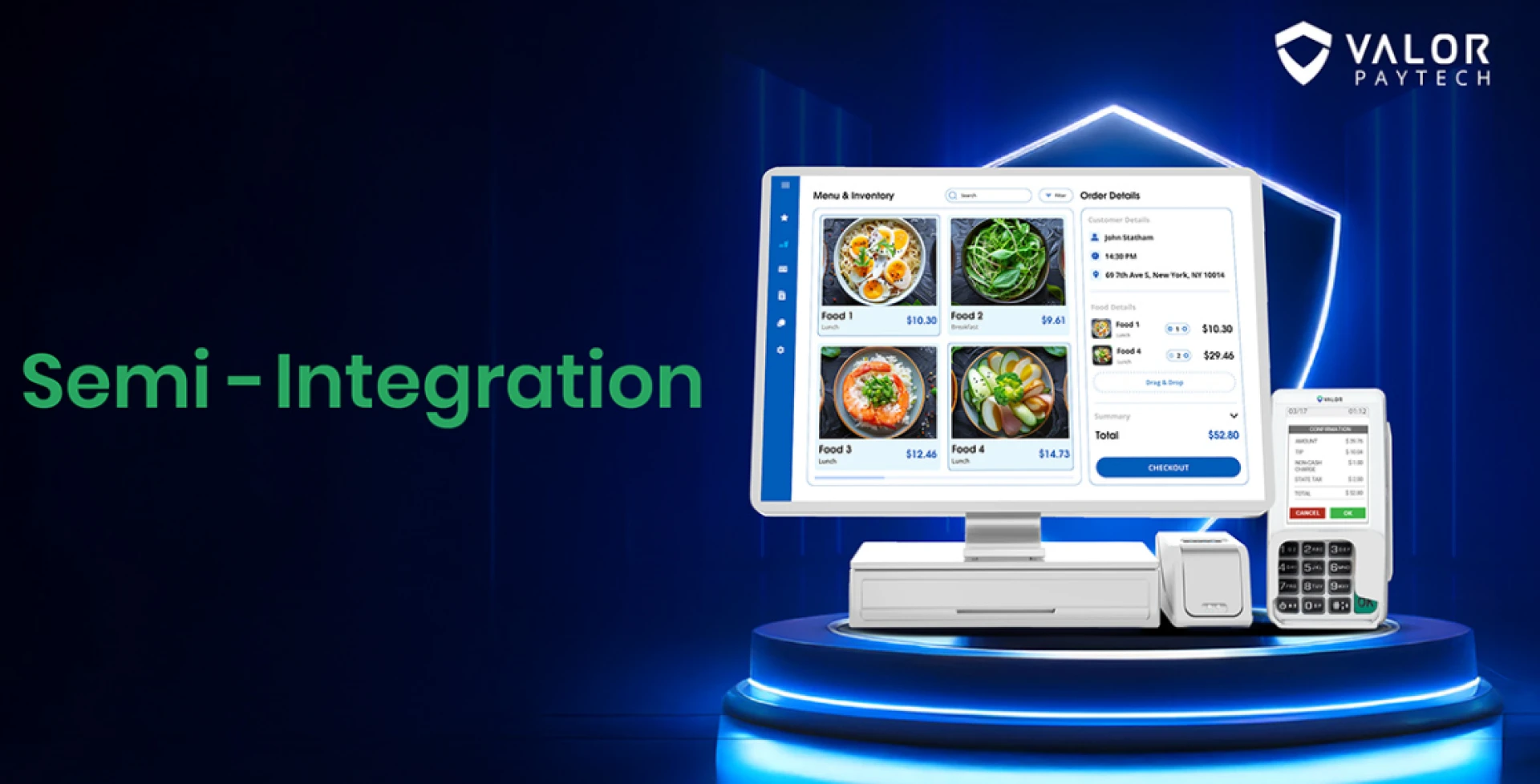
The acronym ‘POS’ or point-of-sale doesn’t necessarily confine itself to a single device. POS refers to the entire system comprising multiple devices such as POS desktops, tablets, scanners, receipt printers, smartphone applications, and credit card readers (terminals). With Semi-integration, the check-out process helps users surpass a lengthy check-out and saves time in daily activities.
In high-traffic urban centers like New York, where speed and efficiency are non-negotiable, this streamlined process becomes critical for maintaining customer satisfaction and business momentum.
Focus on Semi-integration
Semi-integration is a checkout method that integrates payment processing and point-of-sale software into a secure and organized network configuration. It enables stores to accept Chip/EMV credit card and debit card payments while managing inventory changes, returns, voided transactions, and other payment functions. In essence, Semi-integration ensures that payment terminals are connected to retail POS software but maintains a separation between payment information transmission and other systems keeping the POS software out of compliance scope. This separation is vital for meeting Payment Card Industry Data Security Standard (PCI DSS) compliance, offering a cost-effective and compliant solution without the need for extensive investments in fully integrated systems.
In a semi-integrated setup, the POS system kickstarts the transaction. Semi-integration is the reason why the desktop sends the data to the POS terminal, enabling the user to swipe, dip, or tap and complete the payment. The credit card details are then encrypted and securely transmitted from the payment terminal to the gateway or processor via the POS desktop, and subsequently to the acquiring bank for authorization.
Following this, the authorization status is relayed back through the processor to the terminal, which then forwards a PCI-compliant, non-sensitive response to the POS system. This response shields sensitive card data and any personally identifiable information, providing essential details like the approval code, a truncated card number, and, based on the configuration, the transaction token in a safe manner.