
Smooth water-network operation depends on valves that open easily, control flow steadily and close tightly when a pipe section needs maintenance. The right valve can reduce pressure loss and simplify daily operation.
Rubber lined butterfly valves control water flow through pipelines and can close a line when a section needs to be isolated. A circular disc turns through 90 degrees inside the pipe. When the disc is open, water passes around it. When it closes, the disc presses against a flexible rubber lining to form a seal.
This movement makes the valve compact and quick to operate. Results still depend on the correct size, body style, lining and actuator for the network.
Start with the valve's everyday job
Start by asking what the valve must do most of the time. An isolation valve is usually fully open or fully closed. A control valve may stay partly open to change the flow, pressure or water level.
The published data for this concentric valve range covers isolation, regulation and combined duties. It gives a maximum recommended liquid velocity of 5 m/s. Staying within the correct operating range can help reduce cavitation, vibration and noise.
Pipe diameter alone is not enough for selection. A valve can be too large for smooth flow control, even if it fits the pipe. Engineers should compare normal, minimum and peak flow rates with the valve's published flow data at different disc positions. This shows whether the valve can provide useful control across the expected range.
Reduce pressure loss during full flow
The disc remains inside the pipe even when the valve is fully open. It therefore creates some resistance to the water. The shape of the disc and the open flow path affect how much pressure is lost.
One small pressure loss may seem minor. Several losses across a network can increase the work required from pumps. Designers can use the published flow coefficient to estimate the pressure available further along the system.
During commissioning, teams should also check that the disc reaches its correct open position. Travel limits, position signals and valve response should be tested under working pressure.
Check how tightly the valve closes
A dependable seal helps operators take pumps, filters, tanks or pipe sections out of service. In this concentric design, the rubber lining is bonded to the valve body. The disc presses against the lining when it closes. O-rings around the shaft help prevent water from leaking outside the valve.
Published Dutco Tennant product data states 100% tight shut-off, zero leakage and sealing in both flow directions for the range. This can be useful when the direction of water changes during backwashing, pump operation or network changes.
An industrial rubber lined butterfly valve still needs a lining that suits the water passing through it. Drinking water, treated wastewater and process water may have different temperatures and chemical conditions. Before selecting the lining and disc materials, the project team should confirm the water type, temperature, solids, chemical exposure and required approvals.
Compare project needs at WETEX 2026
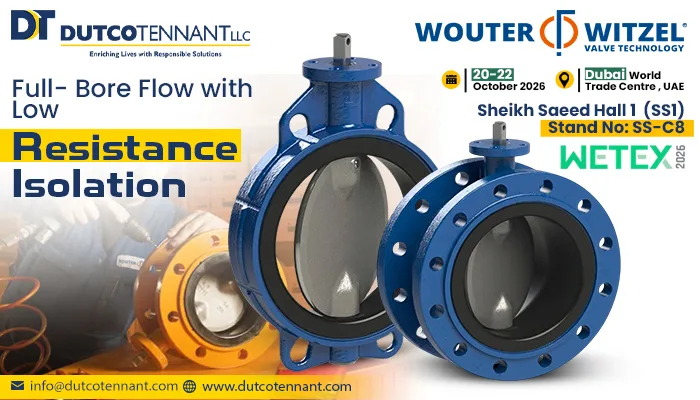
WETEX Dubai 2026 takes place from 20 to 22 October 2026 at Dubai World Trade Centre. At this water technology exhibition in Dubai, visitors comparing rubber-lined butterfly valves can include Sheikh Saeed Hall 1 (SS1), Stand SS-C8, in their technical discussions. Bringing details about flow, pressure, water quality and operation can make those discussions more useful.
Choose a body style that fits the pipe
The valve body affects the space needed for installation, the way bolts are fitted and how the pipe can be maintained. The main options should be reviewed against the actual pipe layout.
A rubber lined wafer butterfly valve, also called a wafer type rubber lined butterfly valve, fits between two pipe flanges. This compact rubber lined wafer valve can help where space or weight is limited. It is normally used within a continuous pipeline. It should not be assumed to support an open pipe end unless the selected model is approved for that duty.
A rubber lined lug butterfly valve has separate bolt connections around its body. Some lug designs allow one side of the pipe to be removed while the valve stays connected to the other side. The exact pressure limit and end-of-line suitability must be checked for the selected model.
A double flanged rubber lined butterfly valve is a rubber lined flanged butterfly valve that connects directly to the pipe flanges on both sides. This format can suit large pipes, buried installations and locations that need a firm connection. The published range covers sizes from 50 mm to 2,000 mm. Body style, support and actuator needs should therefore be checked for the actual valve size.
Choose the right operating method
Butterfly valves can use a manual gearbox or a powered actuator. The choice depends on valve size, pressure difference, operating frequency and the time allowed for opening or closing. The project should also define what the valve must do if electrical power or control air is lost.
The actuator needs enough turning force to move and fully seat the disc. This force is called torque. Flowing water, bearing friction and contact with the rubber lining all affect the required torque. An actuator that is too small may fail to close the valve. One that is much larger than needed can create harsh movement.
For an automatic valve, the specification should state the control signal, safe position, manual override and position feedback. Closing speed also needs attention. Closing too quickly can cause a sudden pressure change in the pipeline. A surge study can help set a suitable closing time where this risk exists.
Keep clear selection and testing records
When discussing a project with a rubber lined butterfly valve supplier, a clear valve schedule should list pipe size, flow, pressure class, maximum pressure difference, water type, temperature, body style, flange standard, materials, installation position and actuator needs. Check every limit against current data from the rubber lined butterfly valve manufacturer. If the valve will be used at the end of a pipe, the permitted pressure for that duty should be confirmed separately.
The same record can support installation and testing. Teams can check flange alignment, free disc movement, bolt tightening, actuator stops, position signals and sealing. They can also test how the valve responds to control commands.
Good records make future maintenance easier for any butterfly valve for water treatment. They show why the valve was selected and how it performed when first installed. Operators can then compare later changes in flow control, movement or sealing with that starting point.