
Every bank, NBFC, fintech, or gig platform operating in India runs into the same wall at some point: how do you know the person signing up is actually who they say they are? For over a decade, the answer has almost always started with one document — Aadhaar.
That's precisely why Aadhaar has also become the document fraudsters try hardest to fake. Morphed photographs, edited PDFs, and doctored QR codes are common enough that relying on a human reviewer to "eyeball" an Aadhaar card is no longer a safe way to onboard customers at scale. This is the gap that Aadhaar verification APIs were built to close, and it's worth understanding how they actually work — not just that they exist.
Why Manual Aadhaar Checks Break Down
Manual verification has three structural weaknesses that don't show up until a business scales past a handful of customers a day:
- It doesn't scale. A team reviewing scanned Aadhaar copies can process dozens of applications a day, not thousands.
- It can't catch sophisticated tampering. A convincingly edited photo or altered date of birth is hard to spot with the naked eye, especially under time pressure.
- It creates compliance exposure. Storing scanned copies of a citizen's Aadhaar card long-term, without a clear consent trail, sits uneasily with India's evolving data protection framework.
What Changes With API-Based Verification
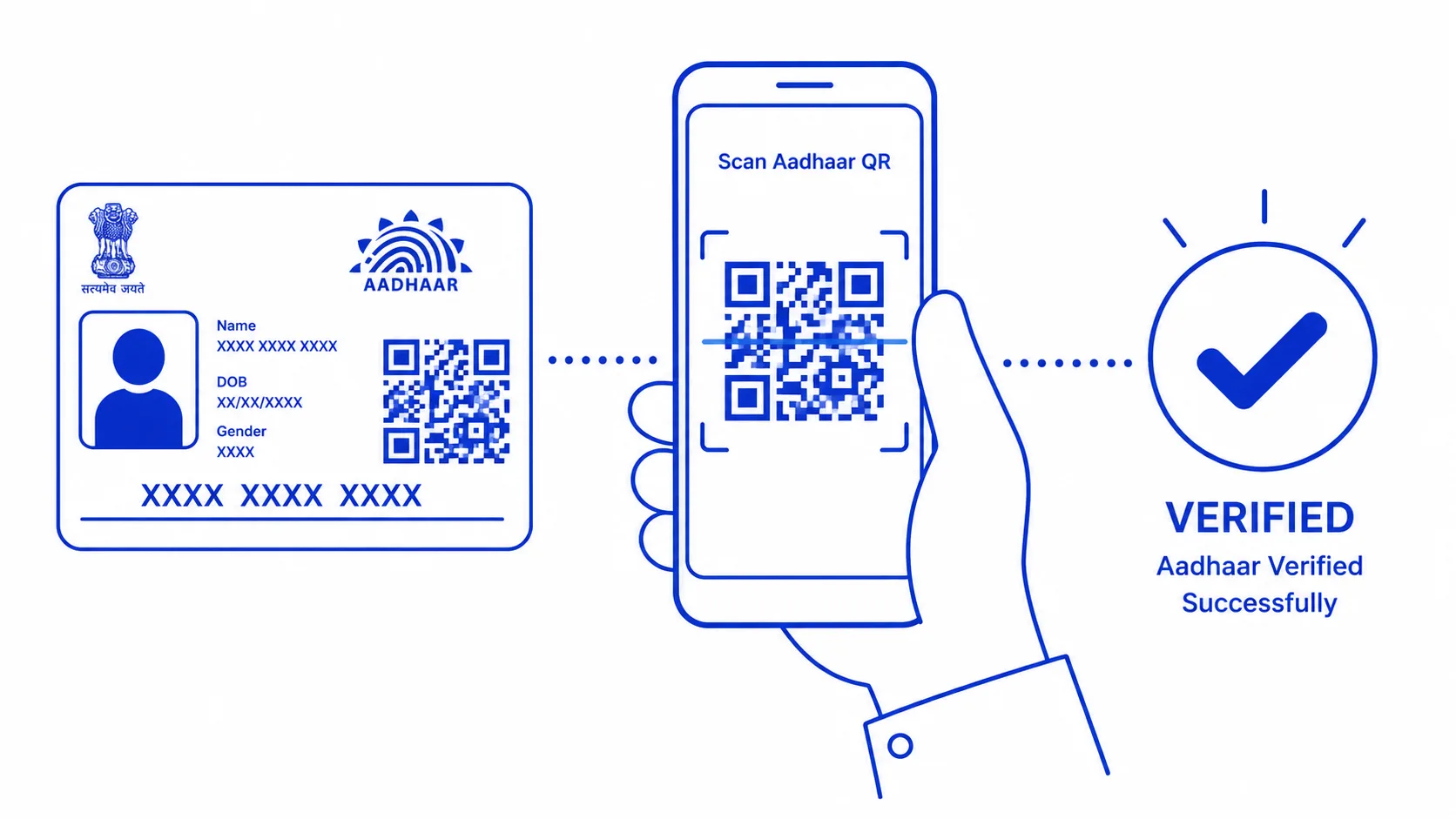
Instead of collecting and storing a copy of the Aadhaar card, a well-built Aadhaar verification API validates the document (or the underlying identity) directly against UIDAI's own infrastructure, using the government's Offline Verifiable Sharable e-KYC (OVSE) framework. In practice, the flow looks like this:
- The business initiates a verification request as part of onboarding.
- The user shares their identity through a QR scan of their Aadhaar or their Aadhaar number, with explicit consent.
- The system returns verified, UIDAI-backed details — name, date of birth or year of birth, gender, photograph, and address — without ever storing a raw copy of the document.
Because the check happens against the source of truth, a masked or manipulated Aadhaar card gets flagged in seconds instead of slipping through a manual review queue.
Where This Actually Gets Used
Aadhaar verification isn't just a banking-sector concern anymore. A few examples of where it shows up in practice:
- Financial services onboarding — savings accounts, loans, and card applications where identity mismatch is a direct fraud and compliance risk.
- Gig and delivery platforms — verifying drivers, delivery partners, and freelancers before they're allowed on the platform.
- Travel and hospitality — verifying guests during hotel check-in or long-stay bookings, where physical ID checks are still common but slow.
- HR and background verification — confirming candidate identity as part of a broader employment verification process.
The Compliance Angle Businesses Often Miss
With the Digital Personal Data Protection (DPDP) Act now moving from legislation to enforceable rules, how a business collects and stores identity data matters as much as whether it verifies it correctly. An API-based approach that verifies Aadhaar without retaining a stored copy of the document is a meaningfully different risk posture than a folder of scanned ID cards sitting on a shared drive. Businesses evaluating verification vendors should be asking not just "how accurate is this" but "what exactly are you storing, and for how long."
What to Look for in an Aadhaar Verification API
If you're evaluating this for your own onboarding flow, a few things are worth checking before you commit:
- Is it built on UIDAI's OVSE framework, or does it rely on scraping/manual OCR of uploaded images?
- Does it support both QR-based and number-based verification, so you're not forcing users into one flow?
- How is consent captured and logged — is there an audit trail if you're asked to prove it later?
- What's the actual turnaround time under load, not just in a sales demo?
This OVSE-based, no-document-storage approach is becoming the standard to look for. Some providers already structure their Aadhaar verification API this way — worth checking how any vendor you're evaluating handles it before you commit.
The Bigger Picture
Identity verification is quietly becoming infrastructure rather than a compliance checkbox. As fraud tactics get more sophisticated and data protection rules tighten, the businesses that treat Aadhaar verification as a real-time, API-driven process — rather than a manual, document-storage-heavy one — are the ones that will spend less time firefighting fraud and audits later.
FAQs
Ques: Is Aadhaar verification through an API legal in India?
Ans: Yes, when done through UIDAI-authorized frameworks like OVSE, with explicit user consent, and without unauthorized storage of Aadhaar data.
Ques: Does API-based verification require storing a copy of the Aadhaar card?
Ans: No — a properly built API verifies details against UIDAI's system and returns verified data without needing to retain the original document.
Ques: Can this be used for offline verification too?
Ans: Yes, several providers support offline verification through Aadhaar's signed XML file in addition to real-time QR or number-based checks.