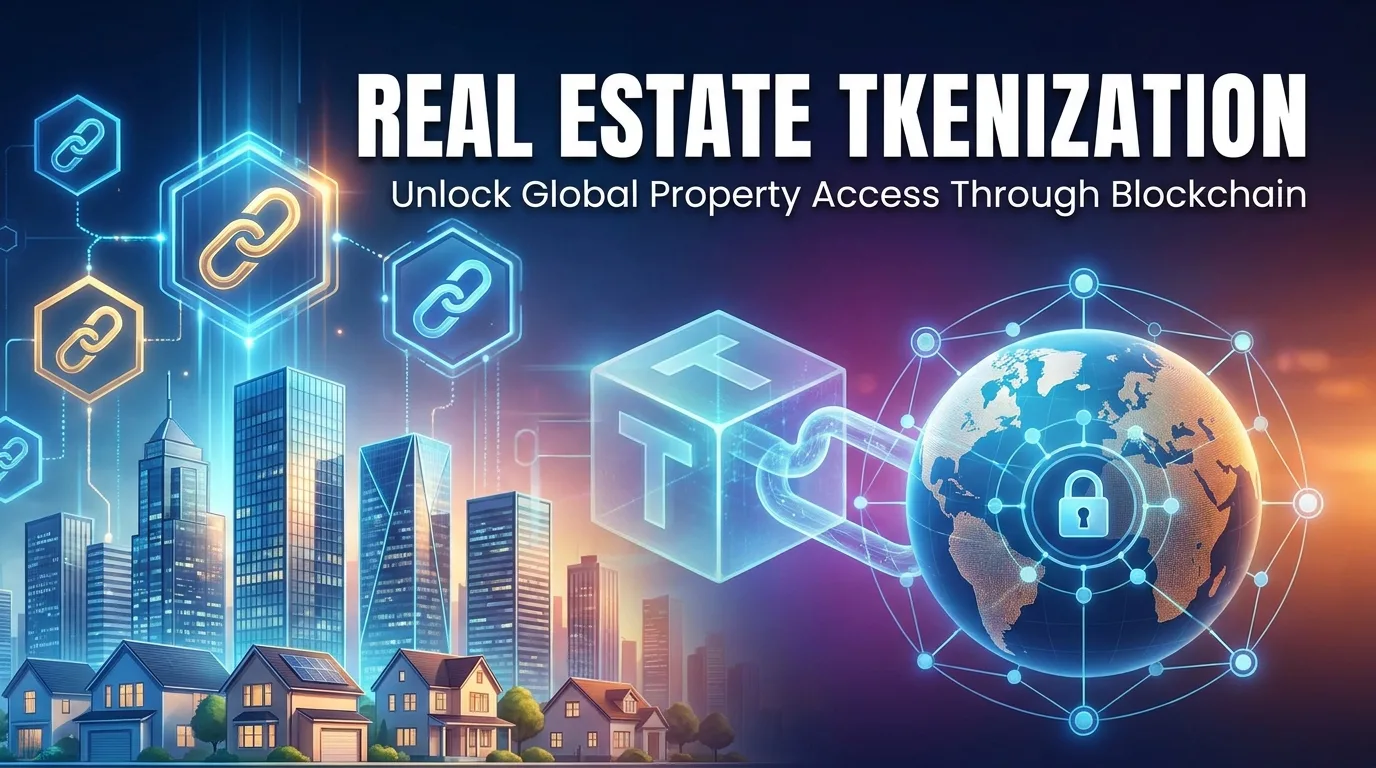
Real estate has always been one of the world’s most valuable asset classes, but it has also been one of the least accessible. Buying property usually requires large upfront capital, legal paperwork, intermediaries, long settlement cycles, and limited liquidity. Real estate tokenization changes this model by converting ownership rights, revenue rights, or economic interests in a property into digital tokens recorded on a blockchain. These tokens can represent fractional shares in an apartment building, commercial property, hotel, land parcel, real estate fund, or mortgage-backed asset.
The idea is powerful because it combines the stability and income potential of real estate with the speed, transparency, and programmability of blockchain. Deloitte has projected that tokenized private real estate funds could grow to about US$1 trillion by 2035, showing how seriously institutions are beginning to view this market. At the same time, regulators are paying close attention. The U.S. SEC has stated that a tokenized security is still a security when it represents a traditional financial instrument on a crypto network, meaning compliance remains central to any real estate tokenization project.
Understanding Real Estate Tokenization and Its Business Value
Real Estate Tokenization is the process of converting real-world property value into blockchain-based digital tokens. Each token may represent a fraction of ownership, a right to rental income, a share in a property-holding company, or participation in a regulated real estate investment structure. Instead of one investor buying an entire building, hundreds or thousands of qualified investors may hold smaller digital interests in the same asset.
This is why demand for a Real Estate Tokenization company has grown among property developers, asset managers, family offices, real estate investment firms, and fintech startups. A specialized provider helps structure the technical, legal, and operational framework needed to launch tokens securely and compliantly. Real Estate Tokenization Services often include token design, smart contract development, investor onboarding, KYC/AML integration, wallet setup, compliance automation, dashboard creation, and secondary-market enablement.
The business value comes from solving long-standing real estate inefficiencies. Tokenization can reduce the minimum investment size, allow faster transfers of ownership interests, automate distributions, and improve transparency through blockchain records. It does not magically remove legal complexity, but it can make real estate investing more flexible, data-driven, and globally accessible when implemented correctly.
Step 1: Selecting the Real Estate Asset
The first step is choosing the property or portfolio to tokenize. Not every property is suitable. A strong candidate usually has clear ownership records, reliable valuation, stable income potential, and a legal structure that can support fractional investor participation. Common examples include rental apartments, office buildings, warehouses, hotels, student housing, retail spaces, land development projects, and private real estate funds.
Asset quality matters because tokenization does not improve a weak underlying investment. If the property has poor occupancy, unclear title, legal disputes, or unrealistic income assumptions, tokenizing it only digitizes those risks. Investors still care about location, rental yield, management quality, debt obligations, maintenance costs, exit strategy, and market demand.
For example, a stabilized multifamily building with long-term tenants may be easier to tokenize than a speculative land project with uncertain approvals. The former provides predictable rental income, while the latter depends heavily on development milestones. A professionally managed tokenization project begins with due diligence before any blockchain development begins.
Step 2: Legal Structuring and Regulatory Review
Once the asset is selected, the next step is legal structuring. In many jurisdictions, investors do not directly own a physical slice of the property. Instead, the property may be held by a special purpose vehicle, limited liability company, trust, fund, or similar legal entity. Tokens then represent rights connected to that entity, such as equity, revenue share, debt interest, or membership units.
This step is critical because most real estate tokens are likely to be treated as securities if investors expect profits from the efforts of a sponsor, manager, or platform. The SEC’s guidance on tokenized securities reinforces that putting an asset on blockchain does not remove traditional securities-law obligations. Compliance may involve private placement exemptions, accredited investor rules, transfer restrictions, disclosure documents, investor verification, and ongoing reporting.
The legal structure also defines investor rights. Token holders need to know whether they receive rental distributions, voting rights, redemption rights, capital appreciation, or priority repayment. They also need clarity on fees, property management responsibilities, taxes, dispute resolution, and exit mechanisms. Without this foundation, the token is only a technical wrapper around an uncertain legal claim.
Step 3: Property Valuation and Financial Modeling
After the legal framework is designed, the property must be valued. This usually involves independent appraisals, rental income analysis, comparable sales, debt review, operating expense projections, and market research. The project sponsor then determines how many tokens will be issued and what each token represents economically.
For example, suppose a commercial building is valued at $10 million and the sponsor chooses to tokenize 40% of the equity. That $4 million interest could be divided into 400,000 tokens priced at $10 each. Investors buying tokens would then participate in the economic rights attached to that tokenized portion, subject to the project’s legal terms.
Financial modeling also determines expected yield. Rental income, management fees, maintenance reserves, insurance, taxes, loan payments, and vacancy assumptions all affect investor returns. A credible tokenization project should present these assumptions transparently rather than relying on marketing language. Blockchain can improve transaction transparency, but the financial quality of the offering still depends on real-world property performance.
Step 4: Creating the Token and Smart Contract
The smart contract is the technical engine of real estate tokenization. It defines how tokens are created, transferred, restricted, burned, distributed, or updated. Depending on the project, tokens may be built using standards such as ERC-20 for fungible tokens or ERC-1400-style security token frameworks that support compliance controls.
Smart contracts can automate important functions. They may restrict transfers to approved investors, record ownership balances, trigger dividend or rental income distributions, enforce lock-up periods, and maintain auditable transaction histories. This programmability is one of the biggest advantages of tokenized real estate compared with traditional paper-based ownership systems.
However, smart contracts must be audited carefully. A coding error can create serious financial and legal consequences. Security reviews, penetration testing, administrative access controls, upgrade policies, and emergency pause mechanisms are all important. Tokenization platforms must also decide whether to use public blockchains, permissioned blockchains, or hybrid systems. A 2026 academic taxonomy of real-world asset systems found that many RWA projects use hybrid architectures, where blockchain manages representation and transfer functions while legal guarantees remain anchored off-chain.
Step 5: Investor Onboarding and Compliance Checks
Before investors can buy tokens, they usually must pass onboarding checks. This includes identity verification, know-your-customer screening, anti-money-laundering review, accreditation verification where required, wallet whitelisting, and acceptance of offering documents.
This process is essential because tokenized real estate is not the same as an unrestricted cryptocurrency. A property-backed token may be subject to securities laws, jurisdictional restrictions, tax rules, and investor suitability requirements. Compliance controls are often embedded into the smart contract so tokens can only be transferred between approved wallets.
For investors, this stage creates trust. They can review the property documents, legal disclosures, financial assumptions, risk factors, and platform terms before committing capital. For issuers, it reduces the risk of unlawful distribution and strengthens long-term credibility.
Step 6: Token Sale or Private Offering
The next step is the token offering. Depending on the regulatory structure, this may be a private placement, institutional offering, fund subscription, or controlled marketplace sale. Investors purchase tokens using fiat currency, stablecoins, or other approved payment methods, depending on the platform’s design.
A well-run offering provides clear information about token price, minimum investment, expected holding period, distribution schedule, fees, investor rights, and exit options. It should also explain risks plainly. Real estate markets can decline, tenants can default, interest rates can rise, regulations can change, and secondary liquidity may be limited.
This point is especially important because tokenization is often marketed as a liquidity solution. In practice, liquidity is not guaranteed. Recent research on real-world asset markets emphasizes that tokenization and actual secondary-market liquidity are separate outcomes; an asset can be tokenized and still trade infrequently. The success of a tokenized real estate offering therefore depends not only on technology but also on investor demand, market structure, compliance design, and asset quality.
Step 7: Asset Management and Income Distribution
After tokens are issued, the property must still be managed in the real world. Tenants must pay rent, repairs must be handled, taxes must be filed, insurance must be maintained, and financial reports must be prepared. Token holders depend on the sponsor or property manager to operate the asset professionally.
Blockchain can improve this stage by making ownership records transparent and automating distributions. Rental income can be converted into approved payment rails and distributed to token holders according to their ownership percentage. Dashboards can show investors their holdings, transaction history, projected returns, and distribution records.
For example, if a token holder owns 1% of a tokenized rental property’s economic rights, they may receive 1% of net distributable rental income after expenses and reserves. Smart contracts can make these calculations more efficient, but off-chain accounting and legal administration remain necessary.
Step 8: Secondary Trading and Exit Options
One of the biggest promises of real estate tokenization is improved liquidity. Traditionally, selling a property interest can take months and involve brokers, lawyers, negotiations, and closing processes. Tokenized ownership interests may be easier to transfer through compliant secondary marketplaces.
However, secondary trading must follow legal restrictions. Many security tokens can only be transferred to verified investors, after holding periods, or through approved trading venues. Platforms may use whitelisting, transfer agents, broker-dealer partnerships, or alternative trading systems to support compliant resale.
Exit options may include secondary-market sale, issuer buyback, property refinancing, property sale, fund redemption, or token burn upon liquidation. Investors should understand these mechanisms before buying. Tokenization can reduce friction, but it cannot guarantee that a buyer will always exist at a desired price.
Step 9: Reporting, Governance, and Ongoing Compliance
A tokenized property project requires ongoing transparency. Investors need regular updates about occupancy, rent collection, expenses, repairs, valuations, distributions, debt, and material events. Depending on the structure, token holders may also vote on major decisions such as refinancing, property sale, management changes, or capital improvements.
Governance can be built into smart contracts, but most real estate decisions still require legal and operational execution. A vote on-chain may record investor preferences, while the property manager or legal entity carries out the approved action. This blend of digital governance and real-world administration is central to tokenized asset systems.
Ongoing compliance is equally important. Issuers must monitor investor eligibility, tax reporting, securities rules, data privacy requirements, and jurisdictional limitations. This is why tokenized real estate is not simply a blockchain development project; it is a coordinated legal, financial, and technical operation.
Benefits and Challenges of Real Estate Tokenization
The main benefit of tokenization is accessibility. Smaller investors may gain exposure to institutional-grade properties without buying entire buildings. Developers can reach a broader investor base. Asset managers can create more flexible investment products. Blockchain records can reduce administrative friction and improve auditability.
Other benefits include fractional ownership, faster settlement, programmable income distribution, broader market reach, and potential secondary liquidity. The World Economic Forum has described real estate tokenization as a way to convert property ownership into digital tokens on programmable ledgers, enabling fractional ownership and new forms of transferability.
The challenges are equally important. Regulatory uncertainty, limited secondary liquidity, investor education, cybersecurity risk, custody complexity, property valuation, and off-chain enforcement all remain major concerns. Tokenization does not eliminate the need for trust; it changes where trust is placed. Investors must trust the legal structure, property manager, smart contract code, compliance system, and marketplace infrastructure.
Conclusion
Real estate tokenization works by combining traditional property investment structures with blockchain-based ownership records, smart contracts, investor onboarding, compliance controls, and digital marketplaces. When executed properly, it can make real estate investing more accessible, transparent, and efficient while preserving the legal protections required for serious financial products. For businesses looking to launch secure and scalable tokenized real estate platforms, Blockchain App Factory provides best services by offering end-to-end support across token development, compliance-focused architecture, smart contracts, investor dashboards, and blockchain implementation.
FAQs
1. What is real estate tokenization?
Real estate tokenization is the process of converting property ownership rights, revenue rights, or investment interests into digital tokens recorded on a blockchain. These tokens can represent fractional interests in real estate assets such as apartments, commercial buildings, land, hotels, or real estate funds.
2. Is tokenized real estate legally recognized?
Tokenized real estate can be legally recognized when it is structured through proper legal entities, contracts, disclosures, and regulatory compliance. In many cases, real estate tokens may be treated as securities, so issuers must follow applicable securities laws and investor protection rules.
3. How do investors earn income from tokenized real estate?
Investors may earn income through rental distributions, profit-sharing, interest payments, capital appreciation, or proceeds from a property sale. The exact income model depends on the legal and financial structure of the tokenized project.
4. Can real estate tokens be traded?
Real estate tokens may be traded on compliant secondary marketplaces, but trading is usually subject to restrictions. Investors may need to pass KYC checks, meet eligibility requirements, and use approved platforms before transferring tokens.
5. What are the main risks of real estate tokenization?
The main risks include property market decline, low liquidity, regulatory changes, smart contract vulnerabilities, poor asset management, inaccurate valuations, and limited investor demand. Tokenization can improve efficiency, but it does not remove the fundamental risks of real estate investing.