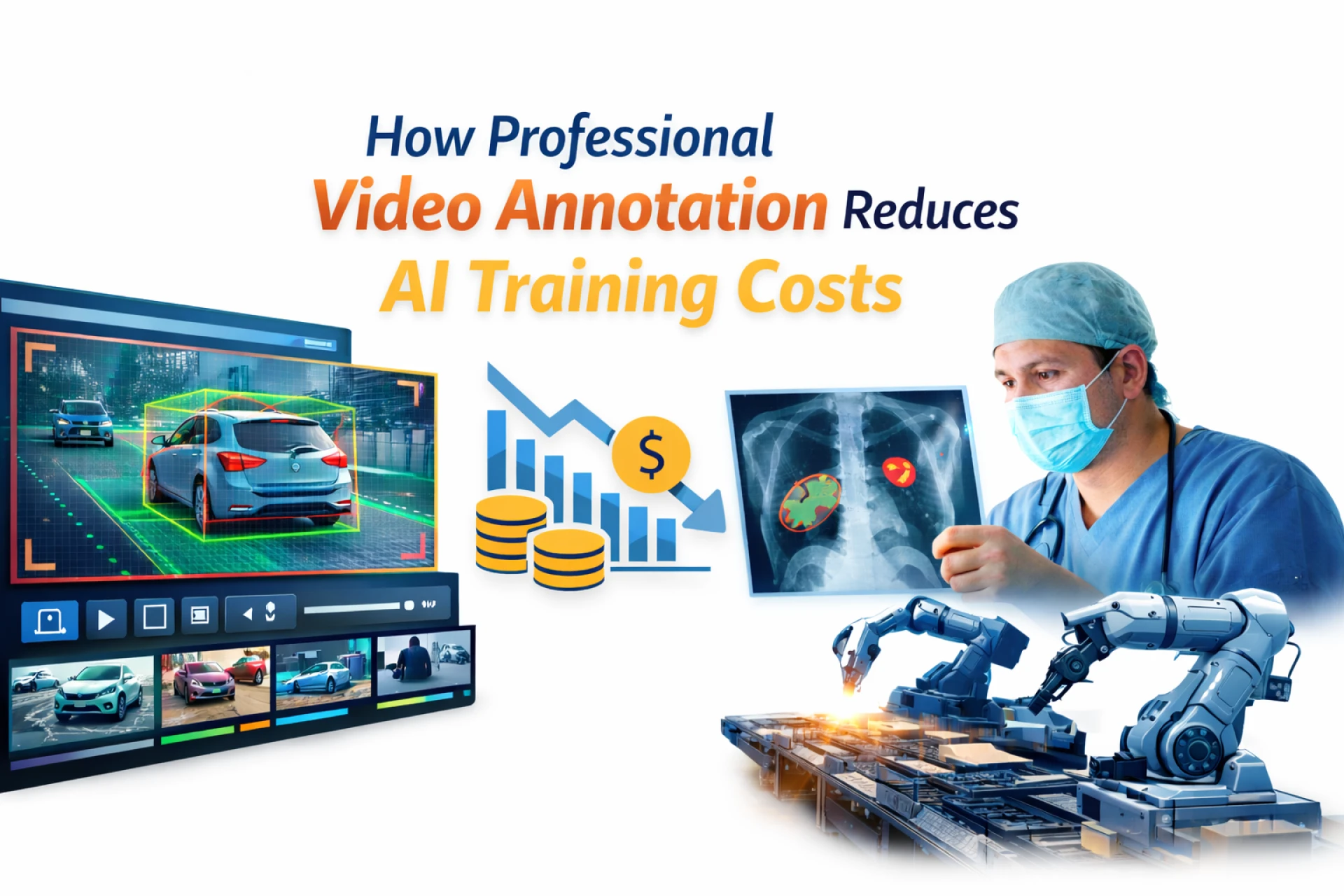
Artificial Intelligence models are only as powerful as the data they learn from. In computer vision projects, especially those involving surveillance, healthcare, retail analytics, and autonomous systems, high-quality Image and video annotation plays a defining role in model accuracy and overall cost efficiency.
While many businesses assume annotation is just a preliminary data preparation step, in reality, professional Video annotation directly influences AI training budgets, model performance, and time-to-market. When done correctly, it reduces rework, prevents model retraining cycles, and optimizes infrastructure costs.
Let’s explore how professional annotation services significantly lower AI training costs while improving long-term scalability.
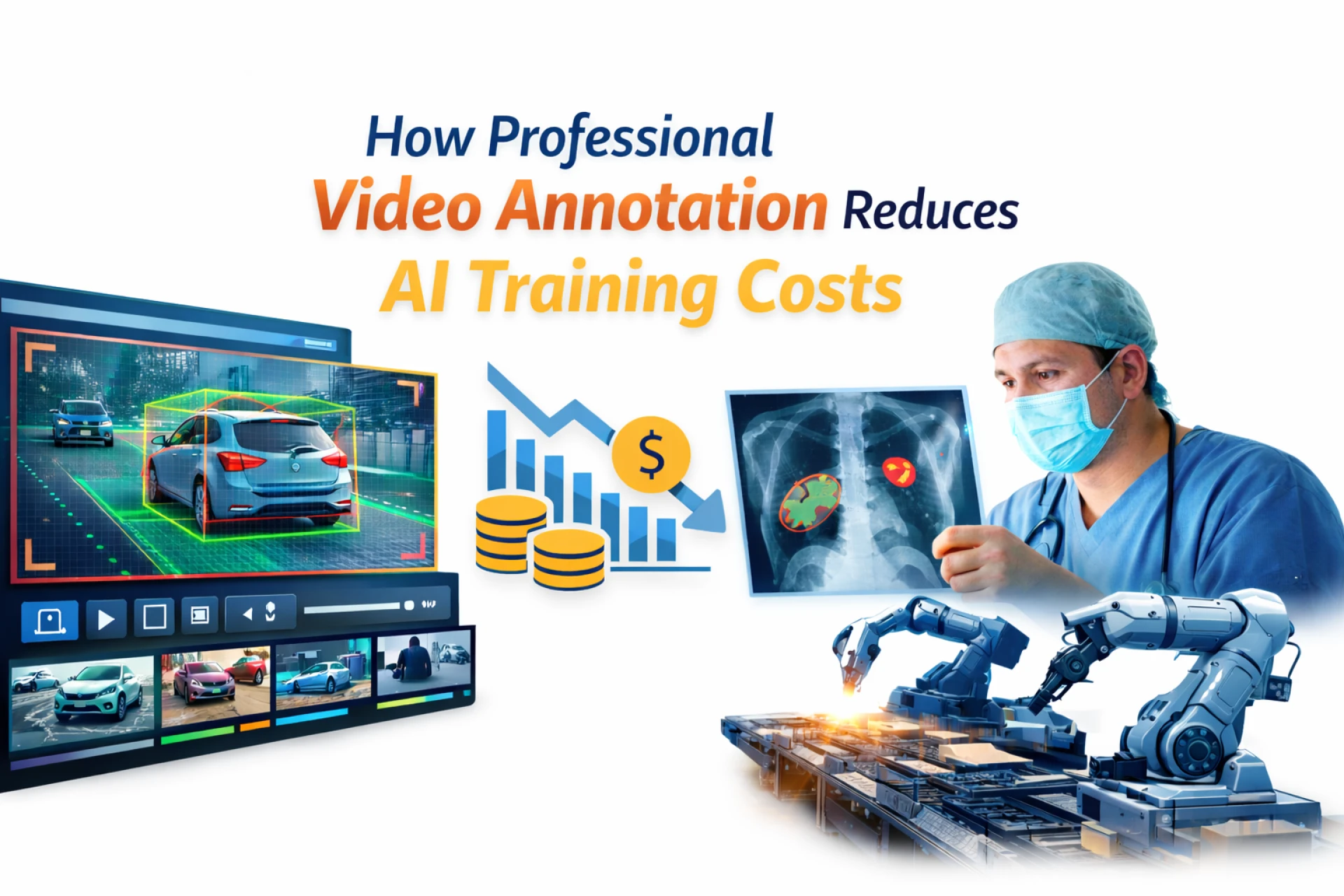
1. Reducing Costly Model Retraining Cycles
One of the biggest hidden expenses in AI development is model retraining. When training data is inaccurately labeled, machine learning models learn incorrect patterns. This leads to:
- Poor prediction accuracy
- Increased false positives and negatives
- Deployment failures
- Multiple retraining cycles
Each retraining cycle consumes computing power, cloud GPU resources, engineering hours, and testing time.
Professional Image and video annotation ensures that bounding boxes, segmentation masks, object tracking, and frame-by-frame labeling are consistent and precise. When annotation accuracy improves, the model learns correctly the first time — dramatically reducing retraining costs.
In large-scale projects, this alone can save thousands of dollars in infrastructure expenses.
2. Improving Data Quality at Scale
In video-based AI systems, errors compound quickly. A small inconsistency in object tracking across frames can confuse a model and degrade performance across thousands of video sequences.
Professional Video annotation teams implement:
- Multi-level quality assurance workflows
- Annotation guidelines documentation
- Inter-annotator agreement checks
- Edge-case tagging standards
This structured process prevents inconsistent labeling, which often happens with in-house or low-cost crowdsourced annotation. Clean, standardized datasets accelerate model convergence, meaning fewer training epochs are required — and fewer compute resources are consumed.
Lower compute time equals lower AI training cost.
3. Faster Model Convergence
High-quality annotated datasets enable faster model convergence. When labels are accurate and consistent:
- The loss function stabilizes earlier
- Model optimization improves
- Training iterations reduce
- Overfitting risks decrease
Professional Image and video annotation ensures correct classification, segmentation, and object tracking across diverse scenarios. This is especially critical for real-time applications such as autonomous vehicles or smart surveillance systems.
Faster convergence means shorter training cycles, which directly reduces GPU usage costs in cloud platforms like AWS, Azure, or Google Cloud.
4. Minimizing Error Propagation in Complex Systems
In multi-stage AI pipelines, annotation errors at the dataset level propagate across the entire system. For example:
- Incorrect bounding boxes affect object detection
- Poor segmentation impacts instance recognition
- Inaccurate tracking disrupts behavior prediction
Correcting such errors post-deployment is far more expensive than preventing them during the annotation phase.
Professional Video annotation teams follow predefined taxonomies and domain-specific labeling protocols. This proactive accuracy approach prevents downstream engineering fixes, saving both operational and maintenance costs.
5. Reducing Engineering Resource Burden
When annotation is handled internally, AI engineers often spend time:
- Fixing mislabeled frames
- Writing data-cleaning scripts
- Reviewing annotation inconsistencies
- Re-validating datasets
This diverts technical talent away from core AI innovation.
Outsourcing Image and video annotation to trained professionals allows engineers to focus on model architecture, optimization, and deployment. The financial value of reclaimed engineering time significantly lowers overall project cost.
Time saved equals cost saved.
6. Optimizing Medical AI Through Accurate Data Labeling
In healthcare applications, annotation accuracy is non-negotiable. In projects involving radiology videos, surgical recordings, or diagnostic imaging, Medical data collection and annotation require domain expertise.
Errors in medical AI training data can lead to:
- Regulatory non-compliance
- Diagnostic inaccuracies
- Increased liability risks
- Expensive model redevelopment
Professional annotation providers implement strict compliance standards and expert-reviewed workflows for medical datasets. This reduces the risk of revalidation cycles and regulatory setbacks, which are extremely costly in healthcare AI development.
In such industries, professional annotation is not an expense — it is a cost-protection strategy.
7. Supporting Scalability Without Increasing Cost Proportionally
As AI systems grow, dataset size expands exponentially. Managing millions of video frames requires:
- Structured workforce management
- Workflow automation
- Annotation tool expertise
- Secure data handling
Professional annotation partners use optimized workflows and advanced tools to handle scale efficiently. This prevents the need to continuously hire and train internal annotators, which increases overhead costs.
Scalable Video annotation solutions allow businesses to expand AI capabilities without proportionally increasing operational expenses.
8. Enhancing Model Generalization
Poor annotation often leads to biased or incomplete training data. Models trained on inconsistent datasets struggle to generalize in real-world scenarios.
Professional Image and video annotation includes:
- Diverse scenario labeling
- Edge-case inclusion
- Context-aware tagging
- Balanced dataset structuring
Better generalization reduces post-deployment fixes and performance tuning, ultimately minimizing long-term AI maintenance costs.
9. Preventing Compliance and Security Risks
In industries handling sensitive video content, secure Medical data collection and annotation processes are critical. Professional annotation providers implement:
- NDA-protected workflows
- Secure data storage protocols
- Encrypted access systems
- Compliance adherence (HIPAA/GDPR where applicable)
Avoiding data breaches or compliance penalties can save organizations millions in potential losses.
Final Thoughts
AI training costs are not just about cloud infrastructure or engineering salaries. A significant portion of expense comes from inefficient data preparation and retraining cycles caused by poor-quality labeling.
Professional Video annotation transforms raw video data into structured, reliable training datasets that accelerate model convergence, reduce infrastructure costs, and prevent expensive rework.
Investing in high-quality Image and video annotation is a strategic move that protects AI budgets, enhances model performance, and supports long-term scalability.
In high-stakes sectors like healthcare, where Medical data collection demands precision and compliance, professional annotation becomes even more critical.