
Introduction
Customer experience plays an important role in the growth of every retail business. From entering a store and finding products to completing purchases and receiving after-sales support, every interaction influences customer satisfaction. Long billing queues, incorrect invoices, unavailable products, and limited payment options can create frustration and affect customer loyalty.
This is where POS software for retail stores becomes valuable. Modern retail POS software helps businesses manage billing, inventory, payments, customer information, and sales activities through a single platform. It reduces manual work, improves checkout speed, and enables employees to provide better customer service.
Whether you operate a supermarket, grocery shop, clothing store, pharmacy, or retail chain, the right POS system for retail stores can simplify daily operations and create a convenient shopping experience.
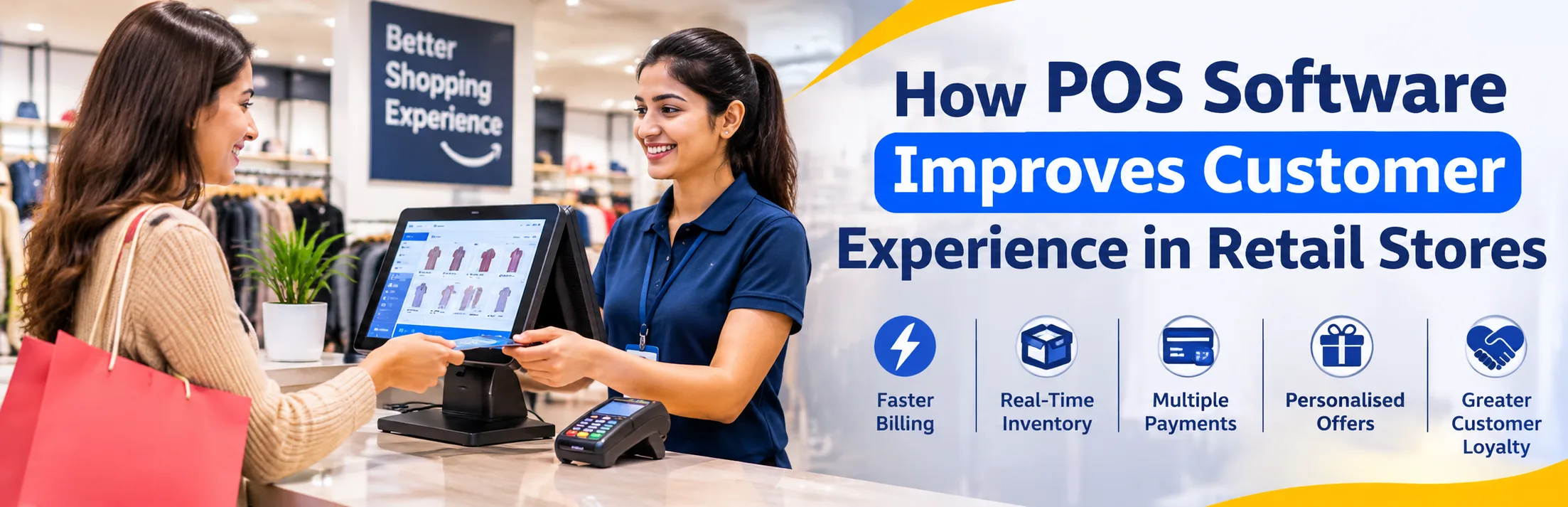
1. Faster Billing Improves the Retail Checkout Experience
Long queues at billing counters are among the most common reasons customers become dissatisfied with retail shopping. During weekends, festive seasons, and promotional sales, slow checkout processes can increase waiting times and affect the overall shopping experience.
A modern POS billing system automates product scanning, price calculations, discounts, tax calculations, and invoice generation. Employees can scan product barcodes, calculate transaction amounts, and generate bills without performing repetitive manual calculations.
With advanced retail POS software, businesses can:
- Scan products using barcode scanners.
- Calculate product prices and applicable taxes automatically.
- Apply promotional discounts and offers.
- Generate accurate digital and printed invoices.
- Process refunds and exchanges efficiently.
For example, a supermarket handling hundreds of daily transactions can use retail billing software to reduce checkout delays and serve more customers efficiently.
Faster billing improves convenience, reduces waiting time, and creates a positive first impression of the retail business.
2. Real-Time Inventory Management Prevents Product Unavailability
Customers expect their preferred products to be available whenever they visit a retail store. However, poor inventory management can result in stockouts, inaccurate stock information, and unnecessary delays.
Retail inventory management software integrated with a POS system automatically updates stock quantities whenever a product is sold. Store managers can monitor product availability, identify fast-moving products, and plan replenishment more effectively.
Important inventory management features include:
- Real-time stock tracking.
- Automated low-stock alerts.
- Product-wise and category-wise inventory monitoring.
- Purchase and stock transfer management.
- Batch and expiry tracking where applicable.
- Inventory visibility across multiple outlets.
For example, when a customer visits a clothing store looking for a particular size, employees can check product availability through the POS system instead of manually searching storage areas.
Retailers can use retail POS inventory management software to maintain better stock visibility and reduce situations where customers cannot find the products they need.
3. Multiple Payment Options Make Shopping More Convenient
Today's customers prefer flexible payment methods. Some choose cash, while others prefer debit cards, credit cards, UPI, or digital wallets.
A modern point of sale software solution simplifies payment processing by supporting multiple payment methods through an integrated billing process.
Depending on the system configuration, retailers can offer:
- Cash payments.
- Debit and credit card payments.
- UPI transactions.
- Digital wallet payments.
- Split payments.
- Store credits and loyalty point redemption.
For instance, a customer purchasing products worth ₹2,000 may want to pay ₹1,000 through UPI and the remaining amount using a credit card. A flexible POS billing system can simplify such transactions.
By offering convenient payment options, retail businesses can reduce checkout difficulties and improve the overall customer experience in retail stores.
4. Personalised Offers Improve Customer Engagement
Customers appreciate shopping experiences that reflect their preferences and purchasing habits. Generic promotions may not always attract attention, but personalised offers can encourage customers to explore additional products and return to the store.
Modern retail customer management software records useful customer information, including purchase history, frequently purchased products, transaction values, and shopping frequency.
Retailers can use this information to:
- Identify regular customers.
- Understand purchasing preferences.
- Offer relevant product discounts.
- Create customer-specific promotions.
- Recommend complementary products.
- Run targeted promotional campaigns.
For example, a customer who regularly purchases skincare products may receive offers on related products during their next visit.
With customer loyalty management software, retailers can manage reward points, membership benefits, purchase history, and promotional offers to encourage repeat purchases.
Personalised engagement helps businesses strengthen customer relationships and improve customer retention.
5. Customer Loyalty Programs Encourage Repeat Purchases
Attracting new customers is important, but retaining existing customers is equally valuable for long-term retail growth.
A customer loyalty program rewards shoppers for their continued purchases and encourages them to choose the same store again. However, managing loyalty points manually can create errors and unnecessary administrative work.
Modern POS software for retail businesses automates loyalty program management by recording eligible purchases, calculating reward points, and maintaining customer reward balances.
Retailers can introduce:
- Points-based reward programs.
- Membership discounts.
- Exclusive customer offers.
- Birthday and anniversary promotions.
- Tier-based membership benefits.
- Referral and repeat-purchase rewards.
For example, a grocery store can offer reward points on qualifying purchases. Customers can accumulate these points and redeem them during future transactions.
Integrating loyalty programs with retail billing software makes reward redemption easier at checkout and gives customers additional reasons to return.
6. Accurate Billing and GST Invoicing Build Customer Trust
Billing mistakes can negatively affect customer relationships. Incorrect product prices, duplicate entries, wrong tax calculations, and inaccurate discounts can create confusion at checkout.
Reliable retail billing software reduces these problems by automating calculations and maintaining updated product information.
A modern POS system helps retailers:
- Maintain accurate product prices.
- Apply discounts according to predefined rules.
- Calculate applicable GST.
- Generate itemised invoices.
- Record refunds and exchanges.
- Maintain transaction histories.
For Indian retailers, GST billing software is particularly useful because it simplifies tax calculations and invoice generation.
Accurate billing creates transparency, gives customers confidence in their purchases, and reduces disputes between customers and store employees.
7. Faster Returns and Exchange Management Improve Customer Satisfaction
A positive retail experience does not end when a customer completes a purchase. Return and exchange services also influence customer satisfaction.
Manual return processing can take time, especially when employees need to search for previous invoices or verify product details.
A modern POS system for retail stores maintains transaction records, making it easier for employees to retrieve previous purchases and process eligible returns or exchanges.
Retailers can use POS software to:
- Search previous transactions.
- Verify purchase details.
- Record returned products.
- Update inventory after approved returns.
- Generate refund records.
- Maintain customer transaction histories.
For example, when a customer wants to exchange a shirt for another size, the employee can access the original transaction and process the exchange more efficiently.
A simple and transparent return process helps build customer confidence and encourages future purchases.
8. Multi-Store POS Software Creates a Consistent Shopping Experience
Retail businesses operating multiple branches often struggle to maintain consistent pricing, inventory availability, and customer service across locations.
Cloud-based POS software connects different outlets through a centralised management system. Business owners can monitor sales, stock levels, customer records, and store performance from a single dashboard.
Multi-store POS management helps retailers:
- Synchronise product information.
- Maintain consistent pricing.
- Monitor inventory across branches.
- Access centralised customer records.
- Track store-wise sales performance.
- Manage loyalty programs across outlets.
For example, a customer enrolled in a retail chain's loyalty program should be able to access their reward points at different branches.
With multi-store POS management software, retailers can improve operational consistency and provide a smoother shopping experience across different locations.
9. Sales Analytics Help Retailers Understand Customer Behaviour
Understanding customer behaviour helps retailers make better business decisions. Without proper reporting, businesses may struggle to identify popular products, customer preferences, and purchasing trends.
Modern retail sales analytics software collects transaction data and converts it into useful business reports.
Retailers can analyse:
- Best-selling products.
- Customer purchase frequency.
- Average transaction value.
- Sales by product category.
- Peak shopping hours.
- Promotional campaign performance.
- Store-wise sales trends.
These insights help retailers identify customer demand and improve product availability, promotional planning, and employee scheduling.
Using a POS sales analytics dashboard, businesses can monitor sales performance and make informed decisions based on real-time information.
Why Choose ZYNO POS to Improve Customer Experience in Retail Stores?
ZYNO POS by Elite Mindz is a retail POS solution designed to simplify store operations and improve customer engagement. It connects billing, inventory management, customer information, loyalty programs, and sales reporting through one platform.
With ZYNO POS software, retailers can:
- Speed up billing through barcode scanning and automated invoicing.
- Manage inventory with real-time stock updates.
- Accept multiple payment methods.
- Maintain customer purchase histories.
- Manage loyalty programs and promotional offers.
- Monitor sales through reporting dashboards.
- Manage multiple retail outlets centrally.
- Generate GST-compliant invoices.
Whether you operate a small retail shop, supermarket, clothing store, grocery business, or multi-branch retail chain, ZYNO POS helps simplify daily operations while supporting a more convenient shopping experience.
Explore ZYNO POS – Retail POS Software to simplify billing, manage inventory, improve customer engagement, and streamline your retail store operations.
Frequently Asked Questions (FAQs)
1. How does POS software improve customer experience in retail stores?
POS software improves customer experience by speeding up billing, reducing checkout errors, supporting multiple payment methods, tracking product availability, and enabling personalised offers and loyalty programs.
2. Why is retail POS software important for retail businesses?
Retail POS software helps businesses automate billing, manage inventory, track sales, maintain customer records, and monitor business performance. It improves operational efficiency and supports better customer service.
3. Can POS software help improve customer retention?
Yes. POS software supports customer loyalty programs, reward points, personalised promotions, and purchase history tracking. These features help retailers encourage repeat purchases and strengthen customer relationships.
4. Does a POS system for retail stores support multiple payment methods?
Yes. Modern POS systems can support cash, debit cards, credit cards, UPI, digital wallets, and split payments, depending on the software configuration and payment integrations.
5. How does POS software help manage customer data?
POS software stores customer information, purchase histories, transaction records, and loyalty details. Retailers can use this information to understand shopping behaviour and provide relevant offers.
6. Is cloud-based POS software suitable for multi-store retail businesses?
Yes. Cloud-based POS software helps businesses manage multiple outlets through a centralised platform. Retailers can monitor inventory, sales, pricing, and customer information across different locations.
7. What features should retailers look for in POS software?
Retailers should consider fast billing, barcode scanning, inventory tracking, GST invoicing, multiple payment options, customer management, loyalty programs, sales analytics, and multi-store management.