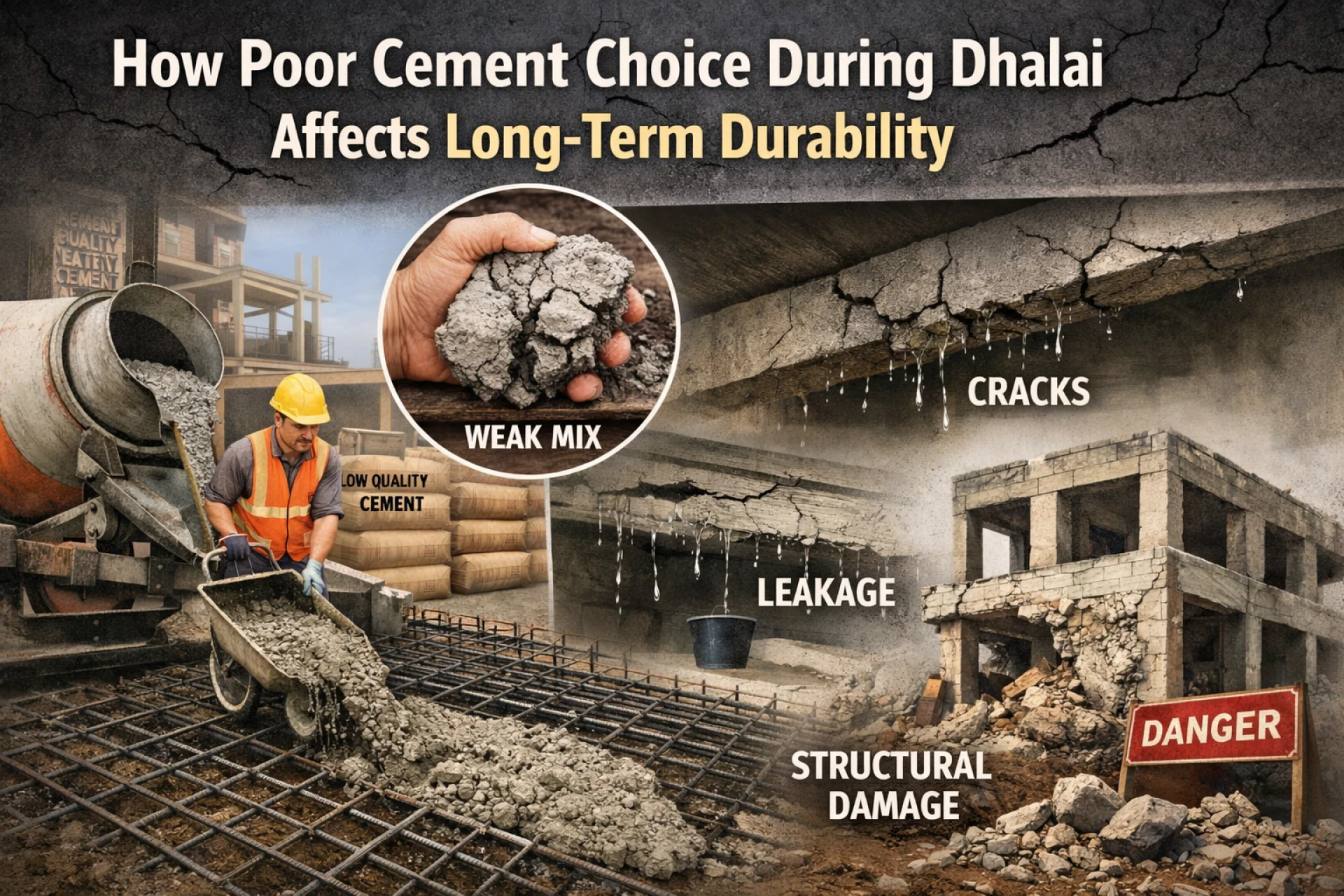
In the Indian construction industry, casting concrete, popularly referred to as ‘dhalai’ is among the most crucial stages of building construction. At this stage, the concrete mixture is laid, pressed down and left to dry to create structural components like slabs, beams, and columns. Although reinforcement design and aggregate grading gets a lot of technical consideration, the type of cement applied in casting has an equally conclusive influence on whether the structure will stand long-time.
The major hydraulic binder of concrete is cement. It reacts with water that results in the formation of strength and internal cohesion. Hence, if the chosen cement lacks the right chemical composition or physical properties, the hardened concrete could result in low mechanical performance and high susceptibility to the processes of deterioration. Unsuitable dhalai cement may consequently affect the performance and stability of a building.
Effect of Cement Composition on Strength Development
The hydration products that are produced upon the chemical reaction between water and cement are the main determinants of the strength of concrete. Compounds such as tricalcium silicate (C₃S) and dicalcium silicate (C₂S) contribute significantly to the formation of calcium silicate hydrate (C-S-H), which is the primary source of concrete strength.
The ratio and activity of these compounds when inferior dhalai cement is employed may not be ideal. Consequently the hydration process may be rendered inefficient and a weaker cement matrix is generated. This decreases the compressive strength and bonding of cement paste and aggregates. Moreover, components being cast in such conditions cannot attain the intended load-bearing capacity and hence pose long-term safety challenges to the slabs, support beams and other load-resisting components.
Impact on Porosity and Microstructure
A concrete is highly dependent on the density of the microstructure to determine its durability. The dense cement paste is formed by keeping the cement very hydrated and this forms a compact that has few capillary vacuoles and hence the concrete becomes less permeable. Substandard dhalai cement is known to produce irregular hydration and incomplete bonding compounds.
This leads to increased porosity of the hardened concrete. Permeability is enhanced by the existence of inter-linked pores and micro-voids, which enable water, oxygen and aggressive ions to permeate the mass of concrete. These internal pathways increase the deteriorating mechanisms such as leaching, carbonation, and sulfate attack.
Shrinkage and Crack Development
Shrinkage is a natural process in concrete which takes place when moisture is evaporated and hydration products are further formed. The degree of shrinkage however may vary with cement composition and fineness. Poor hydration behaviour and poor distribution of particles in the concrete can result in increased drying shrinkage since the unsuitable dhalai cement can be used.
Over shrinkage exerts tensile stress between the concrete mixtutre. The tensile strength of concrete is relatively low thus these stresses tend to cause micro-cracks. Such cracks when they first occur might seem minimal, but they serve as the point of access to the water and other elements of the environment. These micro-cracks grow over time, increase and influence structural performance as well as surface durability.
Reinforcement Corrosion and Permeability
One of the most critical durability concerns in reinforced concrete structures is corrosion of embedded steel reinforcement. Concrete is usually used to coat steel bars by its high level of alkalinity that creates a passive layer of oxide on the reinforcement surface. This protection is somehow effective only when the concrete is dense and impermeable.
Low quality of dhalai cement may also enhance the permeability of concrete which can lead to moisture and chloride ions permeability to the level of reinforcement. When the chlorides infiltrate the protective layer of concrete covering, it interferes with the passive layer surrounding the steel bars and causes corrosion. The development of rust causes corroded reinforcement to expand creating internal pressure on the concrete.
Less Resistance to Chemical and Environmental Attacks
Concrete buildings are constantly being subjected to environmental factors like changing temperature, groundwater contaminants and air pollution. The ability of concrete to resist these factors is highly dependent on the stability of the hydration products that are formed in the course of the curing process.
When the dhalai cement to be cast has impurities or unstable chemical compounds, the concrete that will be formed will be less resistant to chemical reactions. Hydration products can react with sulfate ions found in soil or groundwater to produce expansive compounds such as ettringite that cause internal expansion and cracking. In a similar way, the alkalinity of concrete may be decreased by penetration of carbon dioxide, which may undermine its ability to resist corrosion of reinforcement.
Impact on Long-Term Structural Performance
The cumulative effect of poor cement selection becomes more apparent as the structure ages. The compressive strength is minimized, permeability is maximized, and cracking increases all of which undermine the structural system. Elements like roof slabs and load-carrying beams can start experiencing indications of distress like deflection, surface disintegration, as well as loss of protective concrete cover.
Purchasing dhalai cement from a trusted manufacturer guarantees constant hydration, enhanced bonding to aggregates, and enhanced development of compressive properties. The characteristics are responsible for forming a denser and more resistant concrete matrix that is able to counteract the stresses of the environment and mechanical loads over long durations.
To Sum it up
In the construction of reinforced concrete, durability is a very important aspect that has to be done with a skilled consideration of the materials to be used in the construction before it is cast. The ultimate performance of concrete also depends on compatibility with aggregates, control of water- cement ratio and good curing habits.
Proper choice of dhalai cement during the first stage of construction assists to reduce the number of structural flaws, enhance the effectiveness of structural detrimental mechanisms, and the service time of the construction. Durability is not just a by-product of strength in modern day construction engineering; it is the outcome of scientifically selected materials and controlled building practices.
Finally, the cement used in the dhalai stage becomes a determining factor of the performance of the structure in the long term under mechanical loads and climate changes.