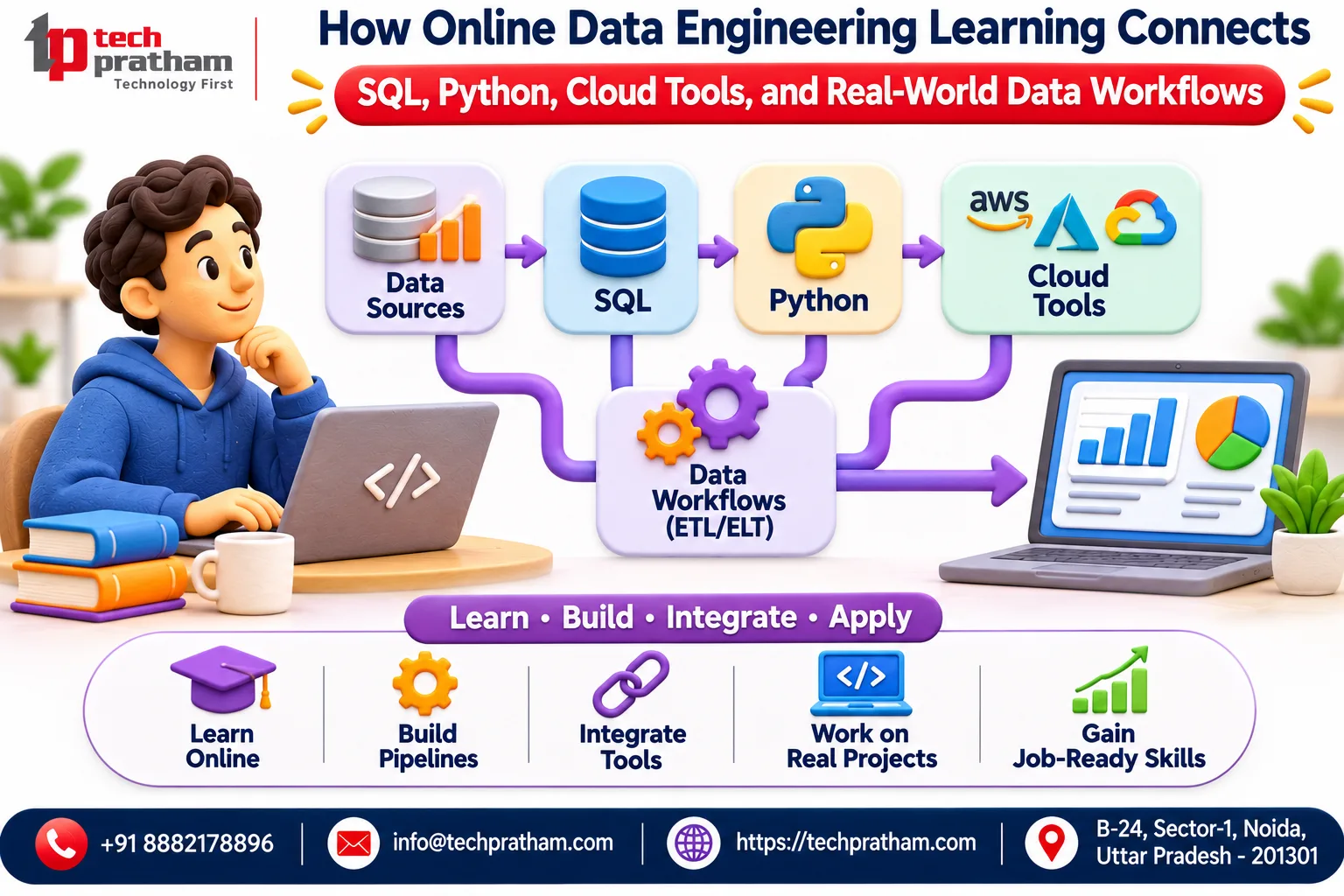
Many people begin exploring data engineering by searching for a list of tools to learn. They may encounter SQL, Python, data warehouses, cloud platforms, Apache Spark, and workflow orchestration. The challenge is understanding how these technologies relate to one another and why organizations use them together.
The answer becomes clearer when we look at a practical business requirement. A company might need to combine information from sales transactions, customer databases, and inventory systems to produce a reliable report. Each source contains only part of the picture, so the information must be collected, checked, transformed, and stored in a suitable format. This process connects the core concepts of data engineering and provides a useful framework for learning them online.
Data Engineering Course Online: How the Technologies Work Together
A Course should help learners understand how data moves through a complete workflow rather than teaching every technology in isolation. SQL is used to query and organize structured information. Python can automate processing tasks and connect different sources. Databases and analytical storage systems hold the resulting information, while pipeline tools coordinate the sequence of operations.
Consider Data Engineering Course Online, a retail company that wants a daily sales report. A workflow might collect order records, validate product identifiers, standardize dates, calculate summary values, and store the prepared information for reporting. Each technology supports one or more steps in that process. Understanding these relationships helps learners make more informed decisions about what to study first.
The First Layer: Collecting Data From Different Sources
Data can originate from relational databases, CSV files, JSON documents, APIs, business applications, and event logs. Before designing a workflow, it is important to understand the structure of the source and how frequently its information changes.
For a beginner project, a CSV file may be sufficient.
More advanced exercises could retrieve information from an API or combine records from multiple databases. Learners should consider questions such as which fields are required, whether identifiers are consistent, and what happens when the source format changes. These details affect how reliably downstream processing can operate.
The Second Layer: Transforming and Validating Information
Raw records often require preparation. Dates may use different formats, customer names may be inconsistent, and some transactions may contain missing values.
SQL and Python can help standardize records, combine tables, apply business rules, and identify problems. However, transformations should be designed around the intended use of the data rather than applied automatically without understanding their effect.
For example, removing duplicate transactions may require a clear definition of what makes a record unique. Simply deleting every repeated row could remove legitimate purchases. Data quality checks are therefore an important part of building dependable workflows.
The Third Layer: Choosing Storage and Data Models
Processed information needs a suitable destination. Relational databases support structured records and queries, while data warehouses are designed to organize information for analytical workloads. Data lakes can store a wide range of formats and data types.
Data modelling determines how entities and relationships are represented. A sales system might separate customers, products, orders, and order items into related tables instead of placing everything in a single large table. A practical Data Engineering Training in India programme should explain why these design choices matter and allow learners to apply them to example datasets.
The Fourth Layer: Orchestration and Automation
A single data transformation can be run manually, but a business workflow may need to execute repeatedly. Orchestration coordinates the order of tasks, schedules execution, and helps manage dependencies. Imagine a pipeline that cannot create a sales summary until the latest order data has been loaded and validated. The workflow should ensure that the earlier tasks finish successfully before the summary is generated.
Logging, failure notifications, retries, and monitoring can make these processes easier to maintain. Learners can start with basic automation before exploring specialized orchestration platforms.
Bringing the Components Together in a Project
A useful project could combine product information and daily order records. The pipeline would ingest both datasets, validate the inputs, standardize relevant fields, store the results, and create summary tables. To improve the project, add checks for missing files, unexpected columns, and inconsistent record counts. Document how each step works and how you would investigate a failure.
Once the local workflow is reliable, you could explore cloud storage or a cloud data warehouse. Distributed processing frameworks such as Apache Spark may be worth studying when the data volume or processing requirements justify them.
The objective is to understand the architecture before adding more tools.
How to Evaluate Online Learning Options
A Course may cover different technologies depending on the programme's intended level and scope. Before enrolling, check whether the syllabus builds from SQL and Python toward transformations, storage, pipeline development, and automation.
If you are considering Data Engineering Certification Training in India, verify the specific credential, examination requirements, and assessment format. Certification objectives should be clear rather than implied by general course descriptions. Also compare the amount of project work, technical support, and guided practice available.
Make Learning Practical and Connected
Data Engineering Course in India becomes easier to understand when every topic contributes to a working solution. SQL, Python, storage, transformation, and orchestration are not isolated skills; they are parts of a larger process.
Whether you choose classroom learning or online study, focus on building one complete workflow before moving to a more advanced architecture. A well-documented project can help you identify gaps in your knowledge, strengthen your understanding, and make future learning more purposeful.