

Whether you manage payroll, plan workforce budgets, or simply want to understand workload distribution, knowing the actual number of hours employees work annually is essential. It directly influences salary calculations, legal compliance, productivity analysis, and employee wellbeing.
This article breaks down annual working hours, explains different work models, and shows how modern HR systems help organizations track time more accurately.
What Is Considered a Standard Workweek?
The most widely used benchmark is the 40-hour workweek — typically 8 hours per day across 5 days.
However, the definition of “standard” varies depending on:
- National labor laws
- Industry requirements (healthcare, retail, manufacturing, IT, etc.)
- Organizational policies (fixed schedules vs. flexible hours)
Because regulations differ by region, HR teams must monitor maximum working hours, overtime limits, and mandatory rest periods to remain compliant.
Annual Working Hours: The Basic Formula
The simplest way to estimate yearly working time is:
Weekly hours × 52 weeks = Annual working hours
For a full-time employee:
40 × 52 = 2,080 hours per year
This is only a theoretical baseline. Once you subtract public holidays, paid leave, and sick days, the actual productive hours are lower.
Working Hours at a Glance
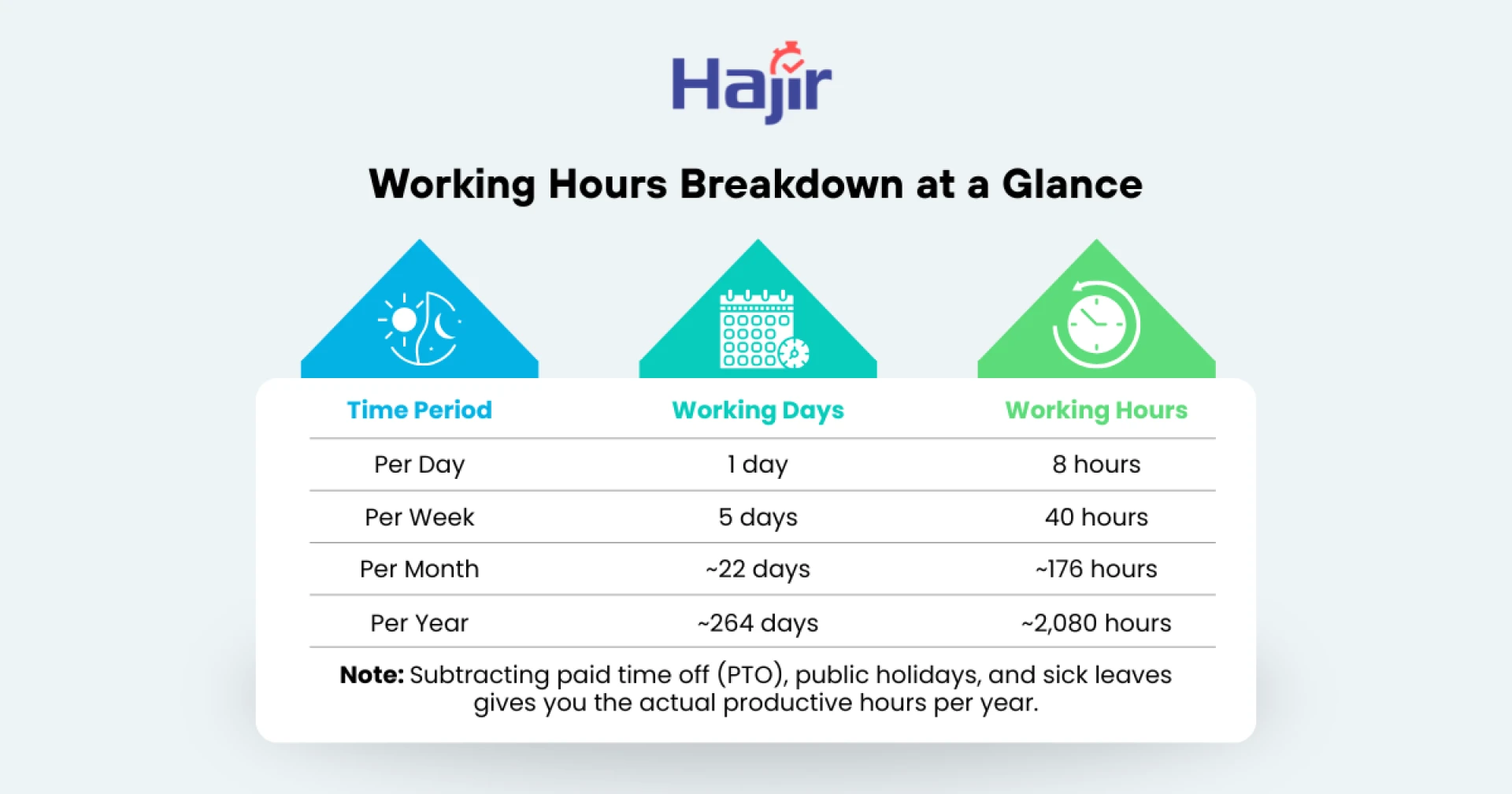
Actual productive hours depend on PTO, holidays, and absences.
Breaking Down the Work Calendar
1. Average Hours per Day
Globally, 8 hours per day is the norm, although sectors like healthcare and hospitality often operate longer shifts within legal limits.
2. Working Days per Week
Most businesses follow a Monday–Friday schedule, but construction, retail, and hospitality frequently run 6-day workweeks.
3. Working Days per Month
On average, employees work about 22 days per month, which equals roughly 176 hours.
4. Working Days per Year
A typical 5-day schedule results in around 264 working days annually before deducting leave and holidays.
Alternative Workweek Models
Modern organizations are moving beyond the traditional 9-to-5 structure.
1. Shift-Based Schedules
Common in hospitals, hotels, and call centers, shift systems divide the day into rotating time blocks. This model requires precise scheduling and overtime tracking.
2. Compressed Workweeks
Employees complete full weekly hours in fewer days (for example, four 10-hour shifts), gaining longer weekends without reducing total hours.
3. Four-Day (32-Hour) Workweek
This model focuses on output rather than time spent, often improving retention and reducing burnout.
4. Flexible Working Hours
Employees choose their start and end times while meeting total hour targets — popular in IT, consulting, and creative industries.
Legal Frameworks That Define Working Hours
Understanding labor law is critical for compliance. Here’s a high-level comparison:
- India: Factory workers are limited to 9 hours per day and 48 per week, with overtime paid at double rates.
- United States: The Fair Labor Standards Act (FLSA) requires overtime pay beyond 40 hours per week.
- United Kingdom: The Working Time Regulations cap the average workweek at 48 hours unless employees opt out.
- UAE: Private-sector employees typically work 8 hours per day, with limited overtime.
- Singapore: The Employment Act allows 8 hours per day or 44 per week, with overtime caps.
- Nepal: The Labor Act 2074 sets 8 hours per day and 48 per week, with 1.5× overtime pay and mandated rest days.
Why Tracking Annual Working Hours Matters
Accurate time tracking is more than a compliance task — it impacts core business operations:
- Payroll accuracy: Prevents underpayment or overpayment
- Workforce planning: Supports realistic budgeting and headcount decisions
- Employee wellbeing: Identifies overwork and burnout risks
- Legal protection: Helps avoid penalties and disputes
- Performance analysis: Connects hours worked with productivity outcomes
Organizations increasingly rely on digital time and attendance systems rather than manual spreadsheets to manage this complexity.
For example, tools like
👉 https://hajirhr.com/blog/time-and-attendance-management/
help automate attendance tracking and reduce payroll errors.
Similarly, selecting the
👉 https://hajirhr.com/blog/best-hr-software/
ensures working hours, leave, and overtime are calculated consistently.
And structured policies such as
👉 https://hajirhr.com/blog/leave-management-system/
make it easier to deduct non-working days from annual hour totals.
Example: Net Annual Working Hours
Let’s assume a standard schedule:
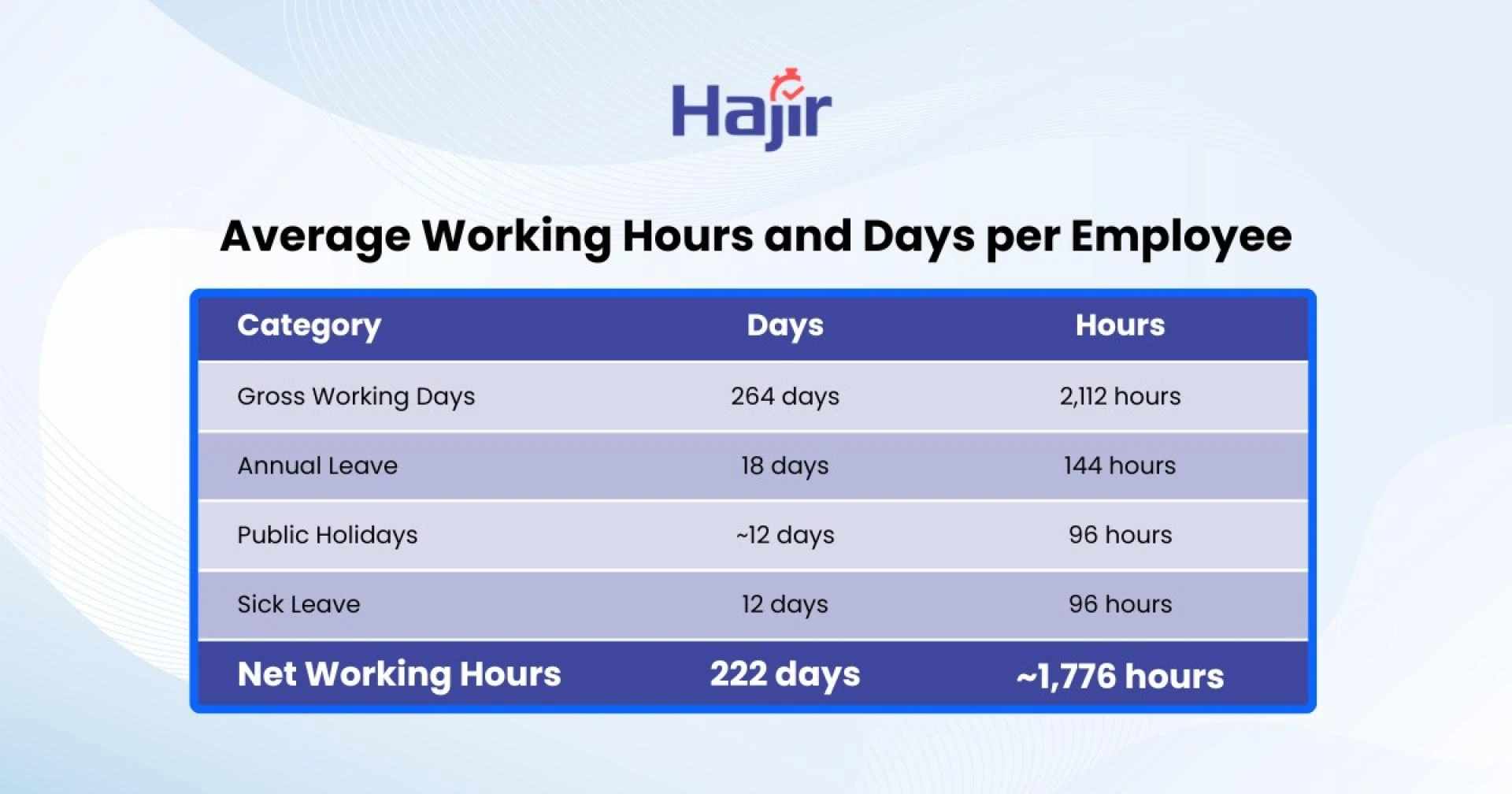
This “net” figure is what organizations should use for capacity planning and productivity analysis.
The Role of HR Technology in Time Tracking
Modern HR platforms automate:
- Real-time attendance capture (mobile, biometric, geofencing)
- Shift and roster planning
- Leave and holiday deductions
- Overtime calculations
- Payroll integration
- Workforce analytics and reporting
This eliminates manual calculations and provides accurate, audit-ready working hour data.
For a deeper look at attendance automation and workforce visibility, you can explore:
👉 https://hajirhr.com/blog/employee-attendance-system/
Final Thoughts
The commonly cited 2,080 hours per year is only a starting point.
Actual productive time depends on:
- Leave policies
- Public holidays
- Overtime patterns
- Shift structures
- Legal limits
For HR teams, understanding this difference is critical for payroll accuracy, compliance, and workforce planning.
As organizations adopt flexible schedules and global teams, data-driven time tracking is no longer optional — it’s a strategic necessity.