
ISO 9001 certification is one of those milestones that businesses often underestimate at the planning stage. The question that comes up almost every time, "How long will this actually take sounds simple, but the honest answer depends on factors that vary significantly from one organisation to the next.
For compliance officers and quality managers carrying the weight of the project, the timeline question is also a resource question. It drives decisions about staff allocation, budget approval, and when to book a certification body. Getting the estimate wrong in either direction creates problems too optimistic and the organisation arrives at Stage 1 underprepared; too conservative and the project loses momentum before it starts.
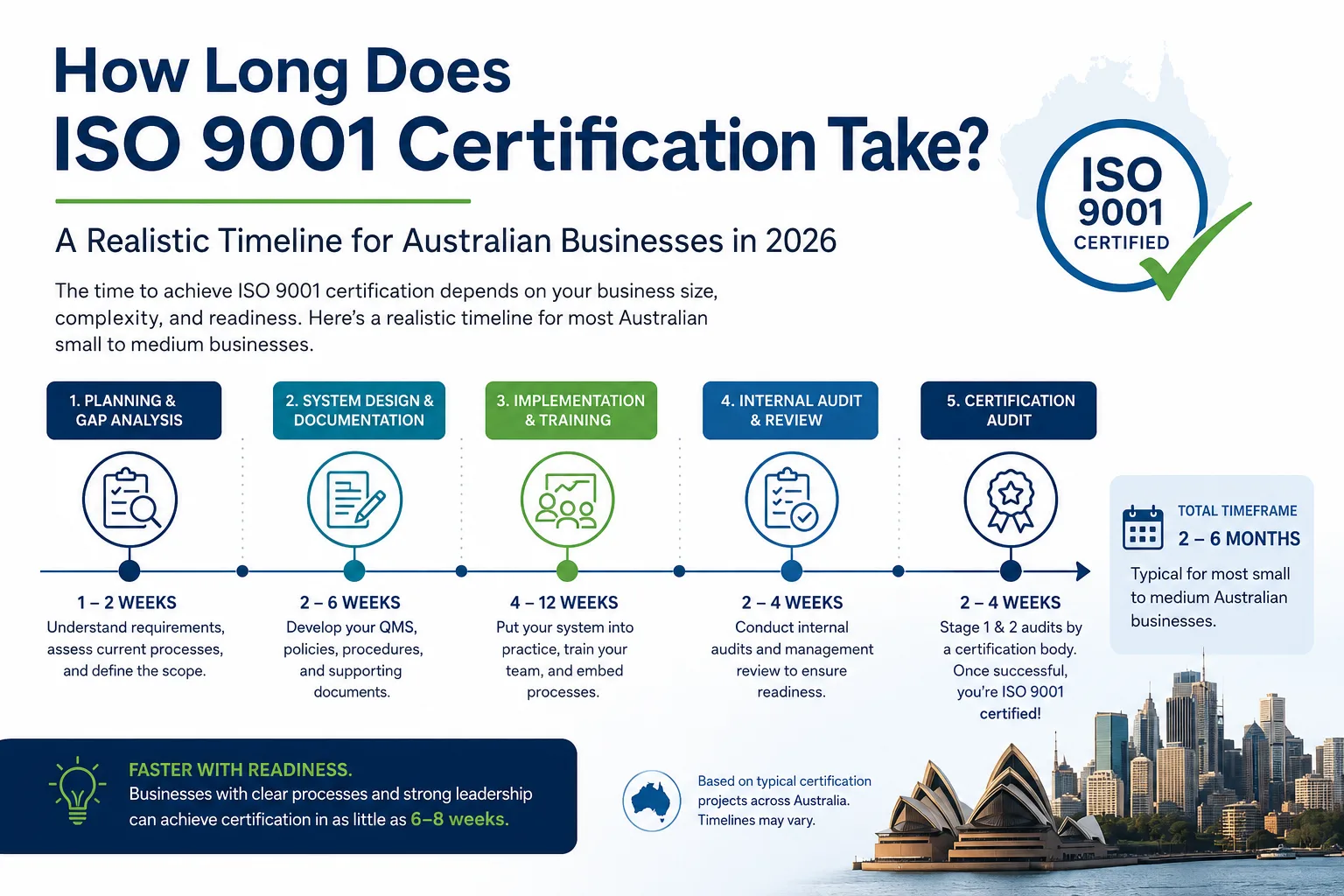
Based on practical experience with Australian businesses pursuing ISO 9001 certification across a range of industries and sizes, a realistic end-to-end timeline sits between six and eight months for most organisations. Some move faster. Some take longer. This article explains what drives that range and what compliance officers can do to stay at the faster end of it.
Why ISO 9001 Certification Timelines Vary Between Organisations
No two certification projects follow the same path, and that is not a problem; it is the nature of a standard that asks organisations to build a quality management system that reflects their actual context. The variables that drive timeline differences are predictable once you know what to look for.
Organisation size matters, but not in the way most people assume. A larger business does not necessarily take longer; it depends on how clearly responsibilities are defined. A 30-person team where everyone knows their role in the QMS can move faster than a 200-person business where the certification project lands on one person's desk and stays there.
Documentation maturity is a larger driver than size. Businesses that already operate with documented processes, even if they are not yet structured to ISO 9001:2015 clause requirements, have a genuine head start. The gap analysis phase is shorter, and the documentation development phase focuses on aligning what exists rather than building from scratch. Organisations with no documented processes should budget for additional months at the front end.
Industry complexity and the number of operating sites both extend timelines. A single-site service business has a narrower certification scope than a manufacturer operating across multiple facilities with distinct operational risks. The certification body will need to audit each site that affects both preparation time and the scheduling of the Stage 2 audit.
Top management engagement is the variable compliance officers have the least direct control over, and it is often the one that stalls projects. ISO 9001:2015 Clause 5 places explicit leadership obligations on top management not as a formality but as a structural requirement. When senior leaders treat the certification project as an administrative task delegated entirely to the compliance team, the system that gets built reflects that. Auditors notice.
A Realistic ISO 9001 Certification Timeline for Australian Businesses in 2026
The following phases reflect a well-managed certification project for a mid-sized Australian business with some existing process documentation. Organisations starting from a lower base should add one to two months at the front end. Those with mature systems may compress the early phases but should not rush the internal audit cycle.
Month 1: Gap Analysis and Project Planning
A structured gap analysis maps the organisation's current state against the requirements of ISO 9001:2015 clause by clause. This is not a documentation audit; it is an assessment of whether the organisation is actually operating in a way that could support each clause and where the genuine gaps are.
The output of a gap analysis is a project plan with realistic milestones and assigned ownership. Without this, the remaining phases tend to drift. Compliance officers who try to skip the gap analysis to save time almost always pay for it later, usually during internal audit preparation when undocumented gaps surface under pressure.
Months 1 to 3: Documentation Development and Process Alignment
ISO 9001:2015 Clause 7.5 requires documented information that supports the operation of the QMS. That phrase, "documented information," covers the quality policy, quality objectives, the scope of the QMS, and the documented processes the organisation determines are necessary for its own system. It is not a prescription for a particular volume of documentation.
The most common documentation error at this phase is writing procedures that describe how the organisation wishes it operated, rather than how it actually operates. When a Stage 2 auditor asks to observe a process and what they see does not match the procedure, that is a nonconformity. Writing accurate documented processes takes longer than writing aspirational ones, but the audit will test accuracy.
Process alignment also involves reviewing operational activities against the QMS scope established under Clause 4.3. If the scope is too narrow to capture what the organisation actually does, the certification will not reflect the business and clients and procurement teams asking to see the certificate may ask questions about what it covers.
Months 2 to 4: Staff Training and Implementation
Training under ISO 9001:2015 is addressed in Clause 7.2, which requires the organisation to determine the necessary competence of persons doing work that affects QMS performance. That is a narrower requirement than many businesses assume; it does not mean training everyone on the full standard. It means identifying which roles affect quality outcomes and ensuring those people have the competence to fulfill them.
Practical implementation in this phase means the documented processes are being followed, not just approved. This is where the gap between a paper system and an operational system becomes visible. Compliance officers managing this phase need regular check-ins with operational teams not to police compliance but to catch confusion early before it becomes an audit finding.
Months 3 to 5: Internal Audits and Corrective Actions
The internal audit is not a rehearsal for the certification audit. It is a requirement under Clause 9.2 and an independent mechanism for the organisation to evaluate whether its QMS conforms to its own requirements and the requirements of ISO 9001:2015. A well-run internal audit program surfaces nonconformities before an external auditor does, which is exactly what it is there for.
Corrective actions raised from internal audits need to be closed, not just opened. Clause 10.2 requires the organisation to determine the root cause of nonconformities and implement actions that prevent recurrence. Auditors reviewing corrective action records want to see the root cause analysis and evidence that the action was effective, not just a note that the problem was addressed.
This phase also typically includes the first formal management review under Clause 9.3. Management review is a governance process; it requires top management to review QMS performance using specific inputs (audit results, customer feedback, process performance, and others) and make decisions about resource allocation and improvement priorities. It is not a status meeting dressed up as a management review.
Months 5 to 6: Certification Audit Preparation
Pre-audit preparation is partly administrative and partly psychological. The administrative side means ensuring all documented information is current, corrective actions are closed with evidence, and the management review minutes reflect genuine discussion and decisions. The psychological side means the people who will be interviewed by the auditor understand what the audit involves and are not surprised by the process.
One practical point that often gets missed: JAS-ANZ accredited certification bodies book out, particularly in the second half of the calendar year. Engaging the certification body early before the internal audit cycle is complete is not premature. It secures a Stage 1 date that aligns with the project timeline rather than the body's availability window.
Months 6 to 8: Stage 1 and Stage 2 Certification Audits
The Stage 1 audit is a documentation review conducted by the certification body. The auditor assesses whether the organisation's QMS documentation demonstrates that the system is designed to meet ISO 9001:2015 requirements and whether the organisation is ready to proceed to Stage 2. Stage 1 findings that are not addressed before Stage 2 become Stage 2 nonconformities.
The Stage 2 audit is the implementation audit. The auditor samples the organisation's processes, interviews staff, reviews records and evidence, and makes an assessment of whether the QMS conforms to the standard and is effectively implemented. A Stage 2 audit that raises only minor nonconformities is a strong result; it means the system is working and the corrective action process is functioning as intended.
After initial certification, the 3-year cycle begins: annual surveillance audits to verify the system continues to operate effectively, followed by a full recertification audit in year three. Organisations that maintain their QMS actively between audits find the surveillance cycle manageable. Those that let the system drift tend to feel the weight of it at recertification.
Common Delays That Extend the ISO 9001 Certification Process
Most certification projects that run significantly over time share the same few causes. Recognising them early is more useful than trying to recover from them later.
Lack of management engagement is the most common and most consequential cause. When top management does not actively support the certification project by attending management reviews, signing off on the quality policy, making resourcing decisions, the system that gets built is a compliance exercise rather than a functioning QMS. That distinction shows up clearly in a Stage 2 audit.
Incomplete or inaccurate documentation is the second most frequent cause. The issue is rarely a shortage of documentation; it is documentation that was written quickly to meet a milestone rather than to accurately reflect operational reality. Auditors ask to observe processes and review records. When the procedure says one thing and the evidence shows another, that is a nonconformity that requires a corrective action before certification can proceed.
Delayed corrective actions are a signal worth taking seriously. If the internal audit raises nonconformities that are still open at Stage 1, the Stage 1 report will note them. If they remain open at Stage 2, they become Stage 2 findings. The corrective action process is not a separate administrative task; it is evidence that the QMS is functioning as a system and not just as a document library.
Poor communication between departments creates a specific kind of problem during Stage 2 audits. When the compliance team knows the system well but operational staff in other areas cannot describe the processes they follow or locate the documented information they are supposed to use, the auditor draws the reasonable conclusion that the system is not embedded. That is a finding, regardless of how comprehensive the documentation is.
How Compliance Officers Can Keep the ISO 9001 Certification Project on Track
The compliance officer's role in a certification project is rarely limited to documentation. In practice, it tends to include project coordination, stakeholder management, internal audit scheduling, corrective action tracking, and liaison with the certification body. Managing all of those simultaneously requires a project structure that is explicit about who is responsible for what.
Document control under Clause 7.5 is worth getting right from the start rather than retrofitting later. That means establishing a version control process, a review and approval workflow, and a clear method for making current documents accessible to the people who need them. The specific tools are less important than the consistency. An organisation that uses a shared folder with clear naming conventions and disciplines itself to follow the process will pass a document control audit. One that uses sophisticated software with inconsistent controls may not.
Internal audit scheduling should be planned for the full audit cycle, not just the pre-certification period. A single internal audit before Stage 2 satisfies the minimum requirement, but a programme that audits different areas of the QMS over a rolling schedule is more defensible and more useful. It distributes the workload and creates an ongoing record of system performance.
Stakeholder engagement across departments is more effective when the certification project has visible senior sponsorship. Compliance officers who can point to active management involvement a signed quality policy, a management review with minutes that reflect genuine decisions, resource commitments that are followed through find it easier to secure cooperation from operational teams. The certification project is harder to deprioritise when the people at the top are visibly committed to it.
Audit readiness preparation in the weeks before Stage 1 should include a walkthrough with the people who will be interviewed. Not a rehearsal with scripted answers; that approach tends to backfire when auditors ask follow-up questions. The goal is to ensure that staff who are likely to be spoken to understand what the audit involves, can describe their work in relation to the QMS, and know where to find relevant documented information.
What Australian Businesses Should Expect from ISO 9001 Certification in 2026
The expectations of certification bodies and the businesses that engage them have shifted over the past few years. Auditors are spending more time on risk management evidence, not just whether the organisation has completed a risk register, but whether it has determined meaningful risks and opportunities under Clause 6.1 and has genuine plans for addressing them.
Process consistency is scrutinised closely in 2026 in a way it was not always handled in earlier audit cycles. An organisation that can demonstrate consistent outputs across its key processes supported by monitoring data, internal audit results, and customer feedback presents a stronger case than one that can show a well-designed system with limited evidence of how it actually performs.
Evidence-based decision making is a principle embedded throughout ISO 9001:2015, and auditors look for it in management review records, corrective action analyses, and quality objective reviews. The question is whether the organisation is making decisions about its QMS based on data and analysis, or based on habit and assumption. The standard expects the former.
Continual improvement under Clause 10.3 is not about doing more each year; it is about demonstrating that the organisation has a functioning mechanism for identifying improvement opportunities and acting on them. Australian businesses pursuing government contracts and supply chain positions where ISO certification is a procurement requirement will find that a certification supported by genuine continual improvement evidence carries more weight than one that was achieved and then maintained minimally.
Frequently Asked Questions About ISO 9001 Certification Timelines
Can ISO 9001 certification be achieved in less than 6 months?
It is possible for organisations with mature, well-documented processes to achieve certification in less than six months, but it is uncommon for businesses starting with limited documentation or low QMS awareness. The more practical risk is that rushing the process produces a system that passes the initial audit but struggles to sustain itself through the first surveillance cycle. The timeline should be driven by implementation readiness, not by a target date.
How much does ISO 9001 certification cost for an Australian business?
Costs vary significantly depending on organisation size, operational complexity, number of sites, the certification body selected, and whether the business uses an external consultant to support implementation. Attempting to compare quotes without accounting for scope differences is rarely useful. Any estimate should clearly specify what is included: consultant hours, certification body fees, Stage 1 and Stage 2 audit costs, and surveillance audit fees over the three-year cycle.
What happens if the Stage 2 audit raises major nonconformities?
A major nonconformity at Stage 2 means certification cannot be granted until the nonconformity has been resolved and verified by the certification body. The organisation will need to address the root cause, implement corrective action, and provide evidence of effectiveness. Depending on the certification body's process, this may be verified through a follow-up visit or through documented evidence submitted for review. It extends the timeline but does not require restarting the process from Stage 1.
Does ISO 9001 certification need to be renewed?
ISO 9001 certification operates on a three-year cycle with annual surveillance audits. After the third year, a full recertification audit is required to maintain the certificate. Surveillance audits are typically less extensive than the initial Stage 2 audit but still involve sampling of the QMS and review of performance data, corrective actions, and management review records. Organisations that maintain an active QMS find the surveillance cycle straightforward. Those that only activate their system before each audit do not.
How do I choose a certification body for ISO 9001 in Australia?
Select a certification body that holds JAS-ANZ accreditation specifically for ISO 9001. The JAS-ANZ register is the primary reference for verifying accreditation status and scope. A certification body may be accredited for ISO 9001 but not for ISO 14001 or ISO 45001. If you are pursuing multiple standards, check the scope for each. Certificates issued by non-JAS-ANZ accredited bodies may not be accepted by clients, procurement teams, or government contract requirements.
ISO 9001 Certification Is Built on Implementation, Not Speed
For most Australian businesses, a realistic ISO 9001 certification timeline runs six to eight months from gap analysis to Stage 2 completion. That estimate assumes adequate resourcing, management engagement, and disciplined documentation and internal audit processes. Compress any of those, and the timeline either extends or the system that results is weaker than it should be.
The businesses that achieve certification and sustain it through the surveillance cycle are not the ones that moved fastest. They are the ones that built a quality management system that reflects how they actually operate, invested in embedding it across the organisation, and treated the audit as a verification of something real rather than a performance of compliance.
If you are at the planning stage or partway through an implementation that has stalled, the ISO 9001 certification process is well understood, and the path through it is clear. What varies is how well-prepared the organisation is when it arrives at the audit.