When setting up a projector, placement plays a critical role in determining image quality, alignment, and overall viewing experience. Two of the most important specifications that influence projector placement are lens zoom and throw ratio. Understanding how these elements work together ensures accurate installations and avoids common projection issues. XTEN-AV provides advanced tools that help AV professionals and users calculate these factors precisely, enabling better design decisions for any space. Whether it is a classroom, home theater, or corporate boardroom, placement determines performance. For many buyers, it often comes down to comparing Video Wall vs Projector solutions to find the best fit for their specific needs.
Introduction to Lens Zoom and Throw Ratio
Projectors use optical lenses to focus and adjust the size of the projected image. Lens zoom and throw ratio define how large the image will be and how far the projector should be placed from the screen.
- Lens Zoom: Refers to the projector’s ability to adjust the image size without moving the projector itself. A zoom lens provides flexibility, allowing you to fine-tune image dimensions after installation.
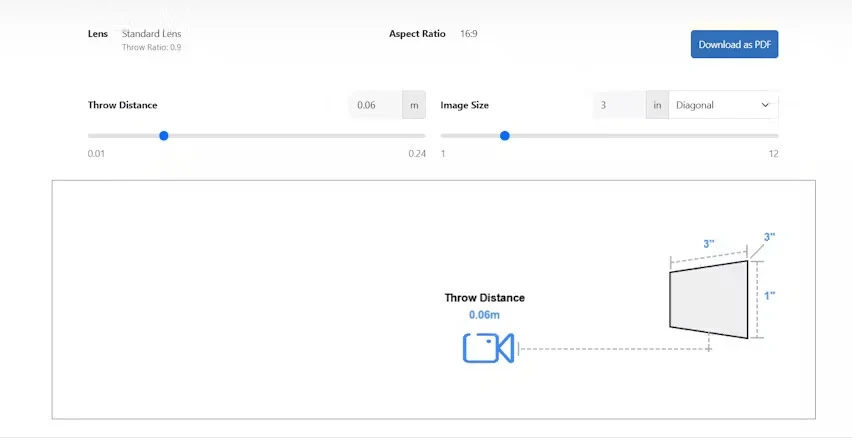
- Throw Ratio: Indicates the relationship between the distance from the projector to the screen and the width of the projected image.
A clear understanding of these two specifications helps determine the most suitable projector for your space and ensures the best image quality.
What Is Throw Ratio
Throw ratio is typically expressed as a number, such as 1.5:1. This means the projector must be 1.5 feet away from the screen for every foot of image width.
The formula is simple:
Throw Ratio = Distance from Projector to Screen ÷ Image Width
For example, if you have a 100-inch-wide screen and a projector with a throw ratio of 1.5:1, the ideal placement distance is 150 inches.
Different projectors come with different throw ratios:
- Standard Throw (1.5:1 to 2.0:1): Common for large rooms and home theaters.
- Short Throw (0.4:1 to 1.0:1): Ideal for smaller rooms or interactive setups.
- Ultra Short Throw (below 0.4:1): Perfect for very small spaces or when wall-mounting close to the screen.
Why Throw Ratio Matters
The throw ratio determines how flexible your placement options are. If your room is long and spacious, a standard throw projector works well. In compact spaces, a short or ultra-short throw projector is necessary to achieve a large image without placing the projector too far away.
Incorrect placement can lead to several issues:
- The image may not fill the screen properly.
- Keystone distortion may occur if the projector is at an awkward angle.
- Brightness and sharpness can degrade if the projector is placed too far from the optimal distance.
Understanding Lens Zoom
Lens zoom provides the ability to adjust the image size without moving the projector. This feature is particularly useful during installation or when the exact projector distance is not fixed.
For example, a projector with a 1.2x to 2.0x zoom allows a wide range of placement flexibility. You can mount it closer or farther within the zoom range and still achieve the desired image size.
Benefits of lens zoom include:
- Greater flexibility in projector placement.
- Easier alignment with pre-existing screens.
- Ability to adjust image size for different events or content.
Projectors with motorized zoom and lens shift features offer even more precise control, making them ideal for professional AV installations.
How Lens Zoom and Throw Ratio Work Together
Throw ratio sets the baseline for how far the projector needs to be placed, while lens zoom allows for fine-tuning within that range.
For example, a projector with a throw ratio of 1.5–2.0:1 and a 100-inch-wide screen can be placed anywhere between 150 and 200 inches away. The zoom lens allows you to adjust the image size to fit the screen perfectly within that distance range.
This combination is crucial for installations where the projector cannot be mounted at an exact distance, such as rooms with structural limitations or ceiling restrictions.
Projector Placement Scenarios
- Fixed Installation in a Large Room
- A standard throw projector with a moderate zoom range works well. Mounting it at the calculated distance ensures a crisp image without distortion.
- Small Classrooms or Conference Rooms
- Short throw projectors minimize shadows and glare. A moderate zoom allows small placement adjustments without moving the unit.
- Multipurpose Event Spaces
- A projector with a wide zoom range provides the flexibility to adjust image sizes for various event layouts and seating arrangements.
- Home Theater Setups
- Lens zoom is valuable for aligning the image perfectly on fixed screens without constant repositioning.
Comparing Video Wall vs Projector Placement
Video walls do not rely on throw ratios or zoom lenses. Each panel displays part of the overall image, and the system is installed flush to the wall. This simplifies placement but requires structural support and power management.
Projectors, on the other hand, demand precise calculations for throw ratio and zoom to avoid misalignment. While video walls deliver consistent brightness and resolution, projectors offer more flexibility in terms of screen size and placement options.
Choosing between these options depends on the intended application, budget, and installation environment.
Common Mistakes to Avoid
- Ignoring throw ratio during purchase: Always match the projector’s throw ratio to your room size and screen dimensions.
- Relying only on keystone correction: Keystone correction can reduce image quality; proper placement is better.
- Not considering zoom range: A limited zoom may restrict your mounting options and require extra adjustments.
- Skipping simulations: Tools like those provided by XTEN-AV help visualize placement before installation, avoiding costly errors.
Conclusion
Lens zoom and throw ratio are two critical factors that directly affect projector placement and image performance. Understanding these specifications allows you to choose the right projector for your space, ensuring clear, sharp, and well-aligned visuals.
While Video Wall vs Projector comparisons focus on brightness, maintenance, and long-term performance, proper placement remains essential for projectors to perform at their best. XTEN-AV offers advanced tools to calculate and simulate placement, making it easier to design accurate projection setups without guesswork. By taking lens zoom and throw ratio into account early in the planning process, you can achieve a professional and visually impressive installation every time.
Read more: https://articlefun.com/how-to-measure-projector-throw-distance-before-buying/