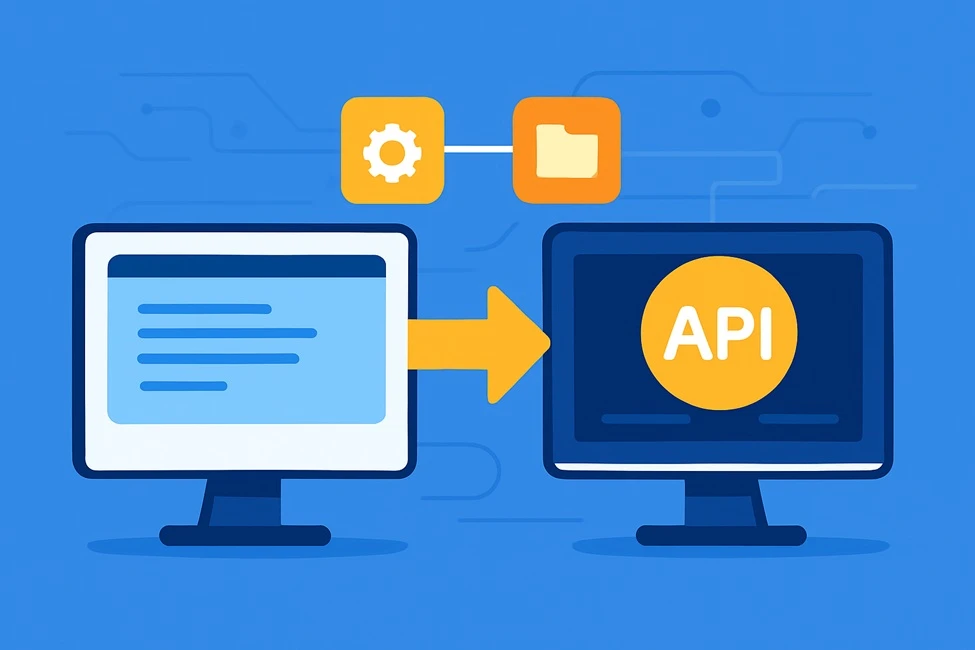
In today’s interconnected digital world, applications rarely work in isolation. They rely on smooth and efficient communication with other systems to share data, trigger processes, and deliver meaningful experiences to end users. This is where interfaces play a critical role. From handling data exchange to enabling complex workflows, interfaces define the rules of interaction between applications. Many professionals explore concepts such as MCP vs API to understand the underlying mechanisms of communication. Still, at the core, interfaces provide the foundation for interoperability across diverse environments.
The Importance of Interfaces in Modern Software
Every piece of software, whether it is a simple mobile app or a large enterprise system, depends on communication. Interfaces act as the structured channels that allow two or more systems to exchange information effectively. They eliminate the need for developers to understand every internal detail of another application by providing standardized methods of interaction.
Without clear interfaces, integrating applications would be time-consuming and prone to errors. According to a 2023 Gartner report, more than 65% of enterprises rank application integration among their top IT priorities, highlighting the critical role of well-designed interfaces in maintaining business agility.
How Interfaces Enable Seamless Communication
At a fundamental level, an interface is a contract. It specifies what data can be exchanged, in what format, and under which conditions. This contract reduces ambiguity and ensures that applications with different architectures, languages, or platforms can still interact.
Consider an e-commerce platform that needs to connect with payment gateways, shipping partners, and customer relationship management systems. Each of these integrations depends on interfaces to ensure transactions are processed securely, shipping updates are delivered accurately, and customer records remain consistent.
Interfaces also enhance flexibility. When systems are loosely coupled through well-defined interfaces, businesses can replace or upgrade individual components without disrupting the entire ecosystem. This modularity is essential for organizations pursuing digital transformation and cloud adoption strategies.
The Evolution of Application Communication
Application communication has evolved dramatically over the past few decades. In earlier systems, interactions were often hard-coded and rigid, making integration a costly endeavor. Over time, structured interfaces emerged as a solution, bringing greater consistency and predictability.
During the early 2000s, service-oriented architecture (SOA) became a popular model, relying heavily on standardized interfaces like SOAP (Simple Object Access Protocol). Today, lightweight approaches such as RESTful APIs and event-driven architectures dominate the landscape, driven by the rise of cloud computing and microservices.
A 2022 report from Postman’s State of the API survey found that over 89% of developers used APIs daily, and the reliance on well-defined interfaces continues to grow as applications become increasingly distributed. This demonstrates that the success of modern software ecosystems depends heavily on seamless interface-driven communication.
Interfaces and Data Consistency
One of the primary benefits of interfaces is maintaining data consistency across multiple systems. When data flows through interfaces, rules are enforced to ensure that formats and structures remain uniform. This is particularly important in industries such as healthcare and finance, where inaccurate data exchange can have severe consequences.
For example, healthcare applications must comply with strict standards like HL7 and FHIR, which define how patient data is shared between electronic health record systems. Interfaces based on these standards ensure that vital information is transmitted accurately and securely, supporting patient safety and regulatory compliance.
Interfaces in Cloud-Native and Microservices Architectures
As organizations adopt cloud-native technologies, the reliance on interfaces becomes even more pronounced. Microservices, by design, break down applications into smaller independent units. Each microservice communicates with others through an interface, often implemented via APIs or message queues.
This distributed model increases scalability and resilience but also highlights the importance of well-governed interfaces. Suppose communication contracts are poorly defined or inconsistently managed. In that case, the result can be fragmented systems that are difficult to monitor and maintain.
Research by IDC suggests that by 2025, over 90% of new digital applications will be developed using microservices architectures, underscoring the growing relevance of interfaces in application communication.
Challenges in Interface-Driven Communication
While interfaces bring significant benefits, they also introduce challenges. Common issues include versioning conflicts, security vulnerabilities, and performance bottlenecks. If an interface changes without proper backward compatibility, connected applications may fail to function correctly.
Security is another concern. Interfaces often expose endpoints that could be exploited by malicious actors if not properly secured. According to IBM’s 2023 Cost of a Data Breach report, misconfigured interfaces and insecure APIs were among the top causes of breaches in cloud environments.
Managing these risks requires robust governance, continuous monitoring, and adherence to industry best practices. Organizations must establish clear policies for interface design, implementation, and maintenance to avoid operational disruptions.
The Human Side of Interfaces
Beyond the technical aspects, interfaces also influence collaboration between teams. By providing a common language for interaction, they reduce misunderstandings and accelerate development cycles. Development teams, operations teams, and business stakeholders can all align around the behaviors defined by an interface.
This shared understanding fosters efficiency. For example, when developers know the exact input and output requirements of an interface, they can work independently on different parts of the system, confident that integration will function as expected.
Future Trends in Application Communication
Looking ahead, interfaces will continue to evolve as new technologies emerge. Artificial intelligence and machine learning are expected to play a growing role in optimizing communication patterns and automating integration tasks.
Event-driven and real-time communication will also gain prominence. As businesses demand faster responses and greater personalization, interfaces will need to handle higher volumes of data with minimal latency.
Another emerging trend is the rise of low-code and no-code platforms, which rely heavily on pre-built interfaces to connect with external services. These platforms are empowering business users to create workflows without deep technical expertise, further expanding the importance of accessible and reliable interfaces.
Conclusion
Interfaces are the invisible backbone of modern software ecosystems. They shape how applications communicate, ensuring consistency, security, and flexibility in increasingly complex environments. From enabling data exchange in healthcare to supporting cloud-native microservices, interfaces define the rules of interaction that make digital transformation possible.
As enterprises continue to adopt new technologies and architectures, the role of interfaces will only grow more significant. Organizations that prioritize interface design and governance will be better positioned to innovate, integrate seamlessly, and deliver superior experiences to their users.