AI-powered chatbots have become an essential part of modern customer engagement, helping businesses automate conversations, answer queries, and provide personalized support. However, delivering accurate responses requires more than understanding individual words or recognizing frequently used phrases. Chatbots must identify what users actually want to accomplish. This is where intent classification plays a critical role.
Intent classification enables AI systems to interpret the purpose behind a user's message and determine the appropriate response or action. Whether someone wants to track an order, request a refund, schedule an appointment, or troubleshoot a technical issue, recognizing the underlying intent helps chatbots deliver relevant and context-aware responses.
As conversational AI continues to evolve, high-quality training data and structured text annotation have become essential for improving chatbot performance. Businesses increasingly rely on professional text annotation outsourcing services to develop reliable datasets that support accurate intent recognition and more effective conversational experiences.
What Is Intent Classification in AI Chatbots?
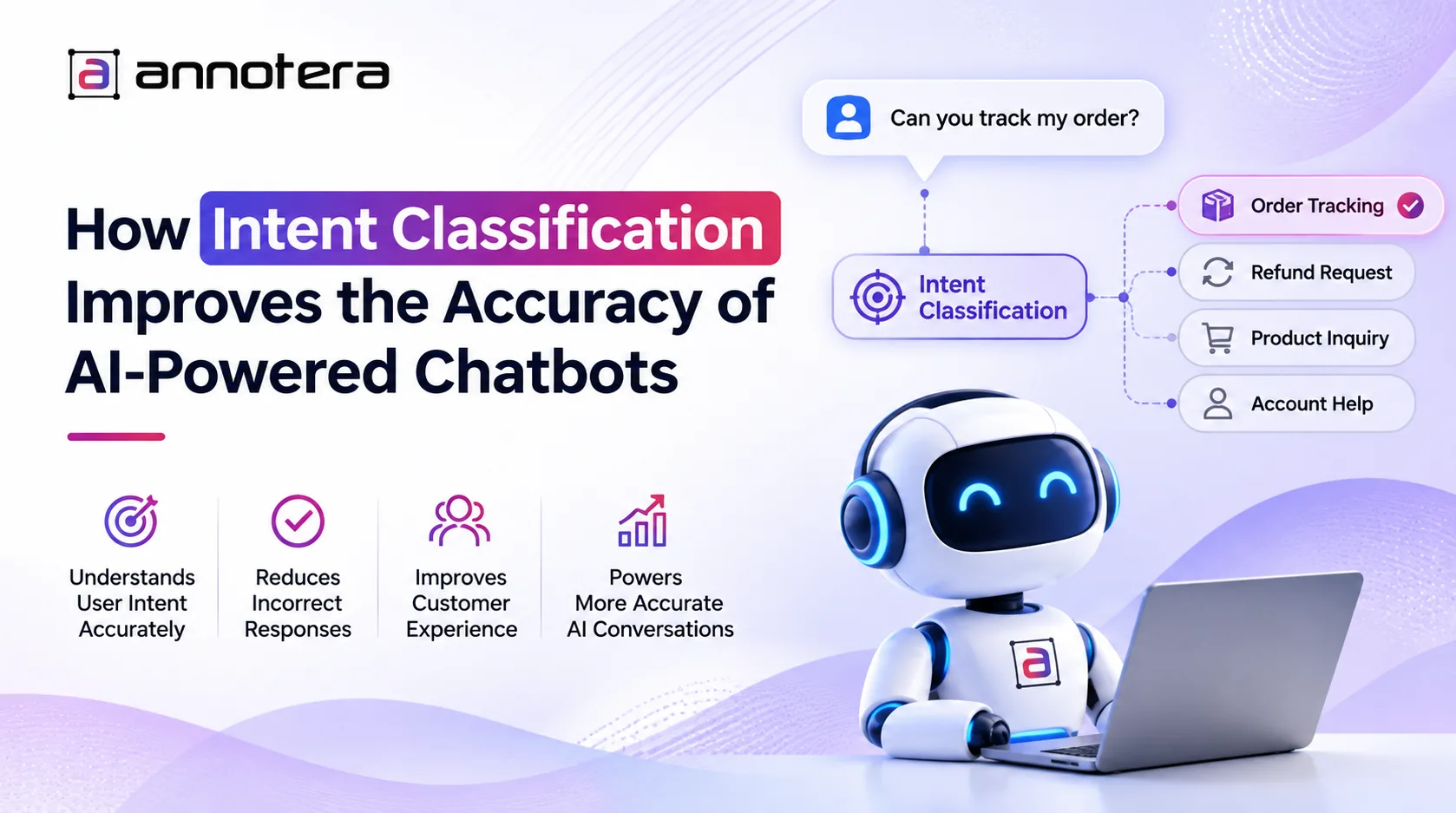
Intent classification is a Natural Language Processing (NLP) technique that identifies the objective or purpose behind a user's input. It categorizes conversational messages into predefined intent labels, allowing chatbots to understand what users are trying to communicate.
For example, consider these messages:
- "Where is my package?"
- "Can you check my delivery status?"
- "When will my order arrive?"
Although the wording differs, all three messages express the same intent: Order Tracking.
Similarly, messages such as "I want my money back" and "How can I request a refund?" can be classified under the Refund Request intent.
By mapping different expressions to meaningful categories, intent classification helps chatbots move beyond basic keyword matching and understand the purpose of conversational inputs.
1. Improves User Query Understanding
One of the biggest challenges in chatbot development is understanding the different ways people express the same requirement. Users rarely follow standardized sentence structures. They frequently use abbreviations, informal language, incomplete sentences, spelling variations, and conversational expressions.
Intent classification helps AI chatbots recognize these variations and associate them with the correct intent.
For example, a customer might write "Need to change my booking," "Can I reschedule?" or simply "Move my appointment." A well-trained chatbot should recognize that all three messages relate to appointment modification.
Achieving this level of understanding requires diverse and accurately labeled training examples. Professional text annotation services help create datasets containing different linguistic patterns, enabling AI models to recognize user intentions more consistently.
2. Reduces Incorrect Responses and Misinterpretations
An inaccurate chatbot response can frustrate customers and negatively affect their experience. When a chatbot misunderstands a request, it may provide irrelevant information, direct users to the wrong service, or initiate an inappropriate workflow.
Intent classification reduces these problems by assigning incoming messages to relevant intent categories before generating a response.
For instance, consider the difference between "I want to cancel my subscription" and "Why was my subscription cancelled?" Although both messages contain similar keywords, their intentions are different. The first indicates a cancellation request, while the second seeks an explanation.
A properly trained intent classification model can distinguish between these requests and route them to the appropriate conversational workflow.
This improves response relevance, reduces unnecessary conversation loops, and helps businesses deliver more dependable automated customer support.
3. Enhances Contextual Understanding in Conversations
Customer conversations rarely consist of isolated questions. Users often provide additional information, clarify previous statements, or change their requirements during an interaction.
For example:
User: "I need help with my order."
Chatbot: "What would you like to know about it?"
User: "I want to return it."
The chatbot must recognize that the second message provides additional context and expresses a return request.
Context-aware intent classification helps conversational AI systems interpret messages based on previous interactions rather than analyzing every sentence independently.
Training datasets should therefore include multi-turn conversations, contextual variations, follow-up questions, and ambiguous expressions. A reliable text annotation company can help organize these examples into structured datasets that improve conversational understanding.
4. Supports Better Personalization and Customer Experience
Modern customers expect chatbots to provide relevant assistance without requiring them to navigate multiple menus or repeat information.
Intent classification makes personalization more effective by identifying customer requirements and directing conversations toward suitable responses.
For example, an e-commerce chatbot can distinguish between customers looking for product recommendations, checking delivery updates, requesting exchanges, or asking about payment methods.
Once the intent is identified, the chatbot can provide relevant product information, retrieve order details, or initiate the appropriate support process.
This creates smoother interactions and reduces the effort required from customers. It also enables businesses to automate repetitive support tasks while maintaining a more personalized communication experience.
5. Improves Multilingual and Informal Language Recognition
Businesses serving international audiences must handle conversations across multiple languages, regional expressions, and communication styles.
A chatbot trained primarily on formal English may struggle to understand slang, regional vocabulary, code-switching, or informal messages.
For example, users might combine English with local language expressions or use shortened phrases when communicating through messaging platforms.
High-quality intent classification datasets should account for these linguistic differences. Text annotation outsourcing services can support this process by organizing multilingual conversational data, identifying relevant intent categories, and maintaining consistent annotation guidelines.
This helps AI models recognize user requirements across different communication styles and improves their ability to serve diverse customer groups.
6. Strengthens Chatbot Training Through High-Quality Text Annotation
The accuracy of an intent classification model depends heavily on the quality of its training data. Incorrect labels, inconsistent categories, insufficient examples, and overlapping intents can negatively affect model performance.
Text annotation provides the structured supervision required to train machine learning models effectively.
A professional text annotation company can support chatbot development through several important activities:
- Intent labeling: Assigning predefined intent categories to conversational messages.
- Entity annotation: Identifying important information such as product names, dates, locations, and order numbers.
- Sentiment annotation: Recognizing emotional signals such as frustration, satisfaction, or urgency.
- Utterance categorization: Organizing different sentence structures and linguistic variations under relevant intent labels.
- Quality assurance: Reviewing annotated datasets to identify inconsistencies, ambiguous labels, and classification errors.
Combining these annotation practices helps businesses develop more representative datasets and improve the reliability of conversational AI systems.
7. Enables Continuous Chatbot Improvement
User behavior, product offerings, and customer expectations change over time. Consequently, chatbot training datasets must evolve to accommodate new queries, emerging terminology, and previously unidentified user intentions.
For example, a banking chatbot may initially support balance inquiries and fund transfers. As its capabilities expand, it may need to recognize new intents related to digital payments, card disputes, or financial product inquiries.
Analyzing real-world conversations helps businesses identify frequently misunderstood queries and discover missing intent categories.
These insights can be incorporated into updated training datasets through continuous annotation, validation, and model evaluation.
A structured approach to dataset improvement helps chatbots remain relevant as customer requirements evolve.
Conclusion
Intent classification is a fundamental component of accurate and reliable AI-powered chatbots. By identifying the purpose behind conversational messages, it enables AI systems to understand user requirements, reduce misinterpretations, improve contextual awareness, and deliver more relevant responses.
However, effective intent recognition depends on diverse, consistent, and accurately labeled training datasets. Partnering with an experienced text annotation company can help businesses build high-quality datasets that strengthen chatbot intelligence and conversational performance.
At Annotera, we support AI development through structured text annotation solutions designed to improve language understanding and model accuracy. Our annotation capabilities help businesses prepare reliable training datasets for intent classification, NLP applications, and advanced conversational AI systems.
Build Smarter Conversational AI with Annotera. Explore our professional text annotation outsourcing services to develop high-quality training data and create AI-powered chatbots that understand users more accurately.