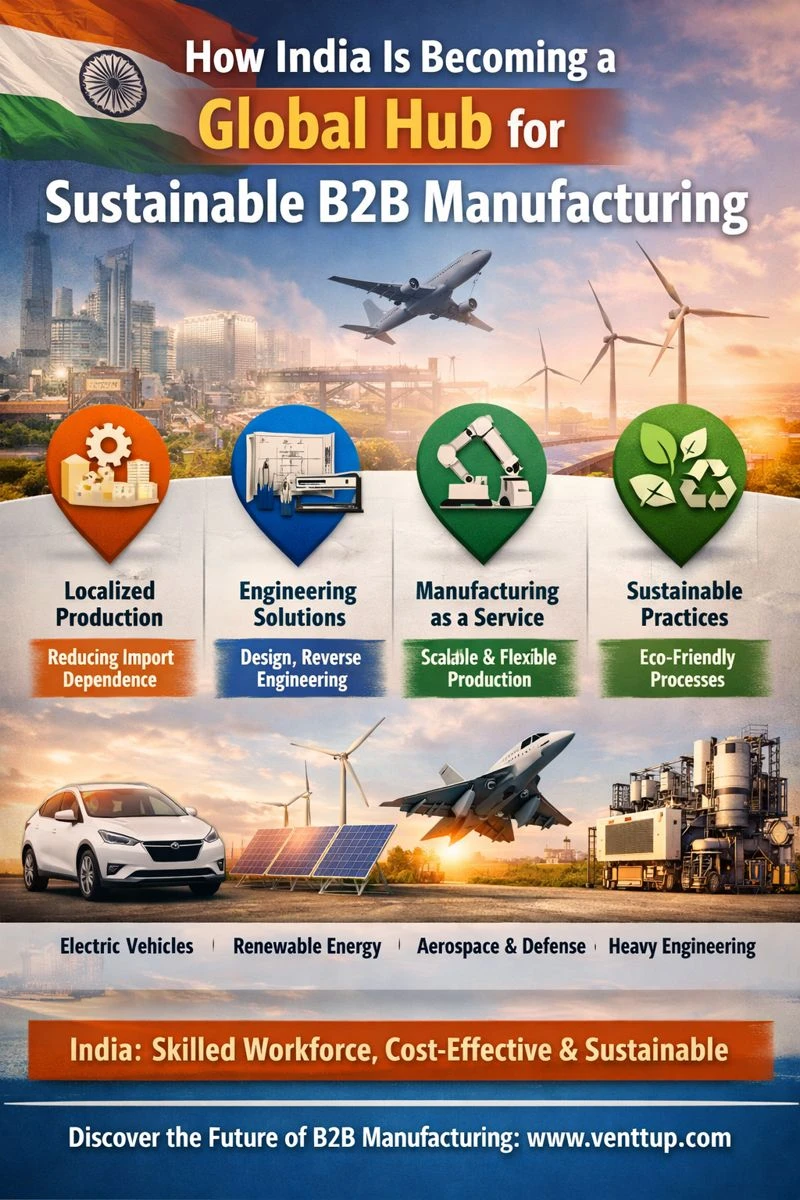
The global manufacturing landscape is undergoing a major shift. Businesses across industries are rethinking how and where they produce critical components. Rising costs, supply chain disruptions, and sustainability goals are pushing companies to explore localized, technology-driven manufacturing models. In this transformation, India is steadily emerging as a preferred destination for B2B engineering and manufacturing solutions.
The Need for Localized Manufacturing
Over the last few years, global supply chains have faced repeated disruptions due to geopolitical tensions, logistics challenges, and dependency on limited sourcing regions. As a result, businesses are now focusing on:
- Reducing reliance on imports
- Shortening lead times
- Improving quality control
- Building resilient supplier ecosystems
Localized manufacturing helps companies maintain better control over production while improving flexibility and cost efficiency.
Role of Engineering-Led Manufacturing
Modern B2B manufacturing is no longer limited to production alone. Engineering plays a critical role in ensuring efficiency, accuracy, and scalability. Many businesses now seek integrated solutions that include:
- Engineering design and validation
- Reverse engineering of legacy components
- New part development
- Indigenisation and localisation of critical parts
This approach enables companies to move from concept to production seamlessly, without managing multiple vendors.
Manufacturing as a Service (MaaS): A Growing Trend
Manufacturing as a Service (MaaS) is gaining popularity among startups and enterprises alike. Instead of investing heavily in infrastructure, businesses partner with service providers that offer end-to-end manufacturing support. Key advantages include:
- Faster prototyping and production
- Lower capital investment
- Scalable manufacturing capacity
- Access to specialized expertise
MaaS models are especially valuable for industries such as electric vehicles, renewable energy, aerospace, and heavy engineering, where precision and compliance are critical.
Sustainability in Industrial Manufacturing
Sustainability is no longer optional in manufacturing. Companies are under increasing pressure to reduce environmental impact and align with global ESG standards. Sustainable manufacturing focuses on:
- Efficient material usage
- Reduced waste generation
- Optimized energy consumption
- Responsible sourcing and production practices
By integrating sustainability into engineering and manufacturing workflows, businesses can reduce carbon footprints while maintaining profitability.
India’s Strategic Advantage in B2B Manufacturing
India offers several advantages that make it an attractive manufacturing destination:
- Skilled engineering and technical workforce
- Competitive production costs
- Strong vendor and supplier ecosystem
- Government support for manufacturing and indigenisation
- Rapid adoption of digital manufacturing tools
These factors position India as a reliable partner for global businesses looking to diversify and future-proof their supply chains.
Industries Benefiting the Most
The shift toward localized and sustainable manufacturing is particularly impactful for industries such as:
- Electric vehicles (EVs)
- Renewable energy
- Aerospace and defense
- Industrial machinery
- Energy and infrastructure
For these sectors, access to reliable engineering and manufacturing support can significantly accelerate innovation and market entry.
Final Thoughts
As global manufacturing continues to evolve, businesses that adopt integrated, sustainable, and localized production strategies will gain a competitive edge. Engineering-driven manufacturing platforms are playing a crucial role in enabling this transition by offering flexible, scalable, and future-ready solutions.
To explore more insights on modern B2B manufacturing and engineering-driven sourcing models, visit: https://venttup.com/