
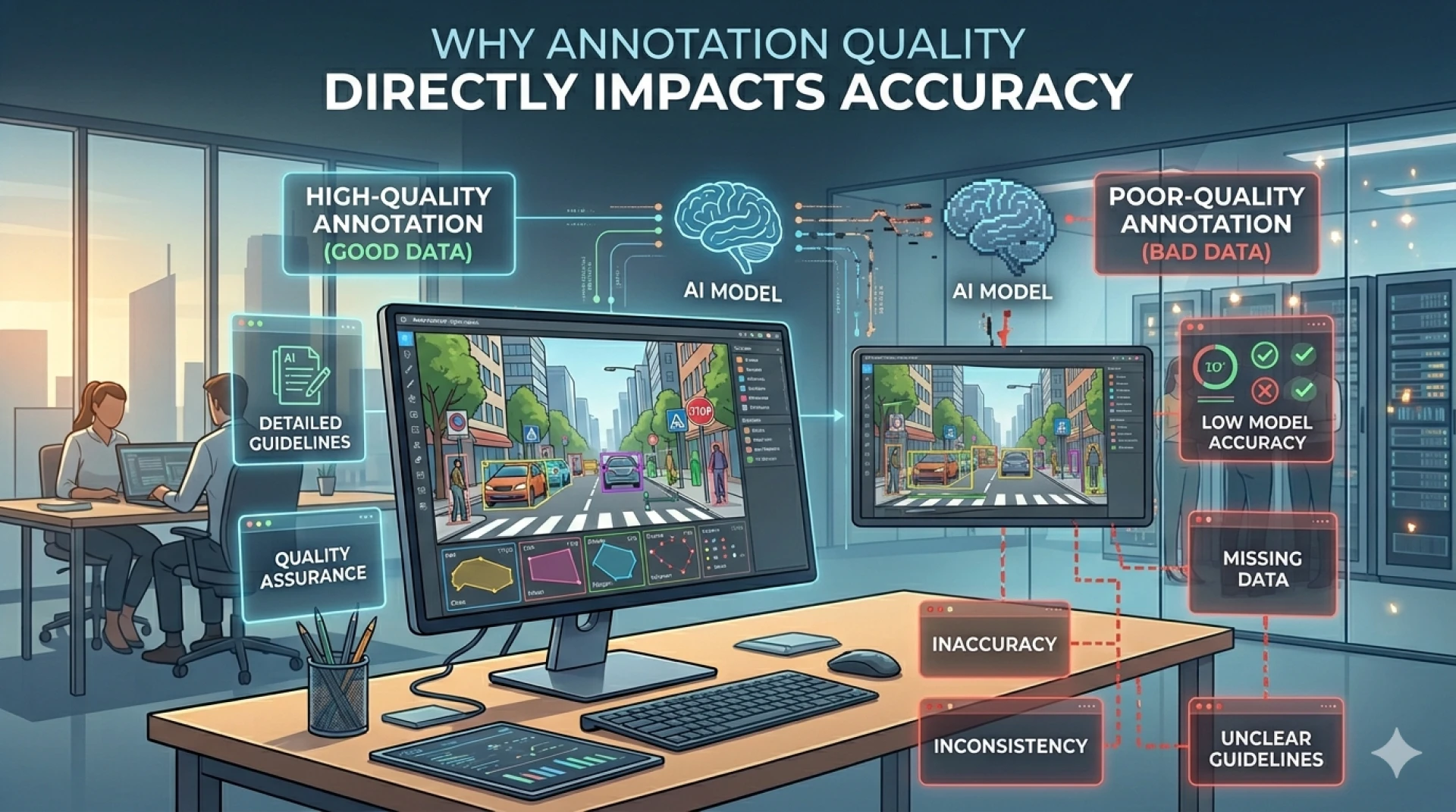
In today’s AI-driven landscape, computer vision systems are transforming industries ranging from autonomous vehicles and retail analytics to healthcare imaging and security surveillance. At the core of every high-performing vision model lies one indispensable component: high-quality image annotation. For object detection and image classification tasks, the quality, consistency, and contextual richness of labeled data directly determine model accuracy and real-world performance.
At Annotera, we understand that successful AI initiatives begin with reliable training data. As a trusted data annotation company, we help organizations build robust computer vision pipelines through scalable, precise, and domain-specific image labeling services. This article explores how image annotation significantly improves object detection and classification accuracy and why partnering with an experienced image annotation company is essential for AI success.
Understanding the Role of Image Annotation in Computer Vision
Image annotation is the process of labeling visual data so machine learning models can learn to identify, classify, and interpret objects within images. Depending on the use case, annotation may include:
- Bounding boxes
- Polygon annotation
- Semantic segmentation
- Keypoint annotation
- Cuboid annotation
- Image classification tags
For object detection, annotations define where an object is located within an image. For classification, they specify what the object is. These labels act as the ground truth that trains AI models to recognize patterns, shapes, textures, and contextual relationships.
Without accurate annotations, even the most advanced algorithms struggle to deliver reliable predictions.
Why Annotation Quality Directly Impacts Accuracy
The performance of computer vision models is fundamentally tied to the quality of the labeled dataset. Poorly labeled images introduce noise into the training process, leading to lower precision, recall, and overall model confidence.
1. Precise Object Localization Improves Detection Accuracy
In object detection, annotation accuracy begins with exact object boundaries. Bounding boxes that are too loose, too tight, or inconsistently placed confuse the model during training.
For example, in traffic monitoring systems, a vehicle detection model must distinguish between cars, buses, motorcycles, and pedestrians. If the labeled boxes overlap incorrectly or exclude parts of the vehicle, the model learns distorted object features.
High-quality annotation ensures:
- Accurate object boundaries
- Proper occlusion handling
- Consistent label placement
- Better localization metrics such as IoU (Intersection over Union)
This directly improves detection performance across metrics like mAP (mean Average Precision).
Better Classification Through Consistent Labeling
Image classification models rely on clean and consistent category labels. Misclassified images during training can significantly degrade model performance.
Consider an e-commerce product recognition system. If sneakers are inconsistently labeled as “shoes,” “sports footwear,” and “trainers,” the model receives conflicting training signals.
A professional data annotation company ensures label taxonomy consistency through:
- Predefined ontology structures
- Annotation guidelines
- Multi-level quality checks
- Domain-trained annotation specialists
Consistency helps models learn clearer feature distinctions between classes, improving classification confidence and reducing false positives.
The Importance of Diverse Training Data Annotation
Accuracy is not only about correct labels but also about dataset diversity. Models trained on narrow or biased datasets often fail in real-world environments.
For example, a facial recognition system trained only on controlled lighting conditions may underperform in low-light or outdoor scenarios.
Comprehensive image annotation outsourcing strategies help businesses scale diverse datasets that include:
- Different lighting conditions
- Multiple angles and perspectives
- Occlusions
- Background complexity
- Object size variations
- Real-world environmental noise
This diversity improves model generalization and enables better performance in production settings.
Specialized Annotation Techniques for Higher Model Performance
Different computer vision applications require different annotation methods. Choosing the right annotation technique has a direct impact on output accuracy.
Bounding Box Annotation
Ideal for standard object detection tasks such as identifying vehicles, people, or inventory items.
Polygon Annotation
More precise than rectangular boxes, polygon labeling captures irregular object shapes such as medical tumors, road lanes, or apparel outlines.
Semantic Segmentation
This pixel-level labeling method provides the highest level of detail and is critical for applications like autonomous driving and medical imaging.
Keypoint Annotation
Used in pose estimation, facial recognition, and gesture analysis, keypoints improve classification of human movement and structural features.
An experienced image annotation company like Annotera recommends the most effective annotation strategy based on model objectives and industry use cases.
Human Expertise Reduces Model Bias and Error
Automated pre-labeling tools can accelerate workflows, but human validation remains essential for accuracy.
AI-assisted annotation systems often struggle with:
- Overlapping objects
- Edge ambiguity
- Rare object classes
- Context-sensitive labeling
Human annotators provide contextual understanding that machines cannot fully replicate. For example, distinguishing between a parked bicycle and a bicycle rack requires human judgment.
This is why many businesses choose data annotation outsourcing partners that combine automation with human-in-the-loop validation.
At Annotera, our quality workflows include:
- AI-assisted pre-labeling
- Human verification
- Expert escalation review
- Randomized QA sampling
- Consensus-based validation
This layered approach significantly improves final model accuracy.
Annotation Consistency Across Large-Scale Datasets
As datasets scale to millions of images, maintaining consistency becomes increasingly difficult.
Small inconsistencies in annotation guidelines can produce compounding model errors during training.
For example:
- One annotator includes shadows
- Another excludes them
- One labels partial objects
- Another ignores them
These inconsistencies create confusion for the model.
Professional image annotation outsourcing solves this challenge through standardized SOPs, training documentation, and inter-annotator agreement frameworks.
As a leading data annotation company, Annotera maintains rigorous quality governance to ensure uniformity across large-scale datasets.
Industry Applications Where Annotation Accuracy Matters Most
Image annotation plays a decisive role in mission-critical industries.
Autonomous Vehicles
Vehicles must detect pedestrians, traffic signs, road markings, and obstacles with near-perfect accuracy.
Healthcare
Medical imaging models depend on highly precise segmentation and classification for diagnostics.
Retail
Shelf analytics systems use object detection to track inventory placement and product recognition.
Security and Surveillance
Threat detection systems rely on real-time classification of people, vehicles, and suspicious objects.
In each of these industries, annotation quality directly impacts operational reliability and business outcomes.
Why Businesses Choose Annotation Outsourcing
Building an in-house labeling team can be costly, slow, and difficult to scale.
That’s why many organizations rely on image annotation outsourcing to accelerate model development while maintaining quality.
Benefits include:
- Faster turnaround times
- Access to trained annotators
- Scalable workforce
- Reduced operational costs
- Domain expertise
- Strong quality assurance
Partnering with a specialized image annotation company enables AI teams to focus on model development while experts manage data quality.
Conclusion
The accuracy of object detection and classification models begins with the quality of image annotation. From precise object boundaries and consistent class labels to scalable quality assurance processes, every aspect of annotation directly influences model performance.
As AI adoption continues to grow, investing in expert annotation services is no longer optional—it is foundational.
At Annotera, we help businesses improve computer vision outcomes through high-precision labeling workflows tailored to industry-specific requirements. As a reliable data annotation company and trusted partner for data annotation outsourcing, we deliver scalable, high-quality image labeling solutions that enhance AI accuracy and accelerate deployment.
If your organization is looking to improve object detection and classification performance, partnering with an experienced image annotation company can make all the difference.