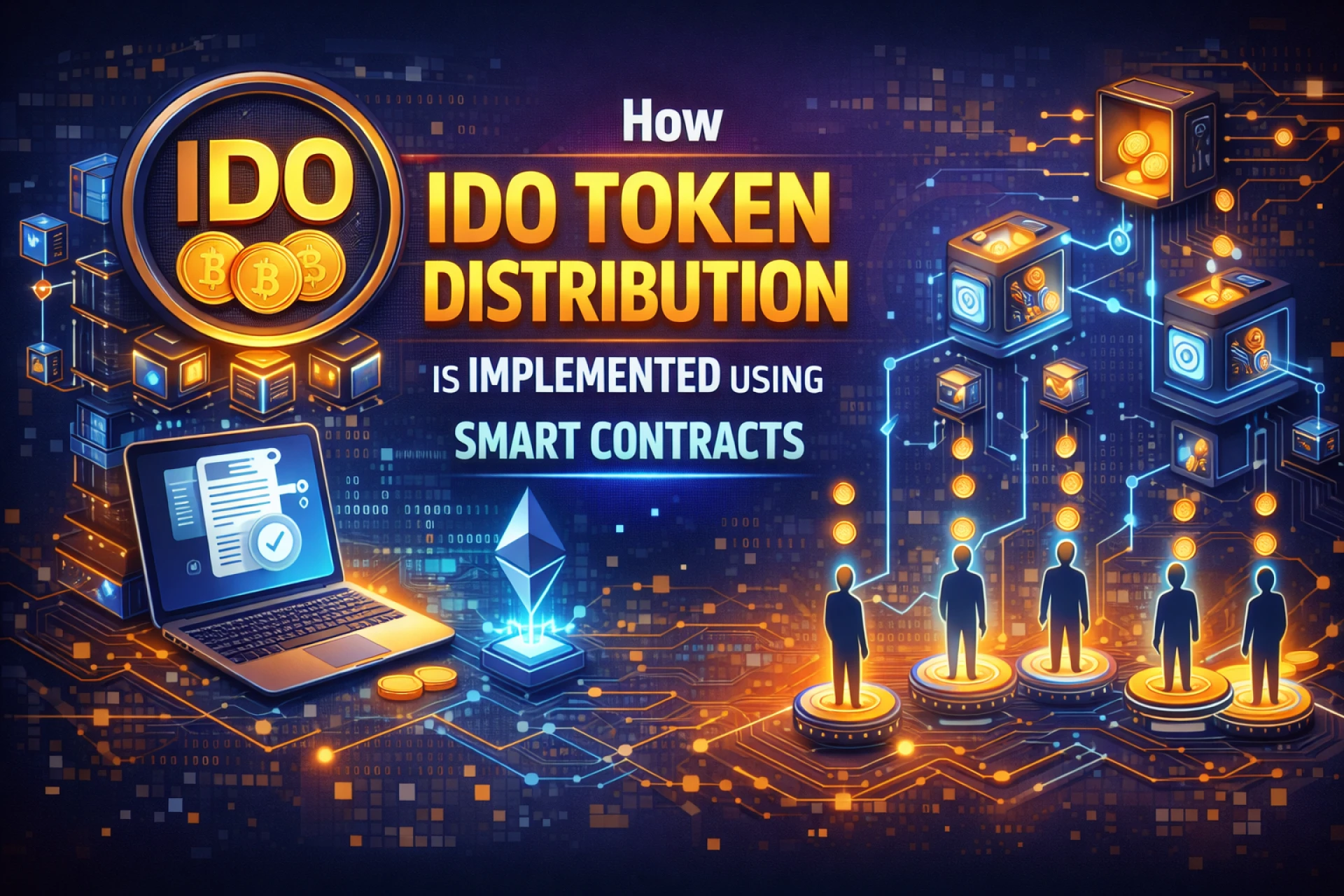
Initial DEX Offerings (IDOs) have redefined how blockchain projects distribute tokens to early supporters. At the heart of this model lies a carefully engineered system of smart contracts that replaces manual allocation, centralized oversight, and opaque decision-making with transparent, automated execution. Token distribution is not merely a final step in an IDO it is the mechanism that determines fairness, trust, and long-term ecosystem stability.
This article explores how IDO token distribution is implemented using smart contracts, examining the underlying logic, architectural patterns, and safeguards that ensure tokens are allocated securely and predictably. Rather than presenting a superficial overview, it focuses on the most critical aspects of distribution design, supported by real-world lessons from successful and failed IDO launches.
Why Token Distribution Is Central to IDO Integrity
In decentralized fundraising, token distribution is where promises meet execution. Allocation rules, vesting schedules, and liquidity timelines all converge at this stage. Any flaw whether technical or economic can undermine investor confidence and destabilize the token economy.
Smart contracts enable IDO platforms to encode distribution rules directly into immutable logic. This removes reliance on human intervention and ensures that every participant is treated according to predefined conditions. The result is a trust-minimized process where outcomes can be independently verified on-chain.
Core Principles Behind Smart Contract Based Distribution
Effective IDO token distribution contracts are guided by a few foundational principles. First, determinism is essential: given the same inputs, the contract must always produce the same outcome. Second, transparency ensures that allocation logic can be audited by anyone. Third, composability allows distribution contracts to integrate seamlessly with vesting mechanisms, liquidity pools, and governance systems.
These principles shape how contracts are structured, how state is managed, and how user interactions are validated throughout the distribution lifecycle.
Pre-Sale Configuration and Parameterization
Before an IDO begins, distribution parameters are defined and locked into smart contracts. These parameters typically include total token supply allocated for the IDO, individual participation caps, accepted contribution assets, and the timeline for claiming tokens.
From a technical standpoint, these values are initialized during contract deployment or through a controlled setup phase. Once the sale starts, most platforms restrict changes to prevent manipulation. This immutability is crucial for maintaining participant trust, as it guarantees that distribution rules cannot be altered mid-sale.
Handling Contributions and Allocation Logic
During the IDO, smart contracts track participant contributions in real time. Each contribution triggers on-chain logic that validates eligibility, enforces caps, and records allocation data.
Allocation models vary across platforms, but smart contracts generally handle:
- Contribution validation against whitelist or tier rules
- Enforcement of per-wallet and total caps
- Calculation of token entitlements
In oversubscribed sales, contracts may implement proportional allocation formulas. These formulas ensure that participants receive a fair share based on their contribution relative to total demand. Encoding such logic on-chain prevents favoritism and post-sale disputes.
Managing Oversubscription and Refunds
Oversubscription is common in popular IDOs, making refund handling a critical part of distribution architecture. Smart contracts are responsible for determining excess contributions and returning funds automatically.
This process requires careful state tracking. Contracts must differentiate between accepted and excess amounts, calculate refunds accurately, and allow users to reclaim funds without relying on centralized operators. Poorly implemented refund logic has historically led to locked funds and reputational damage, highlighting the importance of rigorous design.
Token Minting vs. Token Escrow Models
IDO platforms use two primary approaches to token distribution: mint-on-demand and escrow-based distribution. In mint-on-demand models, tokens are minted directly to participants during the claim phase. In escrow models, tokens are pre-minted and held by a distribution contract until release conditions are met.
Each approach has architectural implications. Mint-on-demand reduces upfront token exposure but requires strict access control. Escrow models simplify distribution logic but increase the importance of secure custody. Smart contracts must be designed to align with the project’s tokenomics and risk tolerance.
Vesting and Claim Mechanisms
Most IDOs do not distribute all tokens immediately. Vesting schedules are implemented to promote long-term alignment and reduce market volatility. Smart contracts automate this process by locking tokens and releasing them according to predefined rules.
Vesting contracts typically define:
- Cliff periods before initial release
- Linear or staged unlock schedules
- Claim functions callable by participants
By separating vesting logic from sale logic, platforms improve modularity and reduce complexity. Participants can independently verify vesting conditions and claim tokens without relying on centralized coordination.
Security Controls in Distribution Contracts
Because distribution contracts manage valuable assets, security is paramount. Common protective measures include reentrancy guards, strict input validation, and explicit state transitions. Contracts are often designed to prevent double claims, unauthorized minting, and timing-based exploits.
Emergency mechanisms, such as pause functions, may be included to halt distribution in case of detected vulnerabilities. While these controls introduce a degree of centralization, they are generally governed by multisignature wallets or decentralized governance to maintain trust.
Integration With Liquidity Provisioning
Token distribution does not occur in isolation. In most IDOs, distribution contracts are coordinated with liquidity provisioning on decentralized exchanges. This ensures that once tokens are claimable, participants have immediate access to secondary markets.
Smart contracts may enforce sequencing rules, such as preventing claims until liquidity is added. This coordination reduces the risk of extreme price volatility and improves market stability during the initial trading phase.
Transparency and On Chain Verifiability
One of the strongest advantages of smart contract based distribution is transparency. Every allocation, claim, and vesting event is recorded on-chain. Participants can verify total distributed supply, individual entitlements, and remaining locked tokens using public blockchain explorers.
This transparency acts as a powerful accountability mechanism. Projects that adhere to clear, verifiable distribution logic tend to build stronger communities and face fewer post-launch disputes.
Lessons From Real-World IDO Distributions
Several high-profile IDOs have demonstrated how subtle distribution flaws can cause significant issues. In some cases, inadequate cap enforcement allowed bots to dominate allocations. In others, flawed vesting logic led to premature token unlocks.
Conversely, platforms that invested in robust distribution architecture have consistently delivered smoother launches. Their success underscores the importance of careful contract design, extensive testing, and realistic adversarial assumptions.
The Role of Professional Development Teams
Implementing secure and fair IDO token distribution requires deep expertise in smart contract engineering, blockchain economics, and adversarial security. Teams specializing in IDO Development bring this multidisciplinary perspective, ensuring that distribution logic aligns with both technical best practices and market realities.
An experienced IDO Development Company typically approaches distribution as a system, not a single contract integrating allocation, vesting, refunds, and liquidity in a coherent architecture. Comprehensive IDO Development Services extend beyond coding to include testing, audits, and post-launch monitoring.
Future Trends in IDO Token Distribution
As the ecosystem matures, token distribution mechanisms are evolving. Innovations such as dynamic vesting, reputation-based allocation, and on-chain governance-controlled unlocks are gaining traction. These trends aim to further align incentives and reduce speculative behavior.
Smart contracts will continue to be the foundation enabling these advances, offering programmable flexibility without sacrificing transparency.
Conclusion
IDO token distribution is a complex, high-stakes process that demands precision, security, and economic foresight. Smart contracts provide the tools to automate this process in a trustless, verifiable manner but only when they are designed and implemented with care.
By encoding allocation rules, vesting schedules, and safeguards directly into on-chain logic, IDO platforms can deliver fairer outcomes and stronger long-term ecosystems. As decentralized fundraising continues to grow, the quality of token distribution architecture will remain one of the most important determinants of success.