Managing people becomes harder when employee information is spread across spreadsheets, emails and separate payroll files. A leave request may sit with HR while attendance data is maintained somewhere else, and a salary change may need to be updated in several places. As the workforce grows, keeping all these records consistent can take more time than expected.
This is where HRMS cloud solutions can offer a more organised approach. Instead of depending on locally stored files and disconnected processes, a cloud-based HRMS can bring important HR activities into a central system. For businesses in Mauritius, this can make it easier to manage employee information, attendance, leave, payroll-related records and routine HR activities from a more structured workflow.
The important point, however, is that moving HR processes to the cloud does not automatically make them better. Businesses still need to consider what the system actually covers, how employees will use it and whether it fits their existing HR and payroll processes.
What Does a Cloud HRMS Actually Bring Together?
An HRMS can act as a central point for different parts of the employee lifecycle. Rather than maintaining separate records for every HR activity, teams can work with connected employee information.
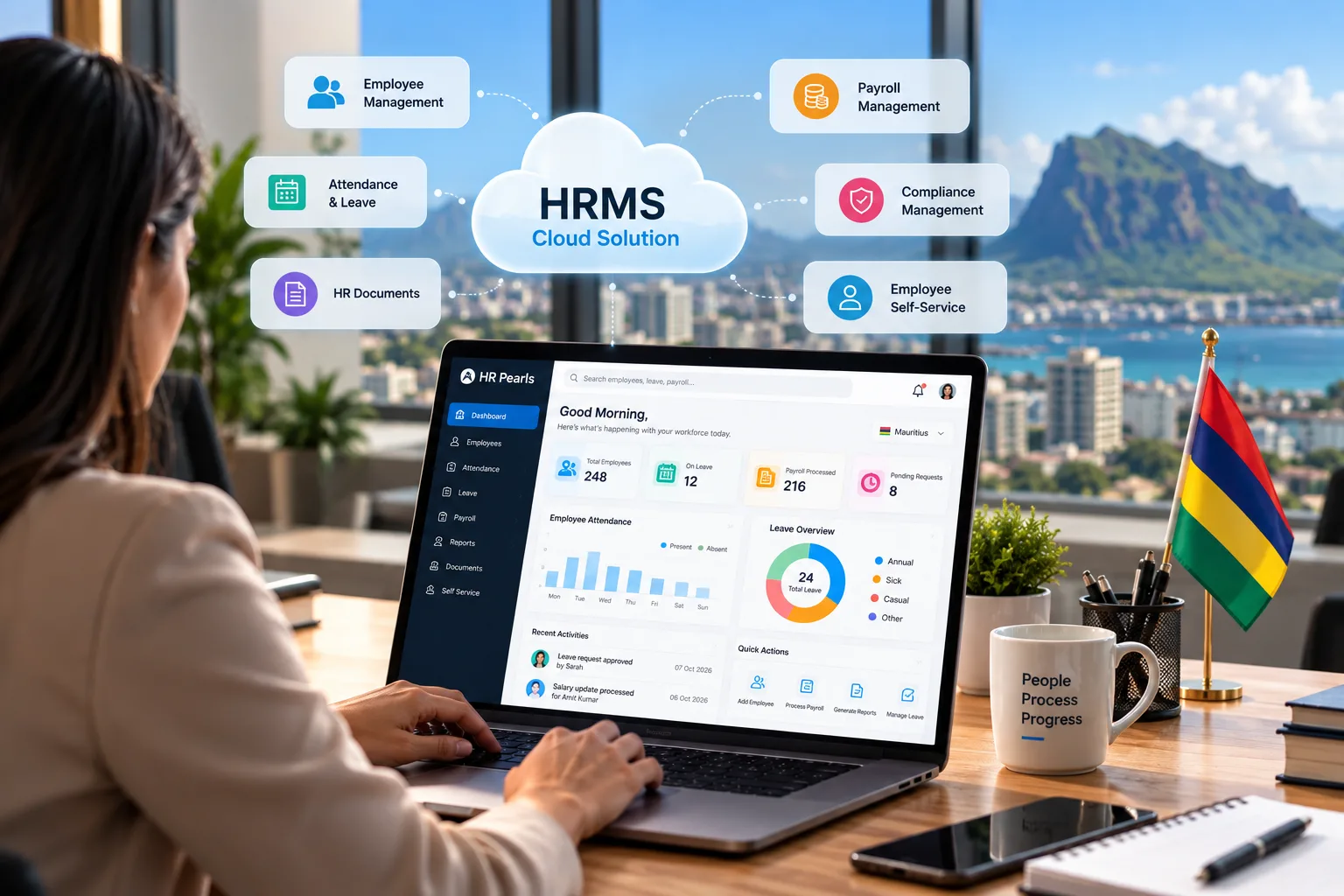
Depending on the system, this can include employee databases, leave and attendance, shift management, HR documents, reporting, payroll and employee self-service. For example, Webtel's HR management solution includes HRMS, payroll management, compliance management and employee self-service modules, along with functions such as employee records, leave and attendance, shift management and HR reports.
The benefit of this approach is easier access to information. When HR, payroll and employees work from consistent records, there is less need to repeatedly collect the same information or maintain parallel spreadsheets.
Why Cloud-Based HR Management Can Be Useful
The biggest advantage of a cloud approach is accessibility. HR teams may need employee information from different locations, while employees themselves may need to submit requests or check their information without contacting HR for every routine task.
A centralised system can also make everyday processes easier to follow. Consider an employee requesting leave. Instead of sending an email and asking HR to update a separate spreadsheet, the request can become part of a defined HR workflow if the chosen system supports that process.
There are other practical considerations too:
HR requirementWhat a cloud HRMS can help organisePractical valueEmployee recordsProfiles and employee informationKeeps core information in one placeLeave managementLeave requests and recordsReduces manual trackingAttendanceAttendance-related informationProvides useful data for HR and payrollPayrollSalary and payroll recordsHelps connect payroll with employee informationHR documentsPolicies, documents and reportsMakes information easier to manageEmployee self-serviceEmployee requests and personal informationReduces routine HR queriesReportingHR and payroll-related reportsSupports review and decision-makingWorkforce changesTransfers, increments and employee updatesHelps keep records currentThe exact features vary between providers, so businesses should evaluate the workflow rather than assuming that every cloud HRMS offers the same functionality.
Payroll Should Be Part of the Conversation
HR and payroll often depend on the same employee information. Changes in salary, attendance, overtime, leave, reimbursements or employee status can all affect payroll processing.
This is why companies evaluating HRMS cloud solutions should look at how the HR and payroll sides of the system fit together. A system that stores employee information but leaves payroll completely disconnected may still require considerable manual work.
Webtel's HR Pearls page describes payroll functions including salary calculation, reimbursements, loans and advances, overtime, bonuses, full and final settlement, gratuity calculation, payslips, bank transfer sheets and salary registers. These are examples of the types of payroll activities businesses may want to examine when comparing HR technology.
For organisations that prefer not to handle every payroll activity internally, outsourcing is another option. A payroll outsourcing service can be considered when a business wants external support for payroll processing rather than maintaining the entire operational workload in-house.
What Should Mauritius Businesses Check Before Choosing One?
A cloud HRMS should be evaluated using real HR situations rather than a feature checklist alone.
For example, imagine an employee receives a salary revision, changes departments and takes leave during the same month. Can the system keep the employee record updated across the relevant HR and payroll processes? Can authorised users review the changes? Can the organisation generate the reports it actually needs?
These questions reveal more about a system's usefulness than simply counting how many modules it contains.
Businesses should also consider:
- Data access: Who can view or change sensitive employee information?
- Employee experience: Can employees handle routine requests without depending entirely on HR?
- Payroll workflow: How are salary changes, deductions, overtime and other payroll inputs handled?
- Reporting: Can HR generate reports that are useful for actual management decisions?
- Scalability: Will the system remain practical as the workforce grows?
- Implementation: How much effort will be required to move existing employee information into the system?
- Support: What assistance is available when users encounter technical or process-related issues?
These questions are especially useful when comparing several HRMS providers because they shift attention from marketing claims to day-to-day usability.
Cloud HRMS Is About Process, Not Just Technology
Moving HR information to a cloud-based system can improve accessibility and organisation, but technology alone does not fix an unclear HR process. Companies still need defined responsibilities, accurate employee information and appropriate controls over sensitive data.
For a Mauritius-based business, the better approach is to start with its actual HR workflow. Identify where information is currently duplicated, where approvals are delayed, where payroll inputs are manually checked and where employees regularly need HR assistance. Those gaps can then become the criteria for evaluating an HRMS.
A good HRMS cloud solution should fit those requirements instead of forcing the organisation to redesign every process around the software. The right choice is therefore less about finding a system with the longest feature list and more about finding one that can bring HR and payroll activities together in a practical, manageable way.