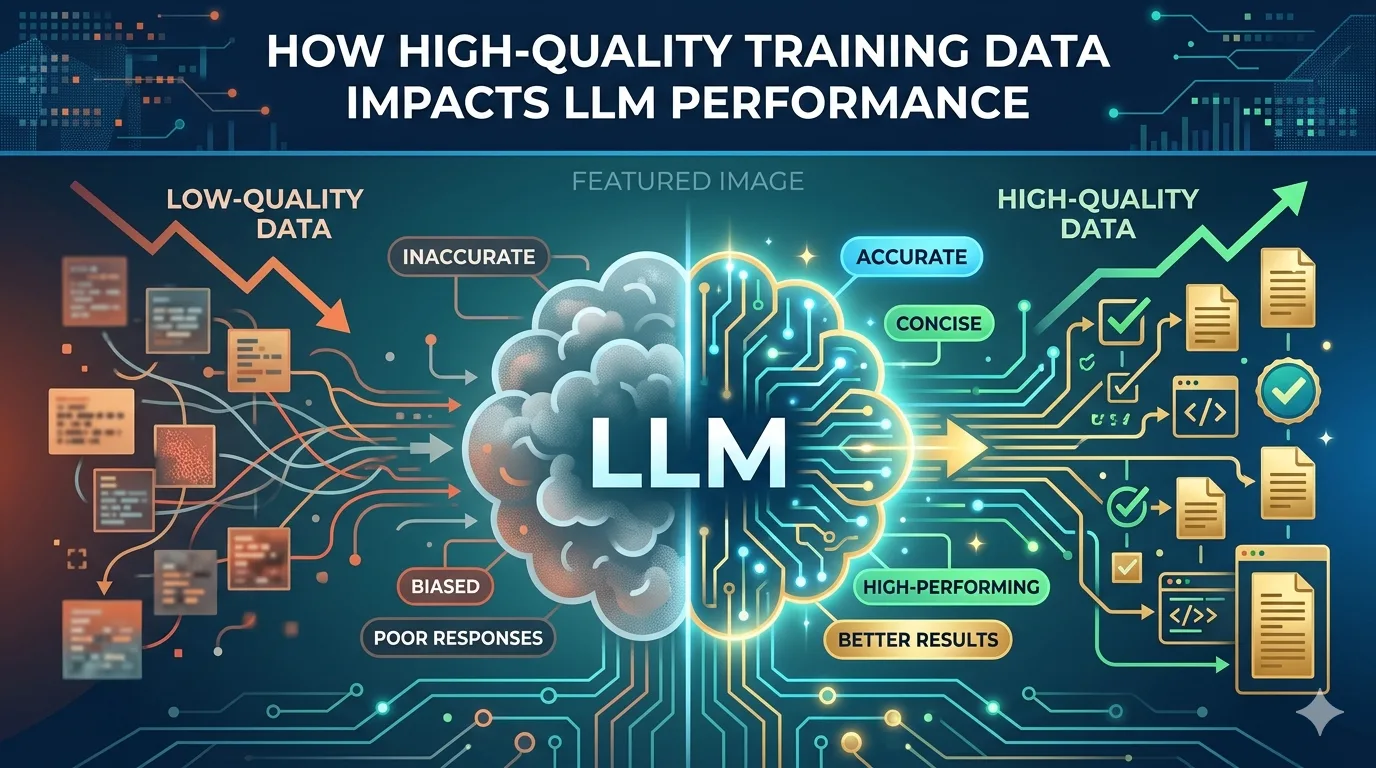
Large Language Models (LLMs) have rapidly evolved into foundational systems powering search, automation, content generation, and enterprise AI. However, despite advancements in model architectures and compute scaling, one factor consistently determines real-world performance: the quality of training data.
At Annotera, a specialized data annotation company delivering scalable data annotation outsourcing and RLHF Annotation Services, we’ve observed that even the most advanced models underperform when trained on poorly curated datasets. Conversely, high-quality data can dramatically enhance accuracy, alignment, and usability.
This article explores How High-Quality Training Data Impacts LLM Performance, breaking down its role across pretraining, fine-tuning, and reinforcement learning stages.
1. The Foundation: Why Training Data Matters More Than Model Size
LLMs learn patterns, language structure, and reasoning capabilities directly from data. While increasing model size improves capacity, data quality determines what the model actually learns.
During pretraining, LLMs ingest vast corpora of text. This stage teaches grammar, facts, and contextual relationships. However, if the dataset contains noise, duplication, bias, or low-quality sources, the model internalizes those flaws.
High-quality datasets, on the other hand, ensure:
- Accurate linguistic patterns
- Reliable factual grounding
- Reduced hallucinations
- Better generalization across domains
In essence, training data acts as the “curriculum” for the model, and poor curriculum design leads to poor learning outcomes.
2. Signal vs. Noise: The Hidden Cost of Low-Quality Data
Not all large datasets are useful. In fact, excessive noisy data can degrade performance.
Low-quality training data introduces:
- Inconsistent labeling
- Contradictory information
- Redundant patterns
- Irrelevant or outdated content
This creates ambiguity during training, forcing the model to learn conflicting signals. As a result, LLMs may:
- Generate hallucinated responses
- Struggle with instruction-following
- Produce inconsistent outputs
High-quality datasets, curated through expert annotation and validation, maximize signal-to-noise ratio, enabling the model to converge faster and more reliably.
3. Role of Data Annotation in LLM Performance
Annotation is the process of structuring raw data into meaningful training signals. For LLMs, this includes:
- Instruction-response pairs
- Classification labels
- Entity tagging
- Conversational datasets
A professional data annotation company ensures:
- Clear labeling guidelines
- Annotator training and calibration
- Inter-annotator agreement
- Continuous quality audits
These practices are critical because inconsistent annotations can “poison” the learning process, leading to degraded model performance.
Through data annotation outsourcing, organizations can scale annotation pipelines while maintaining high accuracy and domain expertise.
4. Supervised Fine-Tuning: Turning Raw Knowledge into Usable Intelligence
After pretraining, LLMs undergo supervised fine-tuning (SFT), where curated datasets refine behavior.
High-quality SFT datasets:
- Improve instruction-following
- Reduce bias and toxicity
- Enhance domain-specific accuracy
This stage relies heavily on human-generated “gold-standard” examples, which guide the model toward correct responses.
Without high-quality annotated data, fine-tuning fails to produce meaningful improvements, leaving models technically capable but practically unreliable.
5. RLHF Annotation Services: Aligning Models with Human Expectations
One of the most impactful advancements in LLM training is RLHF Annotation Services (Reinforcement Learning from Human Feedback).
RLHF introduces human judgment into the training loop by:
- Ranking multiple model outputs
- Training a reward model based on preferences
- Optimizing the LLM to produce preferred responses
This process ensures that models generate outputs aligned with human expectations, not just statistical likelihoods.
Why Data Quality Matters in RLHF
The effectiveness of RLHF depends entirely on the quality of feedback data:
- Accurate rankings → better reward models
- Consistent judgments → stable training
- Diverse examples → broader generalization
If feedback is noisy or biased, the reward model becomes unreliable, leading to misaligned outputs and unintended behaviors.
High-quality RLHF datasets enable:
- Better instruction adherence
- Improved safety and harmlessness
- Enhanced conversational coherence
Moreover, RLHF is not just a refinement step—it directly shapes how the model behaves in real-world interactions.
6. Data Diversity and Coverage: The Key to Generalization
Beyond accuracy, diversity in training data plays a crucial role in LLM performance.
A well-balanced dataset includes:
- Multiple domains (finance, healthcare, legal, etc.)
- Varied linguistic styles
- Multilingual content
- Edge cases and adversarial examples
Research shows that increasing data diversity improves reward model performance and overall system robustness.
Without sufficient diversity, LLMs struggle with:
- Out-of-distribution queries
- Rare use cases
- Complex reasoning scenarios
High-quality data annotation ensures that datasets are not only accurate but also representative of real-world variability.
7. Reducing Bias and Ensuring Ethical AI
Bias in training data directly translates into biased model outputs.
High-quality datasets mitigate this risk through:
- Balanced sampling strategies
- Inclusive representation
- Bias audits and corrections
However, even RLHF can introduce bias if human feedback is inconsistent or skewed toward specific perspectives.
This is why professional RLHF Annotation Services emphasize:
- Annotator diversity
- Clear evaluation rubrics
- Continuous monitoring
Ethical AI is not achieved through algorithms alone—it requires carefully curated and responsibly annotated data.
8. Efficiency Gains: Faster Training and Lower Costs
High-quality data doesn’t just improve accuracy—it also enhances efficiency.
Benefits include:
- Faster convergence during training
- Reduced need for retraining
- Lower compute costs
- Improved ROI
Clean, well-annotated datasets reduce the amount of data required to achieve target performance levels.
In contrast, low-quality data increases iteration cycles, driving up both time and cost.
9. The Role of Data Annotation Outsourcing in Scaling LLMs
As LLM applications expand, organizations face challenges in scaling data pipelines.
Data annotation outsourcing offers:
- Access to trained annotators
- Domain-specific expertise
- Scalable workflows
- Cost efficiency
At Annotera, we combine human expertise with robust quality control systems to deliver:
- High-precision annotation
- Custom dataset design
- End-to-end RLHF workflows
This ensures that clients can focus on model development while we handle the complexity of data preparation.
10. Future Outlook: Data-Centric AI Development
The AI industry is shifting from model-centric to data-centric development.
Key trends include:
- Synthetic data augmentation
- Human-AI hybrid feedback systems
- Continuous data refinement pipelines
- Automated quality evaluation tools
Despite these advancements, one principle remains unchanged:
High-quality training data is the single most important driver of LLM performance.
Conclusion
Understanding How High-Quality Training Data Impacts LLM Performance is essential for building reliable, scalable AI systems.
From pretraining to fine-tuning and RLHF, every stage of LLM development depends on the integrity, consistency, and diversity of data. High-quality datasets enable:
- Accurate and coherent outputs
- Strong alignment with human expectations
- Reduced bias and hallucinations
- Efficient and cost-effective training
As a trusted data annotation company, Annotera delivers industry-grade data annotation outsourcing and RLHF Annotation Services to help organizations unlock the full potential of LLMs.
In the evolving AI landscape, success is no longer defined by model size alone—it is defined by the quality of the data that powers it.