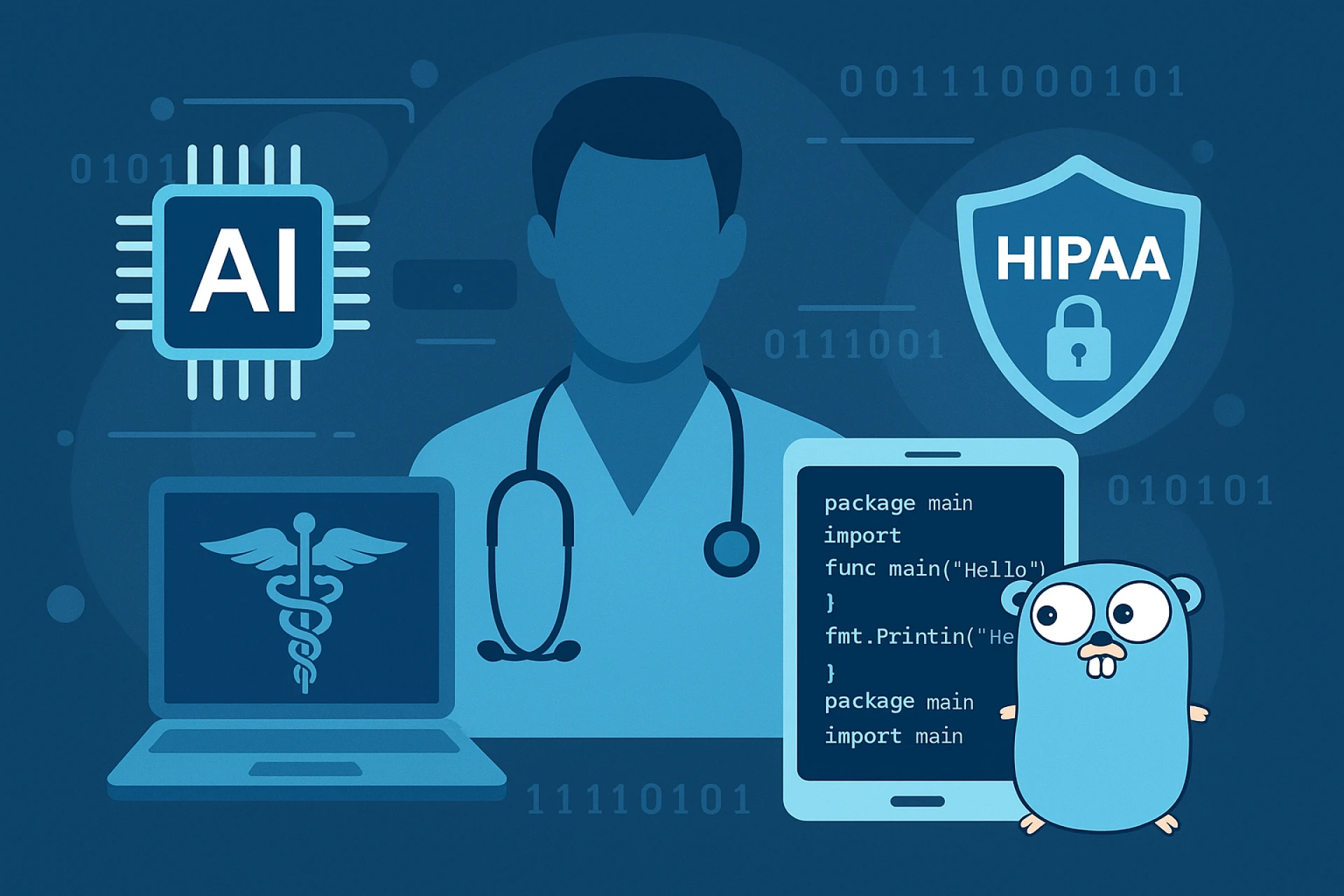
The healthcare industry is transforming rapidly as artificial intelligence (AI) becomes a core part of patient care, diagnostics, and operations. However, with the growing use of AI comes a heightened responsibility to ensure patient privacy and data protection. This is where HIPAA compliance and advanced development technologies converge.
Among modern programming languages, Golang stands out for its speed, scalability, and built-in security features. It provides the foundation developers need to build AI-driven healthcare applications that are both high-performing and compliant with healthcare data regulations.
This article explores how Golang enables the development of AI-powered, HIPAA-compliant healthcare applications that combine intelligence with security.
Healthcare applications that use AI require significant computational power and real-time processing capabilities. Golang, designed by Google, excels at handling concurrent tasks and processing large data streams efficiently.
Developers choose Golang for AI because it simplifies complex workloads without sacrificing performance. AI models in healthcare often need to analyze large medical datasets, make predictions, and communicate across distributed systems all of which Golang supports through its robust concurrency model and fast execution.
Key Advantages of Golang for AI-Based Healthcare Solutions
- High Performance: Golang compiles to native code, ensuring faster processing of AI workloads such as image recognition and predictive analytics.
- Concurrency: Its goroutines allow parallel data handling, ideal for real-time monitoring and diagnostic tools.
- Scalability: Golang handles large user loads and data volumes efficiently, which is essential for cloud-based healthcare platforms.
- Security: Strong type safety and memory management help prevent vulnerabilities in AI-driven systems.
The Role of AI in Modern Healthcare
AI is revolutionizing the healthcare industry through automation, pattern recognition, and predictive modeling. From chatbots assisting patients to algorithms detecting diseases early, AI is making healthcare more efficient and accessible.
Applications powered by AI can help:
- Detect medical conditions faster through image analysis.
- Monitor patients remotely using wearable data.
- Predict health risks based on historical patterns.
- Automate administrative tasks such as record keeping and scheduling.
These innovations are only effective when backed by secure systems that protect sensitive medical information, an area where Golang delivers exceptional reliability.
Ensuring HIPAA Compliance in AI-Powered Healthcare Apps
The Health Insurance Portability and Accountability Act (HIPAA) establishes the standards for protecting patient health information in digital systems. Any healthcare application that processes or stores such data must follow these rules to ensure confidentiality, integrity, and availability.
Developers focused on HIPAA-compliant app development must ensure their applications meet key regulatory requirements, including:
- Data Encryption: Protecting information during storage and transmission.
- Access Control: Restricting sensitive data access to authorized users.
- Audit Logs: Recording data activity for accountability and transparency.
- Consent Management: Ensuring patients control how their data is used.
Golang provides strong cryptographic libraries and efficient API integrations, allowing developers to build apps that meet HIPAA standards without compromising performance.
How Golang Bridges AI and Compliance
Combining AI’s intelligence with healthcare compliance is a complex task. Golang simplifies this balance through its robust architecture and efficient design. It provides the tools needed to integrate machine learning models into healthcare systems securely.
How Golang Helps Build Secure AI-Healthcare Apps
- Optimized Data Handling: Golang manages large datasets in memory with precision, ensuring accuracy and preventing leaks.
- Built-In Encryption Tools: Its libraries support end-to-end encryption, making data protection easier to implement.
- Cloud Compatibility: Golang integrates seamlessly with AWS, Azure, and Google Cloud, enabling compliant infrastructure deployment.
- Error-Free Performance: Static typing and strict syntax reduce bugs, a critical factor in regulated healthcare environments.
By adopting Go, healthcare developers can create intelligent systems that analyze patient data responsibly while maintaining security and compliance.
Real-World Applications of Golang in Healthcare
- Predictive Diagnostics: Golang-based AI solutions analyze real-time data to detect conditions such as cardiac risks or infections before they escalate.
- Telemedicine Platforms: Golang’s concurrency allows smooth, lag-free video consultations and secure data transmission.
- Health Monitoring Systems: AI models process continuous streams from wearable devices using Go’s high-speed APIs.
- Medical Data Processing: Hospitals use Go-powered systems to manage and anonymize patient records in compliance with HIPAA.
These applications highlight Golang’s versatility in combining AI innovation with healthcare privacy.
Why the Future of Healthcare Depends on Golang
As AI adoption accelerates, healthcare organizations must prioritize both innovation and compliance. Golang provides the reliability, scalability, and security required to achieve this balance.
Its lightweight architecture makes it suitable for distributed AI workloads, while its built-in support for secure APIs and encryption ensures patient data remains protected. Whether used in predictive analytics, clinical decision support, or patient engagement platforms, Golang enables the creation of healthcare systems that are fast, compliant, and future-ready.
Conclusion
The combination of AI and HIPAA compliance defines the next era of healthcare software. Golang is emerging as the preferred language for developing AI-powered healthcare applications that deliver speed, precision, and security.
By leveraging Golang for AI and following the principles of HIPAA-compliant app development, healthcare providers can embrace innovation responsibly. The result is a new generation of healthcare technology that enhances patient outcomes while maintaining the highest standards of data privacy and compliance.