
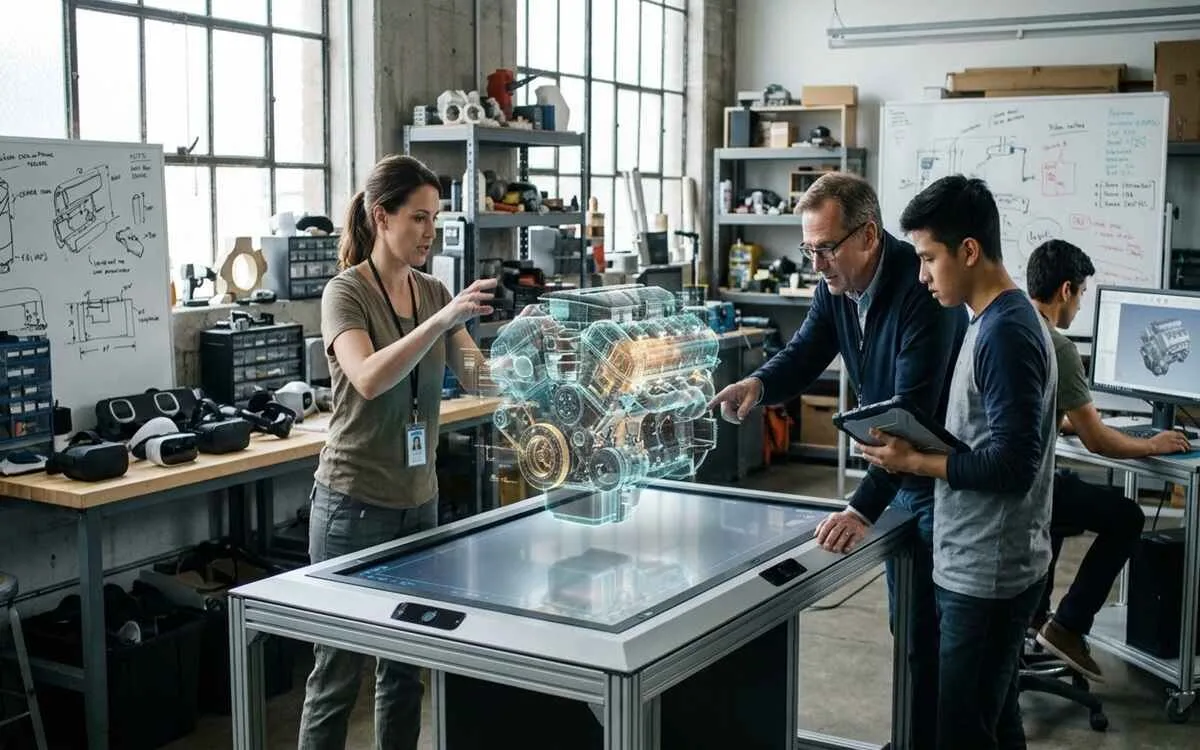
For decades, flat screens have forced human perception to translate two-dimensional pixels into three-dimensional mental models. Whether an engineer inspects a turbine assembly or a surgeon studies a vascular scan, traditional monitors flatten spatial depth onto a single plane of glass. Today, advances in optical physics and real-time rendering are shifting visual computing from flat panels toward true volumetric projection, where a 3d hologram occupies physical space and responds naturally as a viewer walks around it.
Unlike conventional stereoscopic cinema that tricks the brain using polarized glasses, modern holographic systems reconstruct the actual light waves scattered by an object. This distinction matters because human eyes rely on multiple depth cues simultaneously—including parallax, accommodation, and convergence—to judge distance without visual fatigue.
The Optical Physics Behind True Holography
A photograph records only the intensity and color of light hitting a sensor at a single angle. In contrast, a true holographic display captures and reproduces both the amplitude and the phase of light waves across a three-dimensional volume.
Wavefront Reconstruction and Interference
When coherent light interacts with a physical object, the scattered rays carry phase information describing the exact distance each ray traveled. Holographic systems recreate this wavefront using spatial light modulators (SLMs)—microscopic liquid-crystal or micromirror arrays capable of bending light at nanometer precision. By manipulating phase delays across millions of pixels, the display directs specific light rays toward each eye independently.
Solving the Vergence-Accommodation Conflict
Head-mounted virtual and augmented reality devices often cause eye strain because both eyes focus on a fixed focal plane inches away while converging on virtual objects that appear meters distant. Light-field and holographic displays eliminate this mismatch by allowing the eye's lens to naturally refocus between foreground and background elements. As a viewer shifts their head horizontally or vertically, hidden surfaces smoothly come into view with continuous motion parallax.
Four Core Architectures Powering Modern Volumetric Visuals
Not every spatial display relies on the same optical mechanism. Engineers currently deploy four primary architectures depending on viewing distance, brightness requirements, and multi-user collaboration needs.
1. Light-Field Displays
Light-field panels place a dense array of microscopic lenses—known as a lenticular or microlens array—directly over an ultra-high-resolution display. Each microlens projects distinct directional light rays across a viewing cone, enabling multiple observers to see different perspectives simultaneously without wearing tracking hardware.
2. Swept-Volume Volumetric Displays
Swept-volume systems create imagery inside a physical three-dimensional enclosure by projecting high-speed 2D slices onto a rapidly oscillating or rotating diffuser screen. Because the screen cycles faster than the human eye's flicker-fusion threshold, the brain integrates those cross-sections into a solid, translucent object visible from 360 degrees.
3. Spatial Light Modulators (SLMs) and Computer-Generated Holography
Computer-generated holography (CGH) calculates complex diffraction patterns in real time using graphics processing units and neural rendering algorithms. Rather than relying on physical lenses to steer light, CGH programs an SLM to diffract laser illumination into sharp focal points at arbitrary depths in mid-air.
4. Pepper’s Ghost and Optical Combiner Systems
While technically an optical illusion rather than wave-based diffraction, modern Pepper’s Ghost configurations pair high-luminance LED emitters with anti-reflective beam-splitter glass. When calibrated with dark-stage lighting and perspective-correct rendering, these installations produce high-contrast, life-sized spatial visuals suitable for large auditoriums and public exhibitions.
Practical Applications Reshaping Industry Workflows
As compute throughput and optical efficiency improve, spatial displays are moving beyond experimental physics labs into high-stakes operational environments.
Surgical Planning and Medical Imaging
Radiologists and surgical teams routinely interpret volumetric CT and MRI datasets on flat monitors, mentally reconstructing complex anatomical relationships before entering the operating room. Displaying patient-specific organ models in true three-dimensional space lets multidisciplinary teams examine tumor margins, nerve pathways, and vascular branching from every angle at once.
Industrial Digital Twins and CAD Review
Automotive and aerospace designers use collaborative spatial tables to inspect full-scale component tolerances without fabricating costly clay or milled prototypes. Multiple engineers can gather around a single light-field display, pointing directly at interference points in an engine block or airflow simulation while preserving natural eye contact and group discussion.
Cultural Preservation and Museum Curation
Fragile historical artifacts often remain locked in climate-controlled storage because light exposure or transport risks irreversible damage. High-resolution photogrammetry paired with volumetric projection allows museums to exhibit intricate sculptures and archaeological finds at true scale, enabling visitors to inspect surface textures and inscriptions from multiple angles.
Key Engineering Bottlenecks Still Being Solved
Despite rapid progress in neural wavefront calculation, widespread consumer adoption faces three persistent technical hurdles:
- Compute Bandwidth: Calculating real-time diffraction patterns for an 8K light-field panel requires orders of magnitude more mathematical operations than rendering a standard 2D frame. Neural network acceleration has cut calculation times from minutes to milliseconds, though high frame rates still demand dedicated workstation GPUs.
- Etendue and Viewing Angle: Optical physics enforces a strict trade-off between image size and viewing angle, known as the conservation of etendue. Expanding the field of view so a user can walk completely around a projection without losing focus requires novel metasurface optics and multi-projector tiling.
- Ambient Light Contrast: Because projected light rays do not block background illumination the way solid matter does, bright room lighting can wash out mid-air imagery. Engineers address this through directional optical louvers, polarization filters, and high-efficiency laser backlights.
The Shift Toward Ambient Spatial Computing
The evolution of visual interfaces has consistently moved toward reducing friction between human perception and digital information. Just as graphical user interfaces replaced command-line terminals by aligning with spatial memory, glasses-free volumetric displays remove the physical barrier of headsets and flat glass. Over the next decade, tighter integration between neural rendering pipelines and flat-panel metasurface optics will make true three-dimensional visualization a standard fixture across clinical, industrial, and collaborative workspaces.
Related Reading on OmniBuzz: Why AR Glasses Are Becoming Essential: The Future of How We Work, Learn, and Interact