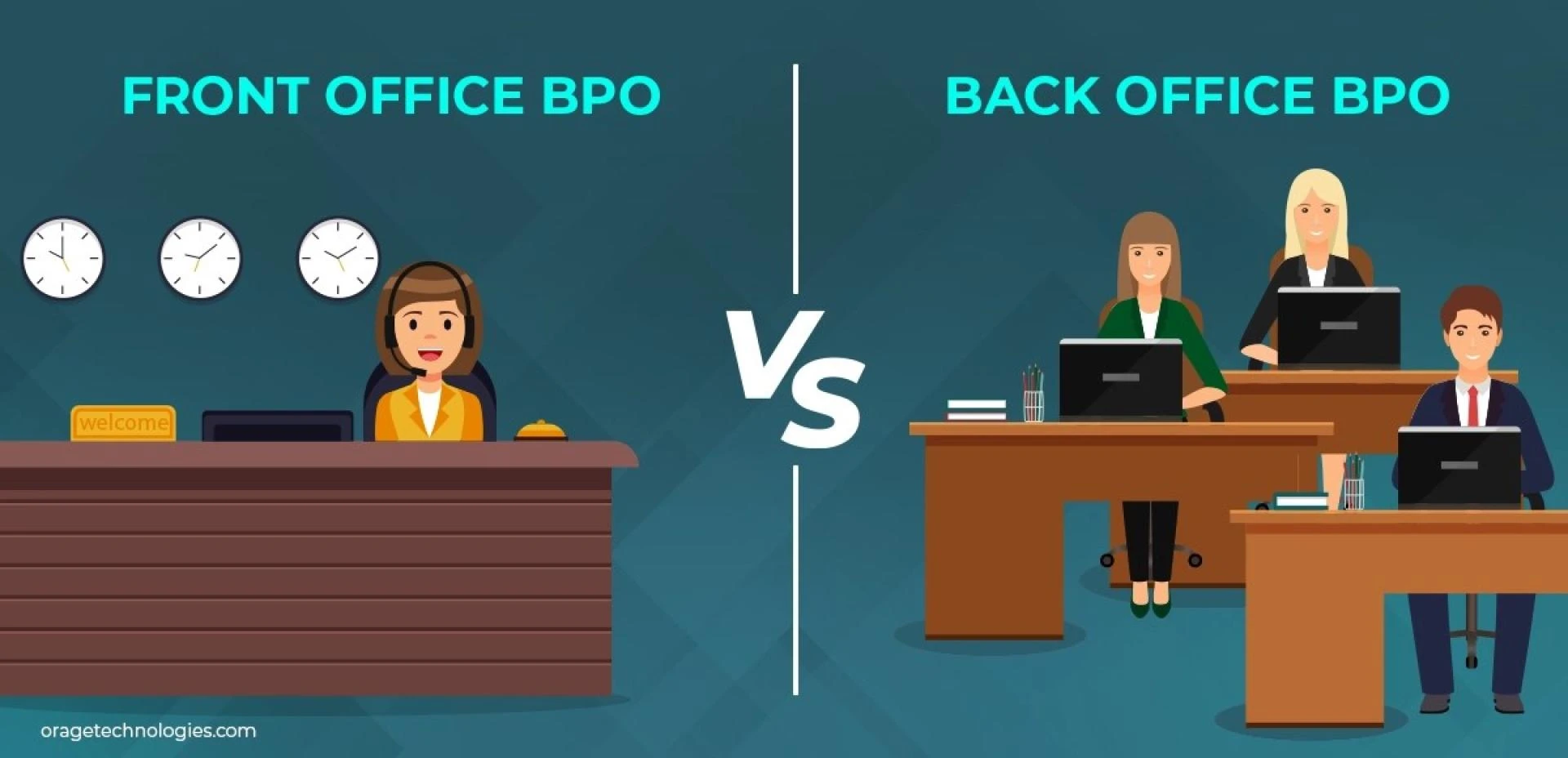
Since the previous paradigm of separating customer service from back-office operations, the business process outsourcing industry has advanced significantly. Due to the introduction of hybrid BPO models that combine both operations into a single, strategic framework, the debate between Front Office BPO and Back Office BPO is now shifting in favor of the former, when companies concentrate on outsourcing their customer service or internal support tasks.
This article will discuss how hybrid BPO is redefining the balance between front office and back office BPO, why it matters, and how it is altering the game.
What Is a Hybrid BPO Model?
Hybrid BPO combines front office (customer) and back office (support and administrative) functions into a single outsourcing arrangement. Rather than outsource sales support to one provider and payroll processing to another, companies now turn to a single partner that can serve both ends.
This unification eliminates the silo mentality common in Front Office BPO vs Back Office BPO, resulting in improved communication, quicker workflows, and effortless customer experiences.
Merging Front and Back Office: Why It Just Makes Sense
Let's begin by exploring the different roles:
Front Office BPO is involved with functions such as lead generation, technical support, live chat, and customer relationship management.
Back Office BPO is involved with functions such as finance, HR, data processing, and compliance documentation.
In a hybrid configuration, these aren't dealt with in isolation—the two are linked.
Example:
When a customer complains (a front office activity), its resolution may be to give a refund or check previous bills (a back office activity). Both halves of such a process can be dealt with by the same provider using hybrid BPO, decreasing lead times and enhancing customer satisfaction.
This is where the Front Office BPO vs Back Office BPO balance breaks down, and a functional, seamless ecosystem comes into play.
Technology as the Bridge
Smart technology fuels Hybrid BPO structures that consolidate data and communications between departments. Technology such as:
- CRM + ERP integrations
- AI-driven workflow automation
- Unified dashboards for service and support metrics
- Cloud-based document sharing
These technologies bridge the traditional front office vs. back office divide. Rather than struggle with multiple tools, firms and service providers can manage everything on top-down platforms.
Thus, in the Front Office BPO vs Back Office BPO debate, hybrid models aren't about either/or—they're about bringing both together with technology innovation.
Hybrid BPO Benefits: More Than Efficiency
The hybrid BPO model not only combines workflows, it also has some strategic advantages:
1. Improved Customer Experience
With smooth collaboration among departments, customer complaints are addressed sooner and more precisely. Whether it's the status of an order, payment receipt, or a refund, the customer experiences one seamless ride.
2. Real-Time Data Sharing
Front office staff have real-time access to back-end data, and vice versa. This enhances reporting, opportunities for upselling, and proactive service delivery.
3. Cost Efficiency
A single provider of both Front Office BPO vs Back Office BPO minimizes overhead, enhances resource optimization, and provides better budget management.
4. Scalable Expansion
Hybrid models scale with business growth without the need for multiple vendor agreements or disjointed communication channels.
Industries That Gain from Hybrid BPO
No industry is exclusive to the use of hybrid BPO. It is being deployed increasingly across:
E-commerce (customer support + inventory and returns management)
Banking & Finance (KYC assistance + back-office document validation)
Healthcare (patient assistance + claim and billing handling)
Travel and Hospitality (booking support + accounting and logistics handling)
In every one of these industries, the combination of Front Office BPO vs Back Office BPO into a hybrid setup guarantees consistency, customization, and operational transparency.
Challenges to Overcome
Although hybrid BPO is unbeatable in its benefits, it's not without challenges:
Data Privacy Issues: Managing both customer information and confidential internal documents requires strong cybersecurity.
Integration Complexity: Integrating current systems (particularly legacy systems) into a hybrid solution may be complicated without advanced planning.
Vendor Dependence: Having all front and back office functions dependent on a single vendor invites scrutiny to ensure no service disruptions.
Nevertheless, with the proper strategy and alliances, these challenges can be managed.
Front and Back Office BPO of the Future
As AI, automation, and cloud technologies evolve, the hybrid model of BPO will gain even more popularity. Companies no longer have to argue about Front Office BPO versus Back Office BPO—they can now adopt one integrated way that enhances customer satisfaction and back-end accuracy simultaneously.
By integrating both processes, companies can become more agile, budget-friendly, and customer-centric.
Conclusion
The Front Office BPO vs Back Office BPO concept is changing. Hybrid BPO models are a smarter, more unified approach to running business functions. They offer an end-to-end optimization solution in which internal procedures and client experience work in tandem in real time. Hybrid BPO is not an option; rather, it is the way of the future for businesses looking to scale, simplify, and prosper in the modern economy.