
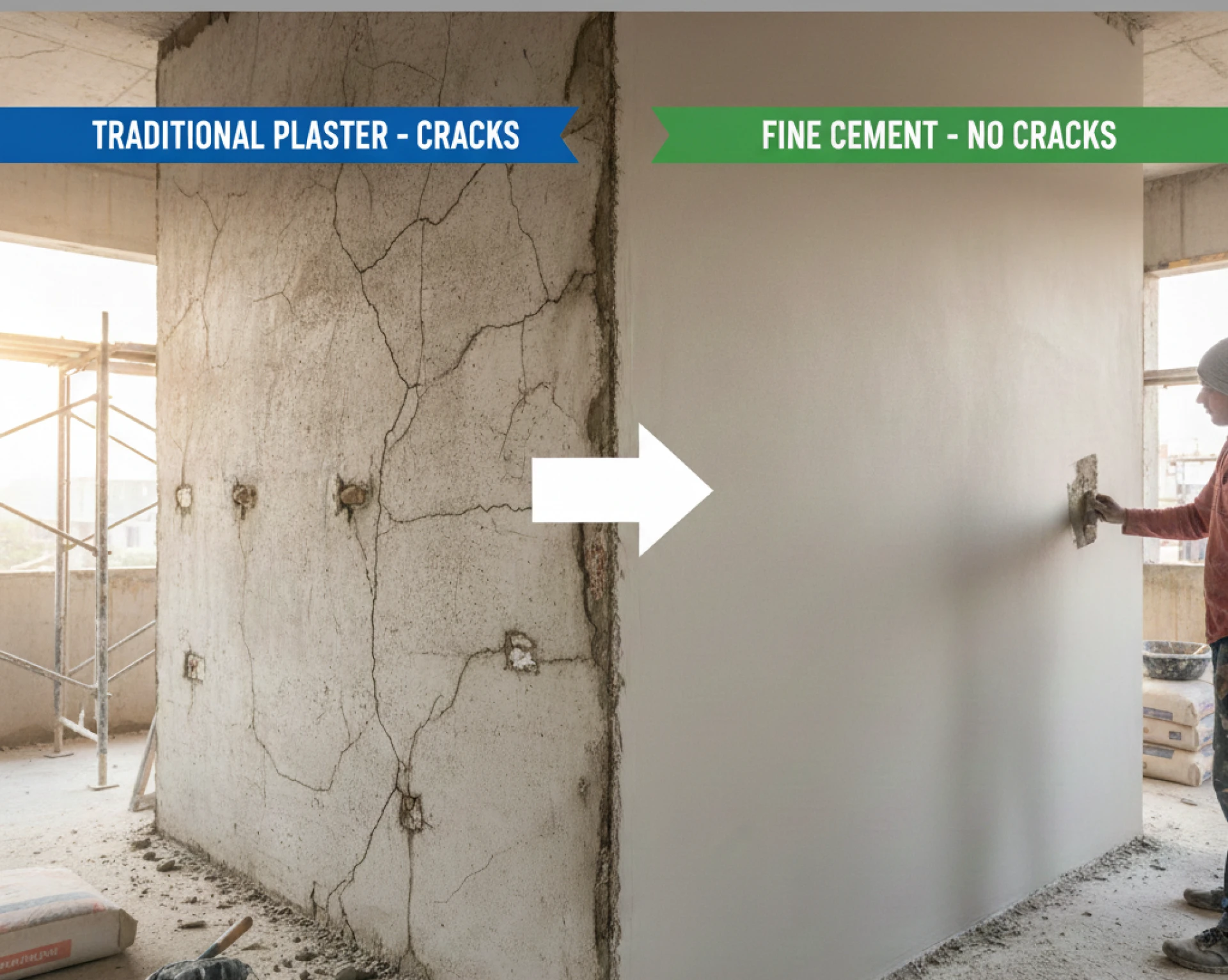
Plaster cracks are one of those problems which is not possible to manifest at the first glance. When the work is complete, the wall may appear smooth only to realise that several weeks or months later, thin lines (cracks) start to appear. In the long run, they expand, gather dust and ruin the surface of the space. Although cracks can be usually attributed to workmanship or curing, the quality and fineness of cement used in plastering is one of the most neglected aspects.
The nature of the fine cement is very significant in the behavior of plaster both during the application process, drying and during its long-term use. Knowing why the best cement for plastering is important can assist you in making better choices of materials and prevent repeated flaws in plaster.
What is Causing Cracks in Plaster?
It is worth knowing the reason why the cracks in plaster develop before knowing how fine cement can help in the process. The majority of the plaster cracks are as a result of stress in the course of drying or when the wall is in use. Some of the common causes are excessive shrinkage, bonding with the surface, uneven drying, thermal movement and inappropriate curing.
The plaster dries out and tends to draw in. Assuming that this shrinkage is either uneven or excessive, the surface becomes relieved through cracking. The amount of the plaster mix, most notably the cement, determines the extent to which it copes with this shrinkage to a large extent.
Explaining Fine Cement and Particle Size
The cement with smaller and more uniform grain is known as fine cement. This fineness influences the cement and water reaction and the mixing of the cement with sand in the plaster mix. The smaller the cement, the higher its surface area that enhances hydration and bonding.
The best cement for plastering forms a more cohesive, smoother layer that is thicker. It occupies inter-gravity spaces between sand particles better, and internal weaknesses that later develop into cracks are eliminated.
How Fine Cement Reduces Shrinkage Cracks
One of the main causes of cracking plasters is shrinkage. Larger cement grains do not hydrate evenly and thus different parts of the plaster layer dry off differently. Certain areas contract more than others, inducing internal stress.
Fine cement hydrates in a more uniform manner due to the uniform penetration of water and its reactions with cement during the whole mix. This is a regulated hydration that minimizes the sudden volume variations in the drying process. Consequently, internal stress of the plaster is reduced and the chances of shrinkage cracks are reduced significantly.
This is among the reasons why the best cement for plastering is usually regarded by contractors to use for both residential and commercial buildings.
Improved Bonding with Fine Cement
Plaster should adhesively join to the surface beneath it like on brick, concrete or blockwork. Weak areas where cracks can start are formed due to poor bonding.
Fine cement enhances sticking together by allowing its bond to be firmer with the surface and the sand particle in the mix. Its size is very small enabling it to infiltrate into the pores of the surface therefore anchoring the layer of plaster. Close bonding will make sure that the movement in the base structure is not concentrated in the weak points but the movement is distributed across.
Smoother Finish Means Fewer Surface Cracks
Surface cracks usually start as small defects, which increase with time. The smooth plaster surface derived by fine cement is better due to the fact that it will mix with sand better and will spread well when applied.
The smooth and dense finish contains less surface discontinuities where moisture can be lost quickly. This is to ensure consistent drying on the wall and minimize the development of hairline cracks which would normally originate at rough or irregular locations.
Increased Workability and Retention
Fine cement enhances the plaster mixes in terms of workability, and it becomes easy to spread and level. Good workability: The plaster may be laid on without troweling too much, thus making the surface weak.
It also increases the retention of water in the mix. Plaster takes a long time to dry and it becomes moist rather than dry too soon. Early-age cracking is usually due to rapid drying, particularly in hot or windy conditions.
Owing to this combination of workability and moisture retention, it is suggested to use the best cement for plastering on areas where durability and finish quality are of importance.
Role of Fine Cement in Long-Term Durability
Cracks do not appear instantly. It can develop over the years through slight structural movement, change in temperature and exposure to moisture. Fine cement helps in long-term durability as it creates a dense cement structure that prevents the entry of water and stress.
Thicker plaster will be less eminent at taking up excess moisture that will lead to expansion and contraction with the change of seasons. This stability causes the plaster layer to be stable with time.
Choosing the Right Cement for Plastering
When choosing the best cement for plastering, do not look at the brand names but pay attention to such properties as fineness, consistency and plastering appropriateness. Finishing cement has a tendency to be more efficient than general-purpose cement that is designed or graded.
It is believed by many professionals that fine grade cement is the most suitable cement to use in plastering due to enhanced workability, smooth finishing and minimal cracks particularly when properly used.
Final Thoughts
Plaster cracks do not simply represent cosmetic defects; they are an indication of material strain. Although this is important in workmanship and curing, fine cement also plays a vital part. Its capacity to hydrate uniformly, bond firmly, retain moisture and make smooth finish has made it one of the important considerations in crack free plaster.
By using the best cement for plastering and proper application techniques, one can save time, repair expenses as well as have a good-looking and durable wall in their home that stands year over years.