
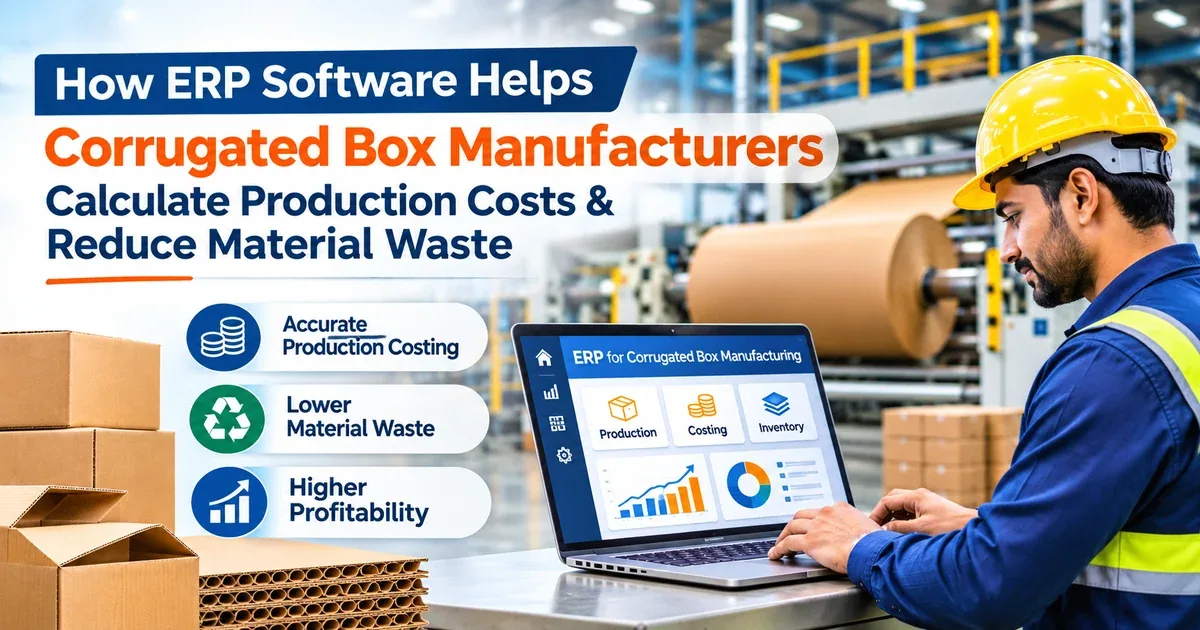
The corrugated packaging industry operates on tight production margins, where even small inefficiencies in paper consumption, machine operations, inventory management and production planning can significantly affect profitability.
Manufacturers must manage multiple paper grades, GSM specifications, flute combinations, production stages, customer-specific box dimensions and frequent order changes. Without accurate production data, calculating the actual cost of every box becomes difficult.
This is where ERP software for corrugated box manufacturers makes a difference.
An integrated ERP system connects production planning, Bill of Materials (BOM), inventory, procurement, quality control and financial management. It helps manufacturers monitor material consumption, compare planned and actual production costs, identify waste and make better operational decisions.
In this guide, we explore how corrugated box manufacturers can use ERP software to improve production costing, control raw material consumption and reduce avoidable manufacturing losses.
1. Why Production Costing Is Challenging for Corrugated Box Manufacturers
Corrugated box manufacturing involves several interconnected processes, from paper procurement to finished-product dispatch.
A typical production workflow includes:
- Raw material procurement and paper reel management.
- Paper preparation and corrugation.
- Single-face and double-wall board production.
- Sheet cutting and sizing.
- Printing and slotting.
- Die-cutting, folding and stitching or pasting.
- Quality inspection and finished-goods packaging.
- Dispatch and delivery.
Each production stage introduces different costs and potential material losses.
For example, a manufacturer producing custom-sized corrugated boxes may experience additional paper consumption because of incorrect sheet dimensions, inefficient cutting patterns, machine setup losses or rejected production batches.
Other common costing challenges include:
- Fluctuating kraft paper prices and supplier rates.
- Different GSM and paper-grade requirements.
- Changes in flute combinations and board thickness.
- Incorrect material consumption estimates.
- Unrecorded production scrap and damaged paper.
- Machine downtime and excess labor hours.
- Rework caused by printing or dimensional defects.
- Difficulty allocating overheads to individual orders.
When these activities are managed using disconnected spreadsheets or manual records, management may struggle to understand the actual cost of each production order.
An ERP system provides a centralized way to connect these activities and monitor their financial impact.
2. What Costs Should Be Included in Corrugated Box Manufacturing?
Before reducing production costs, manufacturers must understand what contributes to the total cost of a corrugated box.
A reliable costing process should consider direct material costs, conversion costs and production overheads.
A. Raw Material Costs
Paper is generally one of the major cost components in corrugated box manufacturing.
Depending on product specifications, raw material requirements may include:
- Kraft paper and recycled paper.
- Liner and fluting paper.
- Different GSM grades.
- Different flute combinations.
- Printing inks.
- Adhesives and starch.
- Stitching wire and other consumables.
The quantity and purchase cost of each material should be recorded against the relevant production order.
B. Conversion Costs
Conversion costs represent the expenses involved in transforming raw materials into finished packaging products.
These may include:
- Corrugation and board conversion.
- Printing and color setup.
- Cutting and slotting.
- Die-cutting.
- Folding, stitching and pasting.
- Labor and machine operating costs.
C. Production Overheads
Manufacturers should also account for indirect expenses, such as:
- Electricity consumption.
- Machine maintenance.
- Factory rent.
- Production supervision.
- Depreciation.
- Quality inspection.
- Other manufacturing-related expenses.
The basic manufacturing cost formula is:
Total Manufacturing Cost = Direct Material Cost + Direct Labor Cost + Machine and Conversion Cost + Allocated Manufacturing Overheads.
Cost Per Good Box = Total Manufacturing Cost ÷ Total Accepted Finished Boxes.
This distinction is important because the cost of materials issued to production is not necessarily the same as the cost of accepted finished products.
3. How ERP Software Improves BOM and Material Consumption Planning
A Bill of Materials (BOM) defines the components and quantities required to manufacture a particular product.
For corrugated box manufacturers, the BOM should reflect the approved product specification and manufacturing process.
Depending on the product, this may include:
| Specification | Role in production |
|---|---|
| Box length, width and height | Defines the finished box dimensions |
| GSM | Indicates paper grammage |
| BF | Helps specify the bursting-strength-related paper grade |
| Flute type | Defines the corrugated board structure |
| Number of plies | Determines the board construction |
| Paper grade | Defines the material requirement |
| Printing specifications | Defines ink and printing requirements |
| Adhesive requirements | Accounts for bonding materials |
An ERP system can maintain product-specific BOM records instead of relying on separate manual calculations for every customer order.
How ERP Helps
1. Standardized Material Specifications
Manufacturers can maintain approved material specifications for different box designs and product variants.
2. Planned Material Consumption
The BOM helps production teams estimate the quantity of paper and other materials required for a manufacturing order.
3. Production Order Visibility
The system connects customer orders with production requirements, material availability and manufacturing operations.
4. Material Consumption Comparison
By recording actual material issues and consumption, businesses can compare actual usage against planned requirements.
5. Better Cost Estimation
Updated material prices and consumption records help manufacturers calculate more reliable estimated production costs.
With accurate BOM management, manufacturers can reduce calculation errors and gain better control over material requirements.
4. How ERP Helps Reduce Paper Waste in Corrugated Manufacturing
Paper wastage is one of the operational challenges that corrugated box manufacturers need to monitor closely.
Waste can occur at different stages of production.
Common Sources of Paper Waste
| Production stage | Potential waste source |
|---|---|
| Paper procurement | Damaged or unsuitable paper reels |
| Corrugation | Edge trimming and startup losses |
| Paper reel handling | Splice losses and reel-end remnants |
| Sheet cutting | Incorrect dimensions and trim waste |
| Printing | Setup sheets and misprints |
| Die-cutting | Cutting-layout scrap |
| Production | Rejected boards and defective boxes |
| Storage | Moisture damage and improper handling |
ERP software helps manufacturers record material movements and identify where excess consumption is occurring.
Five Ways ERP Supports Waste Reduction
1. Better Raw Material Planning
ERP connects customer demand, production requirements and inventory availability.
This helps purchasing and production teams plan material procurement more accurately and avoid unnecessary stock accumulation.
2. Improved Paper Reel Tracking
Manufacturers can record paper reel details such as grade, GSM, supplier, batch or lot, width and available quantity.
This improves traceability and helps production teams select suitable materials for specific jobs.
3. Production-Level Waste Recording
Scrap, rejected boards, damaged materials and excess consumption can be recorded against the relevant manufacturing order.
This provides visibility into where production losses occur.
4. Better Production Scheduling
Coordinating similar production requirements may help reduce unnecessary machine setup changes, repeated adjustments and avoidable startup losses.
5. Waste Analysis and Reporting
Management can review waste quantities by machine, production order, material grade or production stage to identify recurring problems.
An ERP system does not automatically eliminate paper waste. Actual results depend on accurate production data, efficient machine settings, appropriate cutting plans and consistent process control.
5. How ERP Helps Calculate Actual Production Costs
One of the most valuable benefits of ERP software is the ability to compare estimated manufacturing costs with actual production costs.
Consider a corrugated box manufacturer receiving an order for 10,000 boxes.
The production department estimates paper consumption using the approved BOM.
However, actual paper consumption may be higher because of setup losses, trimming, damaged boards or production defects.
Illustrative Production Cost Example
Assume the following figures for one manufacturing order:
| Particulars | Planned consumption | Actual consumption |
|---|---|---|
| Accepted boxes | 10,000 | 10,000 |
| Paper consumption | 4,200 kg | 4,620 kg |
| Paper purchase rate | ₹54/kg | ₹54/kg |
| Paper cost | ₹2,26,800 | ₹2,49,480 |
Actual additional paper consumption:
4,620 kg − 4,200 kg = 420 kg.
Additional material cost:
420 kg × ₹54 = ₹22,680.
This means the order consumed ₹22,680 more in paper than its planned material allowance.
The consumption variance against the planned quantity is 10%.
This does not automatically mean that the entire additional quantity became scrap. The production team should investigate whether it resulted from trimming, startup material, rework, incorrect planning or other operational reasons.
How ERP Helps in This Situation
An ERP-enabled production process can help management:
- Compare estimated and actual material consumption.
- Record paper issued against each production order.
- Track rejected quantities and production scrap.
- Review material purchase-price changes.
- Calculate actual manufacturing costs.
- Identify orders with higher-than-planned consumption.
This gives management a clearer picture of where additional production costs are coming from.
6. How ERP Improves Production Planning and Machine Utilization
Poor production planning can increase manufacturing costs even when raw material prices remain unchanged.
For example, frequent changes in box dimensions, printing requirements and board specifications can result in additional machine setup time and production interruptions.
ERP software helps manufacturers coordinate production requirements across departments.
Key Production Planning Capabilities
Production Scheduling
Production orders can be planned according to delivery commitments, material availability and machine capacity.
Work Order Management
Each manufacturing stage can be tracked through its respective work order.
Work-in-Progress Tracking
Production teams can monitor the progress of orders across different manufacturing stages.
Machine and Work Centre Management
Machine capacity, planned operations, operating time and downtime can be monitored.
Production Delay Monitoring
Managers can identify delayed orders and take corrective action before delivery commitments are affected.
With better production visibility, manufacturers can coordinate resources more effectively and improve production efficiency.
7. How ERP Improves Inventory Management and Procurement
Inventory management is critical because corrugated box production depends on consistent raw material availability.
A shortage of a particular paper grade can delay production, while excessive purchases can increase inventory carrying costs.
An ERP-based inventory management process can connect purchasing, warehouse operations and production requirements.
Important capabilities include:
- Real-time raw material stock visibility.
- Paper reel and batch tracking.
- Inventory valuation.
- Purchase order management.
- Supplier and purchase-price records.
- Reorder level monitoring.
- Material reservation for production.
- Finished-goods stock tracking.
For example, when a new production order is confirmed, the system can help the team review whether the required paper grades and other materials are available.
Where configured, replenishment rules can also support timely purchasing decisions.
This helps reduce avoidable procurement delays and improves coordination between purchasing and production teams.
8. How Odoo ERP Supports Corrugated Box Manufacturing
Odoo ERP offers integrated applications for manufacturing, inventory, purchase, sales, accounting and quality management.
These applications can be configured to support corrugated box manufacturing workflows.
Important Odoo ERP Applications
| Odoo application | Manufacturing use case |
|---|---|
| Manufacturing (MRP) | Production orders, BOMs and work orders |
| Inventory | Raw material, semi-finished and finished-goods tracking |
| Purchase | Supplier management and procurement |
| Sales | Customer orders and quotations |
| Quality | Production quality checkpoints |
| Maintenance | Preventive maintenance and equipment management |
| Accounting | Production-related financial records and reporting |
Connecting the Manufacturing Process
An Odoo-based ERP implementation can connect the following workflow:
Customer Enquiry → Quotation → Sales Order → BOM → Material Planning → Manufacturing Order → Work Orders → Quality Inspection → Finished Goods → Dispatch → Accounting
This integrated approach helps departments work with connected operational and financial information.
Odoo's manufacturing cost functionality distinguishes between the expected manufacturing order cost and the actual manufacturing order cost. Its documentation explains that component quantities, operations and work-centre costs contribute to cost calculations, while actual costs can vary when consumption, operation duration or component prices change.
For more details, refer to the official Odoo manufacturing cost documentation.
Important: Advanced corrugated-specific requirements, such as specialized reel optimization, machine connectivity, custom production formulas or detailed waste dashboards, may require additional configuration, customization or third-party integrations. These requirements should be evaluated during ERP implementation.
9. Key KPIs Corrugated Box Manufacturers Should Monitor
An ERP dashboard becomes more useful when it provides measurable operational indicators.
The following KPIs can help manufacturing managers monitor production performance.
| KPI | What it measures |
|---|---|
| Material Consumption Variance | Difference between planned and actual material consumption |
| Material Waste Percentage | Proportion of material recorded as waste |
| Production Rejection Rate | Percentage of rejected finished products |
| Production Cost Per Box | Total manufacturing cost per accepted box |
| Machine Utilization | Actual productive machine time against available time |
| Production Lead Time | Time required to complete a manufacturing order |
| On-Time Delivery | Percentage of orders delivered as scheduled |
| Inventory Turnover | How frequently inventory is consumed and replenished |
Important Manufacturing Formulas
Material Consumption Variance (%)
= (Actual Consumption − Planned Consumption) ÷ Planned Consumption × 100
Material Waste Percentage
= Recorded Material Waste ÷ Total Material Issued × 100
Production Rejection Rate (%)
= Rejected Finished Units ÷ Total Units Produced × 100
Production Cost Per Box
= Total Manufacturing Cost ÷ Accepted Finished Units
These metrics should use consistent units, clearly defined reporting periods and reliable shop-floor data.
For example, production material waste should be measured separately from finished-product rejection so that management can identify the actual source of losses.
10. How to Choose the Right ERP Software for a Corrugated Box Manufacturing Business
Not every ERP solution is designed for the same manufacturing environment.
Before selecting an ERP system, corrugated box manufacturers should evaluate their existing processes and business requirements.
Here are some important considerations:
- BOM and Product Configuration: Can the software manage different box sizes, GSM specifications, flute types and product variants?
- Production Management: Can it manage corrugation, printing, cutting, slotting, die-cutting and finishing workflows?
- Material Tracking: Can it track paper reels, different paper grades, batches and material consumption?
- Job Costing: Can management compare estimated and actual costs for each production order?
- Waste Management: Can scrap, rejected material and production losses be recorded and analyzed?
- Inventory Management: Does it provide visibility into raw materials, work-in-progress and finished goods?
- Quality Management: Can quality checkpoints be configured according to product and manufacturing requirements?
- Reporting and Analytics: Can management access useful production, inventory and financial reports?
- Scalability: Can the system support additional machines, production locations, users and business processes as the company grows?
- Implementation and Support: Does the implementation partner understand manufacturing operations and provide customization, training and ongoing support?
The right ERP solution should fit the manufacturer's actual production process rather than forcing the business to depend on disconnected manual workarounds.
11. Frequently Asked Questions (FAQs)
1. What is the best ERP software for corrugated box manufacturers?
The best ERP software depends on the manufacturer's production workflows, costing requirements, inventory complexity and business size. Solutions such as Odoo ERP can be configured to connect manufacturing, inventory, procurement, sales and accounting operations.
2. How does ERP reduce material waste in corrugated box manufacturing?
ERP helps track material consumption, record production scrap, compare planned and actual usage, manage inventory and analyze material losses across manufacturing stages. This information helps managers identify waste sources and take corrective action.
3. How can corrugated box manufacturers calculate production costs?
Manufacturers should calculate direct material costs, labour, machine and conversion costs, and allocated manufacturing overheads. Dividing the total manufacturing cost by the number of accepted finished boxes provides the production cost per box.
4. Can Odoo ERP manage paper reel inventory?
Odoo Inventory supports product and lot tracking, stock movements and warehouse management. Corrugated manufacturers can configure their inventory processes to manage paper reel details, grades, quantities and traceability based on their requirements.
5. What is the role of BOM in corrugated box manufacturing?
A Bill of Materials defines the components and quantities required to manufacture a product. It helps standardize material requirements, estimate production costs and compare planned consumption with actual usage.
6. Can ERP calculate actual manufacturing costs?
Yes. An appropriately configured manufacturing ERP can calculate expected and actual manufacturing costs using component consumption, operation costs and other configured cost elements. Accurate results depend on timely and correct production data.
7. How does ERP improve production planning?
ERP connects customer orders, material availability, manufacturing orders, work centers and production schedules. This helps teams coordinate manufacturing activities, monitor work in progress and identify potential delays.
8. Is ERP suitable for small and medium-sized corrugated box manufacturers?
Yes. Small and medium-sized manufacturers can start with the modules that address their immediate requirements, such as inventory, manufacturing, purchase and accounting, and expand the system as their business grows.
9. What is the difference between planned and actual production cost?
Planned production cost is the estimated cost based on product specifications, material requirements and planned operations. Actual production cost reflects the resources and expenses recorded during manufacturing. Differences can result from excess consumption, machine delays, material-price changes or rework.
10. How long does ERP implementation take for a corrugated box manufacturing company?
Implementation time depends on the number of modules, manufacturing complexity, data migration, customization, integrations, testing and user training. A detailed business-process assessment is necessary before estimating an implementation timeline.
Conclusion: Build a More Cost-Controlled Corrugated Box Manufacturing Business with ERP
Corrugated box manufacturers need accurate costing, efficient production planning and better control over raw material consumption to maintain healthy profit margins.
Manual spreadsheets and disconnected systems often make it difficult to understand where additional manufacturing costs and material losses originate.
An integrated ERP system helps bring production, inventory, procurement, quality and financial information together. By monitoring planned versus actual consumption, tracking production losses and improving operational visibility, manufacturers can make more informed business decisions.
With the right Odoo ERP implementation, corrugated box manufacturers can move towards more controlled production processes, transparent costing and improved business efficiency.
Looking to Improve Your Corrugated Box Manufacturing Operations?
Cloudmonte Technologies helps businesses implement and customize ERP solutions to connect manufacturing, inventory, costing, procurement and business operations.
Whether you want to improve production visibility, strengthen material tracking or establish better manufacturing cost control, the right ERP strategy can help your business build a more connected operation.
Talk to Cloudmonte Technologies about your packaging ERP requirements.
Website: https://cloudmonte.com/
Phone: +91-8448249830
Explore ERP for Packaging Industry