Introduction
Field service operations depend on how quickly technicians can access information, diagnose problems, and complete service requests. However, disconnected systems, delayed work-order updates, inaccurate scheduling, and limited visibility into equipment conditions can slow down even experienced field teams.
Enterprise mobile applications address these challenges by connecting technicians, dispatchers, customers, and back-office systems through a shared operational platform. With real-time data integration, artificial intelligence (AI), and predictive analytics, businesses can move beyond manual service coordination toward more proactive and data-driven field operations.
For organizations managing distributed technicians across utilities, manufacturing, telecommunications, HVAC, and equipment maintenance, working with an experienced enterprise mobile app development company can help build applications around their operational requirements.
1. Real-Time Data Access Improves Technician Decision-Making
Field technicians often need information from multiple systems before they can resolve a service request. This may include equipment history, customer details, warranty information, maintenance records, and previous repair reports.
Without centralized mobile access, technicians may need to contact dispatchers or return to the office to retrieve missing information.
Enterprise mobile applications bring these records together through integrations with enterprise resource planning (ERP), customer relationship management (CRM), asset management, and field service management (FSM) platforms.
For example, when a technician visits an industrial facility to repair a malfunctioning machine, the application can provide:
- Equipment identification and maintenance history.
- Previous fault reports and troubleshooting instructions.
- Available spare parts and inventory information.
- Customer service agreements and warranty details.
- Current work-order status and inspection requirements.
Technicians can also update job progress, upload inspection photographs, record replacement parts, and capture customer approvals directly from their devices.
This creates a consistent information flow between field teams and operations managers, reducing manual reporting and improving service visibility.
2. AI-Powered Scheduling and Dispatching Reduce Operational Delays
AI can improve these workflows by evaluating multiple operational factors simultaneously, including:
- Technician availability, location, and technical certifications.
- Job urgency and service-level agreement (SLA) deadlines.
- Spare-part availability and equipment requirements.
- Traffic conditions, weather, and estimated travel times.
- Technician workload and existing appointment commitments.
For example, if an industrial refrigeration unit reports abnormal operating temperatures, an AI-enabled system can prioritize the service request and identify technicians with relevant refrigeration expertise.
The application can then recommend an available technician who has the required tools and replacement components.
According to IBM's March 2026 field service management research, AI-driven scheduling can consider technician training, proximity, and parts availability when optimizing dispatch decisions.
This approach helps businesses reduce unnecessary travel, improve resource allocation, and minimize scheduling conflicts.
3. Predictive Maintenance Helps Prevent Equipment Failures
Traditional maintenance operations often depend on fixed schedules or customer-reported equipment failures. Both approaches can result in unnecessary maintenance visits or unexpected downtime.
Enterprise mobile applications integrated with IoT sensors and AI-powered analytics enable businesses to monitor equipment conditions continuously.
These systems collect operational information such as:
- Equipment temperature and vibration levels.
- Pressure readings and energy consumption.
- Operating hours and performance fluctuations.
- Historical maintenance and failure records.
- Sensor-generated alerts and abnormal operating patterns.
Machine learning models analyze these signals to identify unusual patterns that may indicate developing equipment problems.
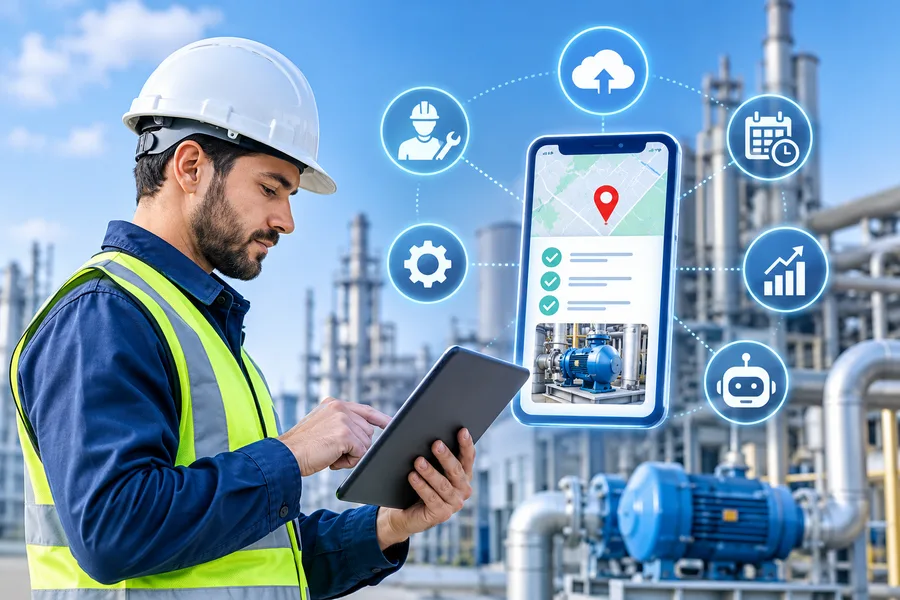
For example, a manufacturing company can monitor industrial motors through connected sensors. If the system detects unusual vibration patterns, it can generate a maintenance alert, create a service request, and notify the appropriate technician through the mobile application.
The technician receives the equipment history, suspected fault, and recommended inspection steps before arriving at the facility.
IBM identifies predictive maintenance as a major AI application in field service, particularly for identifying potential equipment failures through IoT sensor data and scheduling interventions before disruptions occur.
4. Offline-First Capabilities Keep Technicians Productive
Field technicians frequently work in remote industrial facilities, underground infrastructure, construction sites, and locations with inconsistent network coverage.
An enterprise mobile application should therefore support offline-first functionality rather than depending entirely on continuous internet connectivity.
Important offline capabilities include:
- Accessing previously downloaded work orders and equipment records.
- Viewing maintenance instructions and inspection checklists.
- Recording repair activities and equipment readings.
- Capturing photographs, signatures, and customer approvals.
- Saving completed work for synchronization when connectivity returns.
Microsoft Dynamics 365 Field Service documentation explains how mobile applications can download relevant records to devices and synchronize updates when connectivity becomes available.
However, offline synchronization requires careful engineering.
For example, a technician may update a work order while offline, while a dispatcher simultaneously changes its schedule. When the device reconnects, the application must identify and handle conflicting updates rather than silently overwriting important operational information.
Businesses should establish synchronization rules, conflict-resolution policies, timestamps, and audit trails to maintain reliable records.
5. AI Assistants Improve On-Site Troubleshooting
Another important development in enterprise mobile applications is the integration of AI-powered assistants that help technicians access technical knowledge while performing repairs.
Instead of manually searching through equipment manuals or contacting senior engineers, technicians can interact with an AI assistant through natural-language queries.
For example, a technician servicing an industrial generator could ask:
What could cause repeated overheating in this generator model, and which diagnostic checks should I perform first?
An enterprise AI assistant connected to approved maintenance documentation can retrieve relevant troubleshooting instructions, inspection procedures, and historical repair records.
Useful capabilities include:
- Context-aware troubleshooting recommendations.
- AI-generated summaries of previous maintenance activities.
- Search across equipment manuals and technical documents.
- Image recognition for identifying equipment components.
- Remote expert assistance through video or augmented reality.
- Automatic generation of service reports.
Salesforce's field service AI guidance highlights technician assistance through repair instructions, predictive analytics, and remote expert support. Its 2026 Dreamforce content also features a dedicated session on AI within the field service mobile application, indicating continued industry attention to this area.
Importantly, AI-generated repair recommendations should remain advisory for safety-critical operations. Technicians must follow approved procedures and retain control over critical maintenance decisions.
6. Enterprise Integrations Create Connected Field Service Workflows
A mobile application delivers greater operational value when it connects with existing enterprise systems instead of functioning as an isolated tool.
For example, integrating mobile applications with ERP, CRM, FSM, and inventory management platforms allows businesses to coordinate service activities across departments.
Consider an equipment maintenance company receiving an urgent customer complaint.
A connected workflow could operate as follows:
- The CRM system creates a service request using customer and asset information.
- The FSM platform generates a work order and identifies the required technician.
- The mobile application delivers job details, equipment history, and navigation.
- The technician records inspection findings and replacement components.
- The inventory system updates spare-part consumption.
- The application submits the completed service report and updates the work order.
This connected workflow reduces duplicate data entry and provides managers with better visibility into service activities.
Businesses planning such systems can evaluate Mobile Application Development Services to integrate mobile workflows with existing enterprise infrastructure. Similarly, React Native App Development Solutions can support cross-platform application development when organizations need consistent experiences across iOS and Android devices.
7. What Should Businesses Prioritize When Developing an Enterprise Field Service App?
Selecting the right development approach requires more than identifying useful mobile features. Businesses must consider operational complexity, integration requirements, security, and long-term scalability.
An experienced enterprise mobile app development company should evaluate the following areas:
Development priorityWhat businesses should evaluateSystem integrationCompatibility with existing ERP, CRM, FSM, and IoT platformsData securityRole-based access, encryption, authentication, and audit loggingOffline functionalityReliable local storage and synchronization conflict handlingAI implementationData quality, model accuracy, explainability, and human oversightScalabilitySupport for increasing technicians, assets, and service requestsUser experienceSimple navigation, accessible interfaces, and minimal manual input
Security deserves particular attention because field applications may contain customer records, equipment information, location data, and operational credentials.
Businesses should also monitor measurable operational indicators, including first-time fix rate, mean time to repair, technician utilization, SLA compliance, repeat visits, and equipment downtime.
During enterprise application planning, Debut Infotech emphasizes aligning mobile technology with business workflows, integration requirements, and long-term operational needs rather than treating application development as an isolated technology project.
Conclusion
Enterprise mobile applications are becoming an important part of modern field service operations. By combining real-time data access, intelligent scheduling, predictive maintenance, AI-assisted troubleshooting, and offline functionality, businesses can improve coordination between field technicians and operational teams.
However, successful implementation depends on reliable enterprise integrations, accurate operational data, secure architecture, and practical workflows that technicians can use in real working conditions.
Organizations evaluating an enterprise mobile app development company should prioritize solutions that connect existing systems, support AI-driven decision-making, and remain adaptable as their field service requirements evolve.