
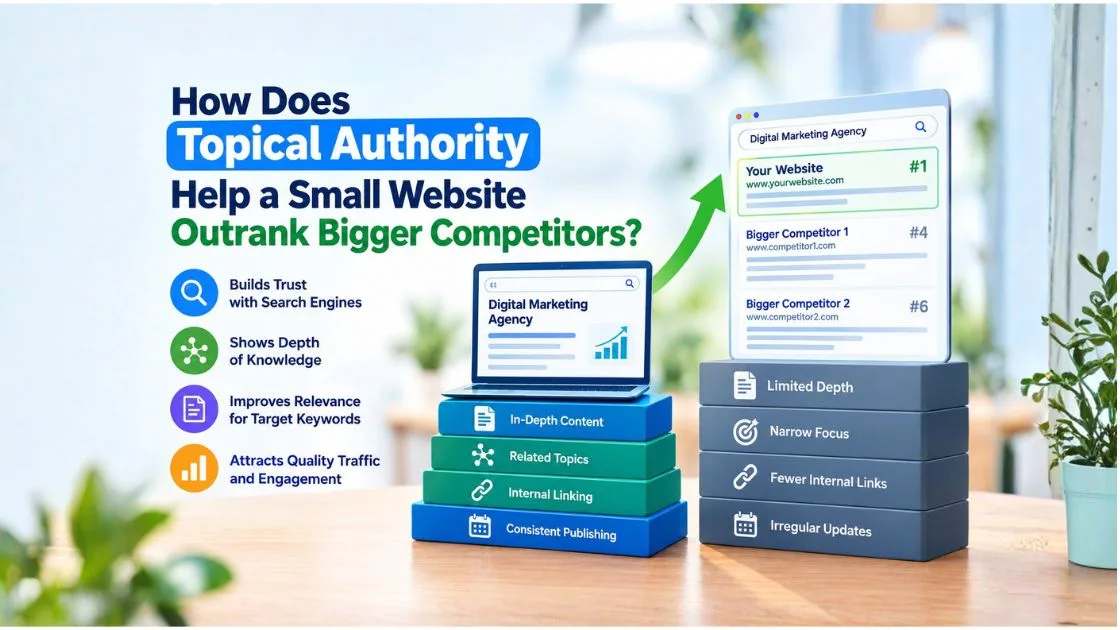
Summary - Topical authority helps small websites compete with larger competitors by building comprehensive, useful content around a specific subject. Through topic clusters, relevant internal links, long-tail keyword targeting, and original insights, businesses can improve their relevance for specific searches. For businesses in Pimpri-Chinchwad, combining topical authority with local SEO can help attract relevant visitors, strengthen search visibility, and generate qualified enquiries.
What Is Topical Authority in SEO?
Topical authority refers to how comprehensively and usefully a website covers a particular subject. Instead of publishing disconnected articles, a website builds a connected collection of content that answers related questions and addresses different user needs.
For example, a website covering digital marketing could publish detailed resources about keyword research, technical SEO, content optimization, internal linking, local search, and performance measurement. Together, these resources help visitors understand the subject from different perspectives.
Topical authority is an SEO concept rather than an official Google score. Google does not guarantee higher rankings simply because a website publishes many related articles. Content must still be useful, relevant, trustworthy, and aligned with what people are searching for.
How Topical Authority Differs From Domain Authority
Domain authority is a third-party metric used by SEO tools to estimate a website's ranking strength. Topical authority, by contrast, describes the depth and relevance of a website's coverage of a particular subject.
A large website may have numerous backlinks and a strong overall reputation but provide only a brief answer to a specific question. A smaller specialist website may offer a more detailed explanation, practical examples, and directly relevant information.
This creates an opportunity for smaller websites to compete for particular queries, although the outcome depends on the search term, competition, and many other ranking signals.
Is Topical Authority an Official Google Ranking Factor?
Google does not publish an official topical authority score that website owners can optimize for. However, creating helpful, reliable, people-first content and organizing relevant information effectively are sensible SEO practices.
The goal should be to demonstrate genuine knowledge, answer user questions clearly, and provide information that is more useful than a superficial overview.
How Does Topical Authority Help a Small Website Outrank Bigger Competitors?
A smaller website does not need to cover every industry or target every popular keyword. It can focus on a specific subject and serve a well-defined audience more effectively.
1. Builds Stronger Relevance Around a Specific Subject
When a website consistently publishes useful content about a related set of topics, it creates a clearer experience for readers and a more organized structure for search engines to discover.
Consider a small website that specializes in website development. It could cover website planning, e-commerce development, mobile usability, technical maintenance, conversion optimization, and website security.
Each article addresses a different need while supporting the site's central subject. This approach is more coherent than publishing unrelated content simply to increase blog traffic.
2. Helps Target Less Competitive Long-Tail Keywords
Broad keywords often attract established competitors. Long-tail keywords provide opportunities to target more specific questions and requirements.
For example, a small business serving Pimpri-Chinchwad may find it difficult to compete immediately for a broad search such as “SEO services.” It could instead develop useful content around local SEO challenges, Google Business Profile optimization, or improving organic visibility for a specific business category.
These searches may have lower demand individually, but they can connect a business with users who have clearer needs.
Keyword selection should be based on relevance, search intent, and realistic competition rather than assumptions that every long-tail phrase is easy to rank for.
3. Covers Search Intent More Completely
Search intent describes what a user wants to accomplish through a query. Some people want an explanation, others are comparing providers, and others are ready to purchase a product or service.
A strong content strategy addresses these different needs with appropriate pages.
For example, someone researching topical authority may need a practical guide to topic clusters. A business owner evaluating SEO support may want information about deliverables, reporting, local keyword research, and realistic expectations.
By matching each page to its intended audience, a website can become more useful throughout the customer journey.
4. Creates Context Through Internal Linking
Internal links connect related pages on the same website. They help visitors navigate supporting information and make it easier for search engines to discover and understand page relationships.
A comprehensive guide to topical authority might link to separate articles about keyword research, content planning, technical SEO, and internal linking.
The links should appear where they genuinely help the reader. Descriptive anchor text is preferable to repeatedly using generic phrases such as “click here.”
A logical internal linking structure also helps prevent useful articles from becoming isolated pages that are difficult to discover.
5. Demonstrates Firsthand Experience and Subject Expertise
Original insights can make a smaller website more valuable than content that merely repeats existing articles.
Businesses can demonstrate expertise through practical examples, documented processes, original research, expert explanations, customer questions, and relevant case studies.
For example, a digital marketing business could explain how it groups related keywords, identifies content gaps, or measures qualified organic enquiries. Any performance figures should be supported by genuine data rather than invented results.
Useful evidence, accurate explanations, and transparent authorship help readers evaluate the credibility of the information.
6. Builds Organic Visibility Across Related Searches
A well-planned collection of related articles can help a website appear for different searches connected to its main subject.
One comprehensive guide may address a broad question, while supporting articles answer specific questions about individual techniques or common problems.
This creates multiple relevant entry points for users. However, every article should have a distinct purpose. Publishing several pages that answer essentially the same question can create unnecessary duplication and keyword cannibalization.
How to Build Topical Authority for a Small Website Step by Step?
Building topical authority requires planning, useful content, and ongoing evaluation. Small businesses can begin with a focused subject instead of trying to publish dozens of articles at once.
Step 1: Choose a Focused Niche and Core Topic
Start with the subjects that align with your expertise, audience, and business objectives.
A manufacturing company might focus on industrial components and maintenance guidance. A digital marketing website could focus on organic search, local SEO, content strategy, and website optimization.
For a business serving PCMC, the content should reflect its actual services and customer needs rather than adding locality names without useful local information.
Step 2: Conduct Topic-Based Keyword Research
Identify a primary topic, supporting keywords, and the questions users ask before making decisions.
Useful research sources include Google Search Console, keyword research tools, Google autocomplete, related searches, and customer enquiries.
Group keywords according to intent. An informational query generally deserves an educational article, while a commercial query may be better served by a dedicated service or comparison page.
This prevents the website from creating unnecessary pages for minor keyword variations.
Step 3: Create a Pillar Page and Supporting Topic Clusters
A pillar page provides a broad overview of a subject, while supporting articles explore specific subtopics in greater detail.
For example, a website building topical authority around SEO could publish a central SEO guide supported by articles about technical SEO, local keyword research, content optimization, backlink evaluation, and search performance reporting.
The pillar page should link to relevant supporting resources, and those resources should link back when useful. Each page must offer distinct value rather than repeating the same information.
Step 4: Publish Helpful, In-Depth Content With Original Insights
Content depth is not simply a matter of word count. A useful article answers the main question, explains important details, addresses common concerns, and provides actionable advice.
Use examples relevant to your audience and cite reliable sources for factual claims. Where possible, include original observations, practical checklists, screenshots, or verified case studies.
Avoid producing large volumes of near-identical articles just to target more keywords. A smaller collection of genuinely useful resources can be a better starting point.
Step 5: Strengthen Internal Linking and Content Architecture
Organize content into logical categories and connect related pages through descriptive contextual links.
Make sure important pages are accessible through the site's navigation or relevant internal links. Review older content to identify opportunities to link to newly published resources.
A clear structure supports discovery and helps users move naturally from general information to more specific guidance.
Step 6: Update Existing Content and Fill Topic Gaps
Review existing articles to identify outdated information, missing explanations, overlapping content, and unanswered user questions.
Update content when there is a meaningful reason to do so, such as a change in industry guidance, new evidence, or a clearer explanation. Combine overlapping pages when appropriate and preserve useful information.
Use search performance data to prioritize improvements rather than updating every article on an arbitrary schedule.
How a Small Website Can Outrank a Larger Competitor?
Imagine a small website focused on organic gardening competing with a large general-interest publisher.
Rather than trying to cover every gardening subject, the smaller site could create a comprehensive guide to growing tomatoes, supported by useful articles about watering schedules, soil selection, common plant diseases, container gardening, and yellowing leaves.
Each article addresses a specific question and links to related resources where appropriate.
This approach gives the site opportunities to compete for particular searches by offering relevant, practical answers. It does not guarantee higher rankings, but it creates a more focused and useful resource for people interested in growing tomatoes.
The same principle can apply to businesses in Pimpri-Chinchwad. A company that serves a clearly defined industry can develop connected resources addressing its customers' technical questions, buying considerations, and common problems.
Topical Authority vs. Backlinks: What Matters More for Small Websites?
Topical authority and backlinks serve different purposes. Comprehensive content helps address user needs, while relevant backlinks can help users discover resources and may contribute to search visibility.
Can a Website With Fewer Backlinks Outrank a High-Authority Website?
Yes, a smaller website can outrank a larger competitor for particular queries. This can happen when its page better matches the query or provides more useful, relevant information.
However, backlink profiles, competition, technical accessibility, content quality, and other signals can also affect rankings. Fewer backlinks do not automatically create an advantage.
Should Small Websites Focus on Content or Link Building First?
Begin by making sure the website has useful pages, a clear structure, and a sound technical foundation. Then build visibility through relevant content promotion, professional relationships, legitimate industry publications, and naturally earned links.
Avoid purchasing links intended to manipulate rankings. Paid promotional links should be appropriately qualified in accordance with search engine guidelines.
Common Topical Authority Mistakes Small Websites Should Avoid
Several mistakes can undermine a topical authority strategy:
- Publishing unrelated articles simply to increase content volume.
- Creating multiple pages that target the same search intent.
- Repeating keywords unnaturally throughout articles.
- Producing thin content with little original value.
- Neglecting internal links between relevant resources.
- Publishing unsupported claims or fabricated case studies.
- Expecting instant rankings after publishing a topic cluster.
- Treating backlinks or third-party authority scores as the only measures of success.
The better approach is to prioritize relevance, originality, useful organization, and consistent improvements.
How to Measure Whether Your Topical Authority Strategy Is Working?
There is no official Google metric that directly measures topical authority. Instead, evaluate the website's search performance and the quality of its content coverage.
Google Search Console can help you track impressions, clicks, queries, and page-level performance. Website analytics can help you understand visitor behaviour and conversions.
Review whether more relevant queries are generating impressions, priority pages are attracting organic traffic, and visitors are completing meaningful actions such as submitting enquiry forms or requesting quotations.
For businesses in PCMC, this may include evaluating whether local service pages attract relevant visitors from the areas the business genuinely serves.
Measure performance over time and investigate changes before drawing conclusions. More impressions alone do not necessarily mean more qualified leads.
How Long Does It Take to Build Topical Authority?
There is no fixed timeline for building topical authority. Progress depends on the website's existing reputation, technical condition, competition, content quality, and how effectively the pages satisfy search intent.
New websites may need time to establish visibility, while established sites may improve through stronger content organization and meaningful updates.
Focus on creating useful resources consistently, improving existing pages, and monitoring performance. Avoid promises that publishing a specific number of articles will guarantee rankings within a set number of weeks.
Ready to Build Stronger Search Visibility for Your Website?
Outranking bigger competitors starts with a focused subject, useful content, and a clear understanding of what your audience wants to know. Build your content around real customer questions, connect related resources, and use performance data to guide improvements.
For businesses that want to strengthen their local search presence, working with an experienced SEO agency in PCMC can help identify content gaps, improve local keyword targeting, organize topic clusters, and develop a measurable organic growth strategy.
Before choosing an SEO partner, review its approach to content quality, technical SEO, reporting, and lead generation. Prioritize a strategy that builds sustainable visibility and attracts the right audience instead of promising guaranteed rankings.
Frequently Asked Questions About Topical Authority
Can a Small Website Outrank a High-Authority Website on Google?
Yes. A smaller website can rank above a larger competitor for specific searches when its content is more relevant and useful. Rankings depend on multiple factors, so topical focus alone does not guarantee success.
How Many Articles Does a Website Need to Build Topical Authority?
There is no fixed number. The right amount depends on the subject's complexity and the questions the audience needs answered. Prioritize meaningful coverage over publishing a predetermined number of articles.
What Is the Difference Between Topical Authority and Domain Authority?
Topical authority describes a website's depth and relevance within a subject. Domain authority is a third-party SEO metric that estimates domain strength; it is not an official Google ranking score.
Do Topic Clusters Improve Google Rankings?
Topic clusters can improve content organization, internal linking, and coverage of related user questions. Their structure can support an SEO strategy, but creating a cluster does not automatically improve rankings.
How Can I Check My Website's Topical Authority?
Review your topic coverage, content quality, internal links, search queries, organic traffic, and relevant conversions. Google Search Console provides useful performance data, but it does not provide an official topical authority score.