
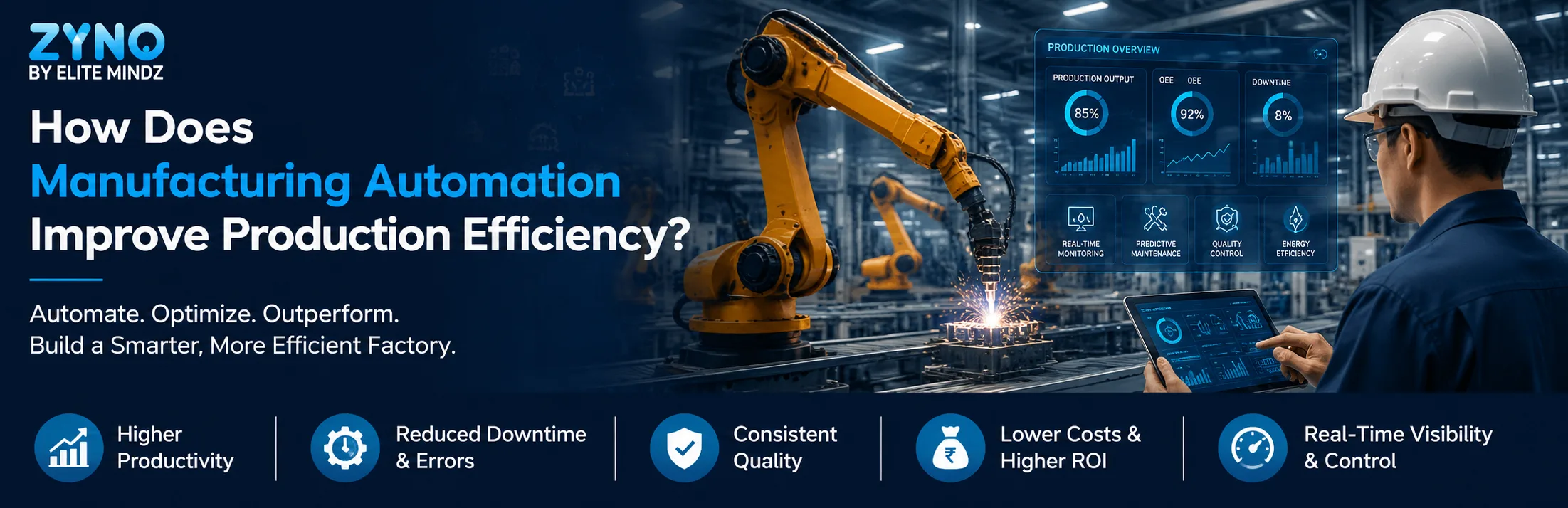
Manufacturing floors across India and beyond are under constant pressure to produce more, waste less, and deliver faster, all while managing rising labor costs and tighter margins. This is exactly where manufacturing automation has become less of an option and more of a necessity. Factories that once relied entirely on manual scheduling, paper-based tracking, and human judgment for every decision are now shifting toward automated systems that handle repetitive, data-heavy tasks with far greater speed and accuracy.
But automation isn't just about replacing manual labor with machines. It's about connecting every stage of production, from planning to shop floor execution to inventory, so decisions happen faster and with fewer errors. In this blog, we'll break down exactly how manufacturing automation improves production efficiency and what factories should look for when adopting it.
What Is Manufacturing Automation?
Manufacturing automation refers to the use of technology, software, and machinery to perform production tasks with minimal human intervention. This spans everything from automated production planning and scheduling to real-time inventory tracking, quality checks, and workflow automation across departments.
Modern manufacturing software goes beyond simple task automation. It integrates production management, supply chain visibility, and factory management into a single connected system, which is often built on top of an ERP system or a dedicated ERP software platform designed specifically for manufacturers.
Key Ways Automation Improves Production Efficiency
1. Smarter Production Planning and Scheduling
One of the biggest inefficiencies in traditional manufacturing comes from poor production planning. When schedules are created manually or based on outdated data, factories end up with idle machines, delayed orders, or overworked shifts.
Automated production management tools use real time data on machine availability, raw material stock, and order priority to generate optimized production schedules. This reduces downtime significantly and ensures machines and labor are used where they're needed most.
2. Reduced Manual Errors in the Manufacturing Process
Manual data entry across the manufacturing process is one of the biggest sources of costly mistakes, whether it's incorrect inventory counts, missed quality checks, or duplicate work orders. Process automation removes much of this risk by capturing data directly from machines, sensors, or digital work orders instead of relying on manual logs.
Fewer errors translate directly into fewer reworks, less material waste, and smoother production runs.
3. Real Time Visibility Across the Factory
Traditional factory management often means managers only find out about a bottleneck after it has already delayed production. With digital manufacturing tools, floor managers get real time dashboards showing machine status, production progress, and pending tasks.
This kind of visibility allows teams to respond to problems within minutes instead of hours, which has a direct impact on overall production efficiency.
4. Tighter Inventory and Supply Chain Coordination
Inventory management and supply chain delays are two of the most common reasons production lines stop. When raw material stock isn't tracked accurately, production planning becomes guesswork.
Automated inventory management systems sync stock levels with production schedules automatically, triggering reorder alerts before shortages happen. This keeps the supply chain aligned with actual shop floor demand instead of relying on manual stock checks.
5. Workflow Automation Across Departments
Manufacturing doesn't happen in a single department. Procurement, quality control, production, and dispatch all need to work in sync. Workflow automation connects these departments so that, for example, a completed quality check automatically triggers the next stage of production or updates inventory without manual follow-up.
This cross-departmental automation is often what separates a smart manufacturing setup from a traditional one.
The Role of AI in Manufacturing Automation
While basic automation handles repetitive tasks, AI automation takes things further by enabling systems to actually learn and make decisions. This is where AI manufacturing and AI software come into play, using historical production data to forecast demand, predict machine maintenance needs, or flag quality issues before they become costly.
An AI ERP system doesn't just automate a task, it can analyze patterns across production, inventory, and supply chain data to suggest better decisions. For example, it might recommend adjusting a production schedule based on predicted delays in raw material delivery.
Intelligent and Agentic Automation: What's Next
The next stage of manufacturing automation is moving toward intelligent automation and agentic AI. Unlike traditional automation, which follows fixed rules, agentic ERP systems can take autonomous actions within defined boundaries, such as automatically reordering materials, rescheduling production based on live constraints, or flagging anomalies without waiting for human review.
This shift toward autonomous manufacturing doesn't mean removing human oversight entirely. It means freeing up production managers from repetitive monitoring tasks so they can focus on higher-value decisions, while AI production tools handle the routine analysis and adjustments in the background.
Platforms like ZYNO Manufacturing ERP are built around this idea, combining production planning, inventory management, and workflow automation into a single system so manufacturers get both the operational control of a traditional ERP software and the predictive advantages of AI automation.
Measurable Benefits of Manufacturing Automation
Factories that adopt automation across production management and factory operations typically see improvements in several areas:
- Reduced production downtime due to better scheduling and predictive maintenance
- Lower material waste from fewer manual errors
- Faster order fulfillment through synced inventory and production data
- Improved quality consistency with automated checks at each stage
- Better resource utilization across labor and machinery
These improvements compound over time. A factory that saves even a small percentage of downtime per shift sees significant gains in output over a full quarter.
Getting Started With Manufacturing Automation
For manufacturers just starting this shift, it's worth prioritizing automation in areas with the biggest bottlenecks first, whether that's production scheduling, inventory tracking, or quality control, rather than trying to automate everything at once. Choosing manufacturing software that integrates production, inventory, and supply chain into one connected system tends to deliver faster returns than automating each department separately with disconnected tools.
Frequently Asked Questions
What is the difference between manufacturing automation and a manufacturing ERP system? Manufacturing automation refers to the use of technology to reduce manual work in production tasks, while an ERP system is the broader software platform that connects automation across departments like production, inventory, and procurement into one system.
Does manufacturing automation eliminate the need for skilled workers? No, automation reduces repetitive manual tasks but skilled workers are still essential for machine oversight, quality judgment, and decision-making that automated systems support rather than replace.
How does AI improve manufacturing automation compared to traditional automation? Traditional automation follows fixed rules for repetitive tasks, while AI automation can analyze data patterns to predict issues, forecast demand, and recommend adjustments, making it more adaptive to changing production conditions.
Is manufacturing automation only suitable for large factories? No, small and mid-sized manufacturers also benefit from automation, particularly in areas like inventory management and production scheduling, where even modest improvements in efficiency can significantly reduce costs.
What is agentic AI in the context of manufacturing? Agentic AI refers to systems that can take autonomous actions within set boundaries, such as automatically adjusting schedules or reordering materials, rather than simply providing recommendations for a human to act on.
How long does it typically take to see results after implementing manufacturing automation? Most factories start seeing measurable improvements in scheduling efficiency and error reduction within the first few months, while larger gains in overall production efficiency usually build up over two to three quarters as teams adapt to the new workflows.