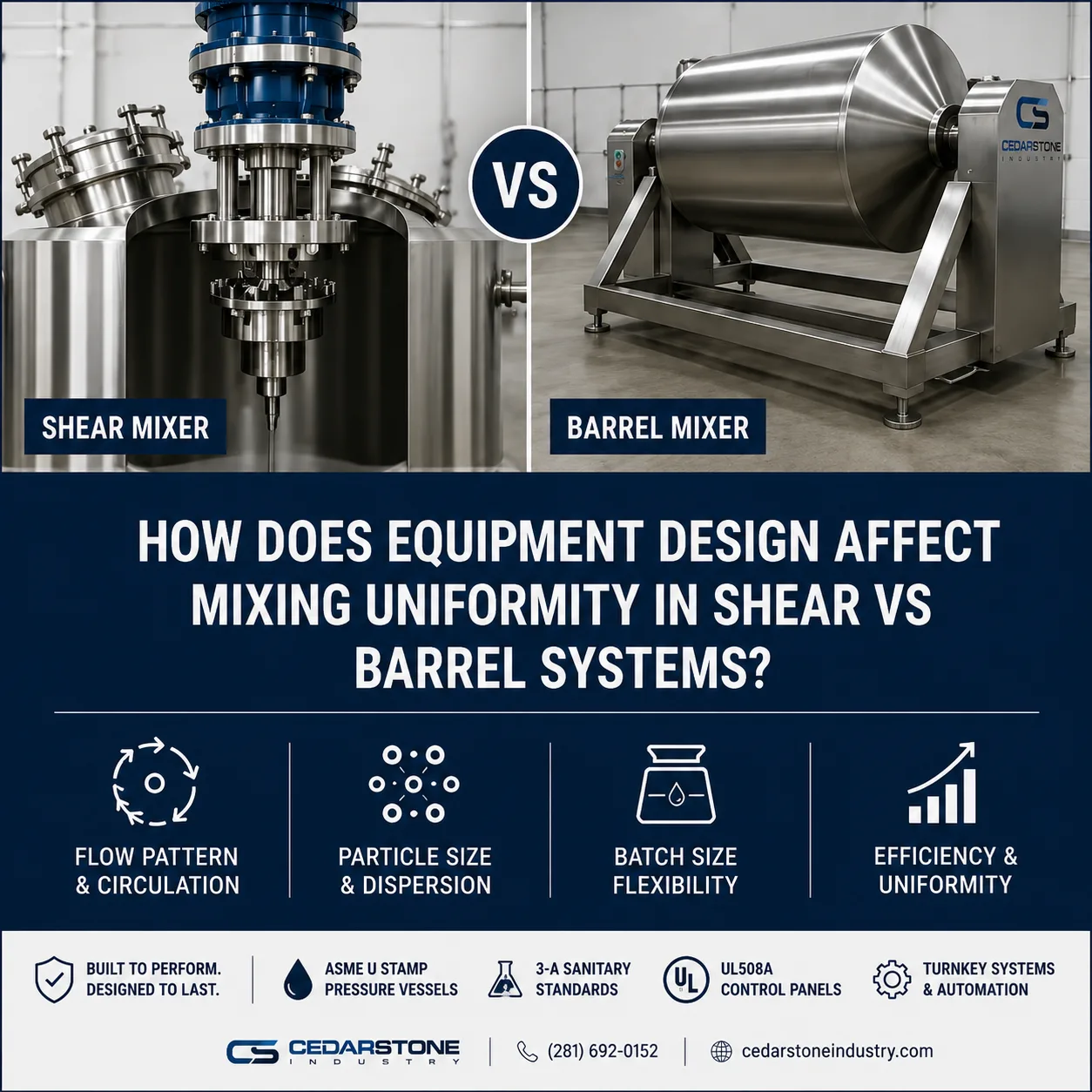
Mixing uniformity can make or break product quality. Whether you are handling powders, liquids, or viscous blends, the way materials combine depends heavily on equipment design. A well-engineered Shear Mixer behaves very differently from a Barrel Mixer, and those differences directly impact consistency, efficiency, and scalability. So, let’s break it down in a practical, engineering-focused way.
Why Mixing Uniformity Matters
Uniform mixing is not just about appearance. It affects reaction rates, product stability, and even safety. For example, uneven distribution of active ingredients can lead to batch failures. In industrial settings, that means wasted time and money.
That’s why engineers pay close attention to how mixers are built. Design features like impeller type, vessel geometry, and flow patterns all play a role. And honestly, even small tweaks can lead to big improvements.
Understanding Shear-Based Mixing Systems
A Shear Mixer relies on high-speed mechanical forces to break down particles and disperse them evenly. It uses rotating blades or rotors that create intense localized energy. This energy pulls materials apart and blends them at a micro level.
Key Design Features of Shear Mixers
High-speed rotor-stator assemblies that generate strong shear forces
Tight clearances between moving and stationary parts
Compact mixing zones for concentrated energy transfer
Because of this design, shear mixers excel at emulsification and dispersion. They are ideal for applications where fine particle size and uniform distribution are critical.
However, there’s a catch. High shear can sometimes lead to over-processing. Sensitive materials may degrade if exposed for too long. So, design balance is crucial.
Understanding Barrel Mixing Systems
A Barrel Mixer, on the other hand, focuses on bulk movement rather than intense shear. It typically rotates a drum or barrel to tumble materials together. The mixing action is gentler and more macro in nature.
Key Design Features of Barrel Mixers
Rotating cylindrical vessels that promote tumbling
Internal baffles or fins to improve material movement
Larger batch capacities for bulk processing
This design works well for dry powders and granular materials. It ensures materials are blended evenly without applying excessive force. That said, it may struggle with cohesive or sticky substances.
Flow Patterns and Their Impact
Here’s where things get interesting. The flow pattern inside a mixer determines how well materials interact.
In a Shear Mixer, flow is typically radial and turbulent. Materials are pulled into the high-energy zone, then expelled outward. This continuous cycle ensures rapid mixing. As a result, uniformity is achieved quickly, even for complex formulations.
Meanwhile, a Barrel Mixer produces a cascading or rolling motion. Materials move in layers, folding over each other. This creates a diffusive mixing pattern. It takes longer, but it is gentle and consistent.
So, the choice depends on the material. If you need speed and precision, shear systems shine. If you need careful blending, barrel systems do the job.
Influence of Geometry and Scale
Equipment geometry plays a huge role in mixing performance. For instance, the diameter-to-height ratio of a vessel affects circulation patterns.
In shear systems, smaller mixing chambers concentrate energy. This leads to faster homogenization. But scaling up can be tricky. Engineers must ensure that shear rates remain consistent across larger volumes.
With barrel systems, scaling is more straightforward. Larger drums simply handle more material. Still, maintaining uniformity requires proper design of baffles and rotation speed.
In both cases, poor geometry can create dead zones. These are areas where materials do not mix properly. And yes, they are a common headache in industrial setups.
Energy Input and Efficiency
Energy input is another key factor. A Shear Mixer uses high power to generate intense forces. This leads to quick results, but also higher energy consumption.
On the flip side, a Barrel Mixer uses lower energy. It relies on gravity and rotation rather than mechanical force. While it takes more time, it is often more energy-efficient for large batches.
So, there’s always a trade-off. Faster mixing versus lower operating cost. Engineers must weigh both when selecting equipment.
Material Behavior and Compatibility
Not all materials behave the same way. Some need aggressive mixing, while others prefer a gentle touch.
Viscous liquids and emulsions respond well to shear mixing
Dry powders and granules are better suited for barrel systems
Heat-sensitive materials may degrade under high shear
Because of this, equipment design must align with material properties. Otherwise, you risk poor uniformity or product damage.
Control and Repeatability
Modern mixing systems often include advanced controls. These allow operators to fine-tune parameters like speed, time, and temperature.
In a Shear Mixer, precise control over rotor speed ensures consistent shear rates. This improves repeatability across batches.
In a Barrel Mixer, control focuses on rotation speed and cycle duration. While simpler, it still plays a key role in achieving uniform results.
Consistency is everything in industrial production. And good design makes it easier to hit the same target every time.
Final Thoughts
Equipment design is not just a technical detail. It is the foundation of mixing performance. A Shear Mixer delivers high-intensity blending with fast results, while a Barrel Mixer offers gentle, large-scale mixing with steady uniformity.
Both systems have their strengths. The real trick lies in matching the design to the application. Once that alignment is right, everything else falls into place. Efficiency improves, product quality stabilizes, and operations run smoother.
And at the end of the day, that’s what every engineer is aiming for.
Suggested Cedarstone Call to Action
Looking for a custom stainless steel mixing solution? Cedarstone Industry designs and manufactures stainless steel mixing tanks, drum mixers, high shear mixers, sanitary process equipment, CIP systems, and complete automated processing skids. Contact our engineering team to discuss your application.