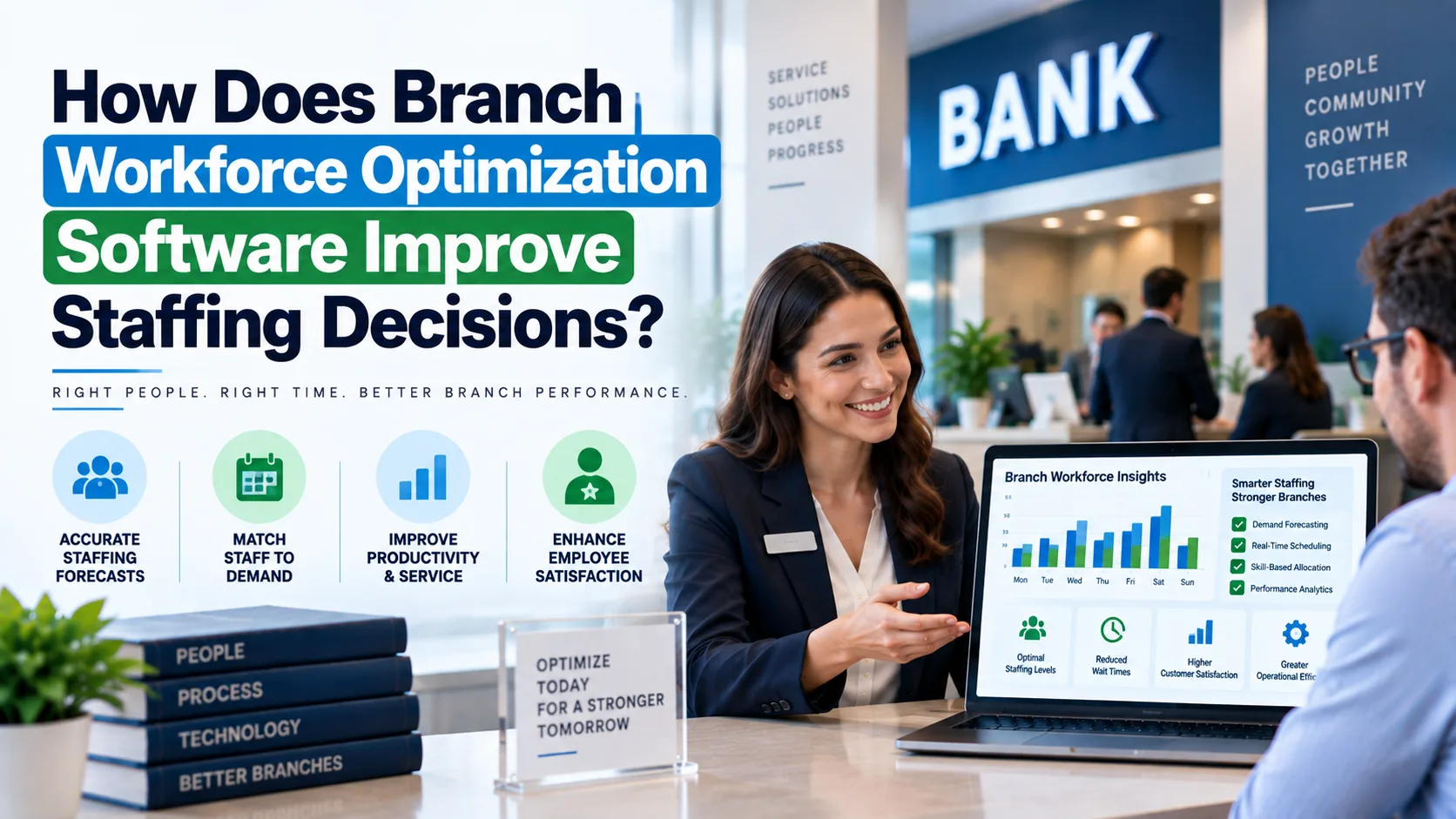
In a Nutshell: Branch managers have long relied on spreadsheets, intuition, and incomplete data to make staffing decisions. An approach that consistently produces costly forecasting errors.
Industry data reveals that traditional staffing forecasts typically carry error rates between 15%-20%. Meaning branches are frequently either overstaffed during slow periods or understaffed during peaks.
In an era where customer expectations demand seamless service and operational budgets face relentless scrutiny, these inefficiencies are no longer sustainable. Branch workforce optimization software addresses this challenge by using artificial intelligence, real-time data, and advanced analytics to transform how financial institutions plan, schedule, and deploy their frontline staff.
Keep reading to learn how this software helps with staffing decisions.
What Makes Branch Workforce Optimization Software a Game-Changer for Staffing?
Getting that question right can mean the difference between a branch that runs smoothly and one that constantly struggles to keep up. Branch workforce optimization software uses artificial intelligence to solve a simple but powerful question: Who should work when, and why?
At its core, this technology does three things:
- Forecasts demand for services based on previous appointment schedules and peak times.
- Maps employee competencies to customer requirements (such as staffing someone who speaks Spanish on Tuesdays).
- Automatically schedules appointments without requiring managers to create schedules manually.
The old way of scheduling relied on gut feelings and patterns from last year. That approach fails when customer behavior shifts quickly.
Why Manual Scheduling Creates Problems
Before discussing the use of optimization software for staffing decisions, one must first understand the reasons why traditional approaches are inadequate. Branch staffing using the traditional approach uses history, experience, and pre-designed schedules.
Key Shortcomings of Manual Staffing
- Static scheduling templates are not responsive to changing patterns of customer flow.
- Previous data does not account for changes that occur seasonally or due to local events.
- Lack of insight into branch operations results in reactionary decision-making.
- Failure to handle multi-dimensional parameters such as skills and experience.
- Digital banking transformation has changed branch roles, demanding more nuanced staffing approaches.
When demand forecasting error rates sit between 15-20% with traditional methods, branches constantly miss the mark. They overstaff during slow periods and understaff during rushes.
How Branch Workforce Optimization Software Works for Staffing Decisions
1. Demand Forecasting and Predictive Analytics
At the core of branch workforce optimization software lies sophisticated demand forecasting capability. Modern platforms leverage AI to synthesize thousands of data points to generate precise predictions of customer demand at the branch level.
Branch data analytics serves as the foundation for this process, transforming raw operational data into actionable staffing intelligence. This represents a fundamental departure from spreadsheet-based planning.
How AI-Powered Forecasting Works
- Data synthesis: It includes appointment records, lobby movement, walk-in behavior, and external variables
- Hourly interval prediction: Predicts the demand within specific time intervals in an hour
- Pattern detection: Recognizes repeated patterns during days, weeks, or seasons
- External variables inclusion: It takes into account the weather, local events, or economic conditions
- Continuous learning: It enhances the model with the addition of more data
Implications for staffing would be immense. Managers would have experienced staff being unavailable during periods when they expect a heavy workload. The managers will be in a position to have flexible staffing in the periods when there are fewer customers.
2. Skills-Based Scheduling and Role Alignment
Besides identifying how many people should be working, workforce optimization software helps organizations match the right skill set to the shift. In conventional scheduling, employees are seen as interchangeable and are assigned to shifts according to availability.
The Skills Matching Advantage
- Assignment through capability: Assignment of personnel using their capabilities
- Specialized role: Assignment of mortgage specialists when there are many home buyers
- Alignment to community: Assignment of multilingual personnel to serve diverse communities
- Maximizing sales: Assignment of sales personnel when opportunities arise
- Advisory services: Assignment of competent personnel to handle complex client requirements
This will be especially useful in relation to the transformation process within bank branches. With fewer tellers being required due to the increase in electronic transactions, the banks are redeploying the staff to become involved in sales and advising roles. The software helps in scheduling the right personnel for each period based on their skills.
Employee Satisfaction Benefits
- Staff scheduled for roles matching their strengths perform better
- Higher engagement is reported when skills align with assignments
- Software accommodates employee preferences and availability
- Balances organizational needs with individual flexibility
- Reduces turnover through better work-life balance
3. Automation and Manager Productivity
The obvious advantage of workforce optimization software is the elimination of the administrative workload. The creation of schedules manually requires much of the managers' time, which can be spent on training, customer care, and other projects.
Time Savings and Reallocation
- Managers can reclaim up to eight hours per week previously spent on manual scheduling
- Time redirected toward team development and coaching
- Greater focus on customer engagement and relationship-building
- More capacity for strategic initiatives and branch improvement
- Reduced administrative stress and burnout
Operational Efficiency Gains
- Scheduling done by automated means reduces repetitive manual efforts
- Real-time changes can be achieved without heavy calculations
- Tracking compliance makes sure labor regulations are automatically complied with
- Shift swapping is streamlined through self-service portals
- Analytics offer continuous visibility into staffing performance
This time saved goes beyond convenience alone. The manager’s ability to save time from administrative coordination leaves him free to invest his time in team development and customer interaction.
This change fits into the larger change taking place in branch banking, where interpersonal relationships are becoming more important than transactions.
In a Nutshell
Workforce optimization solutions revolutionize the way that banks think about their staffing requirements. With AI-driven forecasting and skill-based scheduling and optimization processes, banks will be able to match their staffing more accurately to their needs than ever before.
The advantages of doing so span the organization, ranging from cost savings and better customer service to increased employee engagement and improved efficiency on the part of managers. As the branch banking industry continues to develop, these solutions will be critical to any bank that wants to compete effectively.