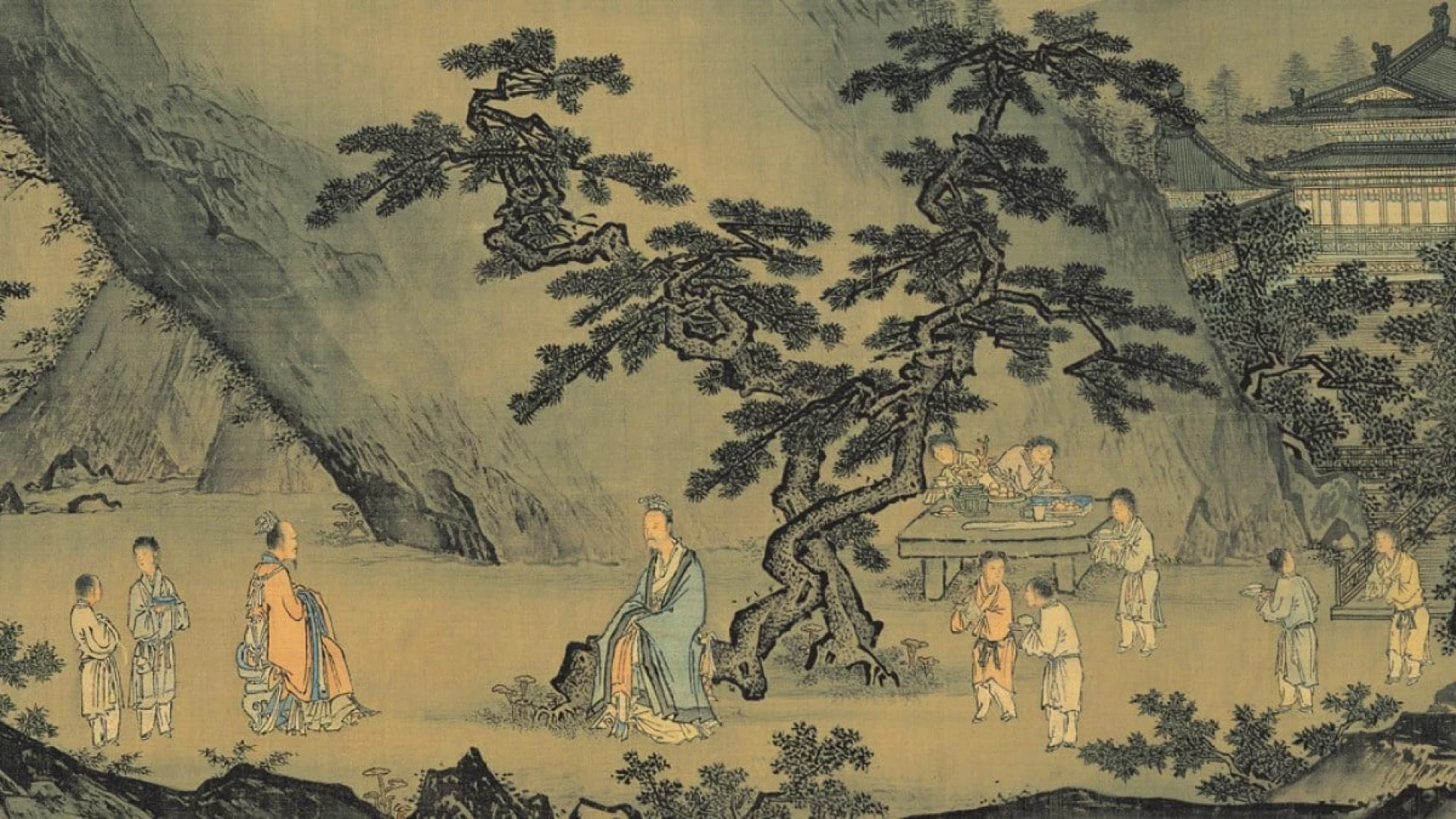
Art in ancient China was never just decoration or entertainment—it was a language of power, a mirror of philosophy, and a pillar of cultural identity. It told stories of emperors and sages, landscapes and heavens, harmony and rebellion. Every brushstroke, carving, sculpture, or embroidered symbol conveyed deeper meanings connected to Confucianism, Taoism, Buddhism, dynastic authority, and ancestral legacy.
In exploring art in ancient China, we uncover the soul of a civilization that viewed creativity not as mere expression, but as a responsibility and a sacred duty. From jade ornaments to monumental murals, ancient Chinese art carried messages that shaped minds, guided governance, and cultivated national identity for over three millennia.
The Role of Philosophy in Ancient Chinese Art
Chinese civilization evolved alongside deep philosophical systems—Confucianism, Taoism, and later Buddhism. These ideologies didn’t just influence people’s lives—they shaped every aspect of art in ancient China.
Confucianism emphasized order, hierarchy, and filial piety. In visual art, these values translated into portraits of wise officials and elders, harmonious family scenes, and respectful depictions of rituals. Confucian art often centered on human relationships, morality, and the celebration of ethical role models.
Taoism, on the other hand, encouraged alignment with the natural world and spontaneity. Artists inspired by Taoist ideals produced sweeping landscapes that embodied the vastness and mystery of nature. Mountains, rivers, and misty forests weren't just physical forms—they were metaphors for the infinite Tao, the path that runs through all existence. These works invited viewers to escape worldly concerns and reflect on nature's wisdom.
Buddhism, introduced from India, brought with it a rich iconography of deities, bodhisattvas, and mandalas. Buddhist murals, sculptures, and temple carvings spread throughout China, especially during the Tang dynasty. The serenity of Buddha figures and the elaborate heavenly realms depicted in cave temples like those at Dunhuang show how religious themes merged with traditional Chinese aesthetics to form a spiritual fusion.
Dynastic Power and Political Messaging
Every dynasty in China used art to promote its vision of authority. Whether it was through monumental architecture or delicate ceramics, art in ancient China served as a visual proclamation of the emperor's divine right to rule.
During the Han Dynasty, emperors encouraged the creation of tomb art to illustrate the afterlife and reflect their legacy. This included murals, pottery figures, and jade burial suits. These works demonstrated both reverence for ancestors and the imperial ambition to remain honored for eternity.
In the Tang Dynasty, art became an instrument of global diplomacy. Colorful frescoes, calligraphy scrolls, and Buddhist statuary projected the dynasty’s power, culture, and religious tolerance. Even in portraits, emperors were presented with an idealized majesty, surrounded by symbols of cosmic harmony.
The Song Dynasty leaned toward more subtle expressions of power. The famed monochrome ink landscapes expressed Confucian ideals of restraint and order, showcasing an empire governed by scholar-officials. Art became a domain of the educated elite, reflecting refined tastes, poetic introspection, and intellectual depth.
By the time of the Ming Dynasty, imperial porcelain production became both a cultural phenomenon and a commercial enterprise. The famous blue-and-white ceramics carried coded imperial symbols—dragons, phoenixes, lotus flowers—expressing the dynasty’s cultural supremacy.
Symbolism and Allegory
Chinese art rarely spoke in a literal tone. Symbolism and allegory were the backbone of visual storytelling. Animals, plants, colors, and mythical beings each had a symbolic role.
- The dragon, often portrayed in royal artworks, symbolized imperial strength and celestial favor.
- The phoenix represented harmony, peace, and the empress.
- Bamboo, resilient yet flexible, symbolized moral uprightness—beloved by scholars.
- The peony was the flower of wealth and honor.
- The crane, often depicted in paintings and robes, stood for longevity and wisdom.
Artists layered these symbols within paintings, embroidery, and pottery, turning everyday objects into cultural texts. A single vase could silently speak of hope, prosperity, fertility, and fortune.
Art Forms That Defined Ancient China
Calligraphy, perhaps more than any other art form, was revered in ancient China. Not just writing—it was a performance of the soul. Scholars trained their entire lives to master strokes that conveyed not only meaning, but character and integrity.
Painting, particularly ink wash painting, became a fusion of poetry, philosophy, and technical mastery. Artists often painted not to reproduce the physical world but to express an idea or inner emotion. Empty space in a painting wasn’t a flaw—it was intentional, representing the Taoist concept of the void, full of potential.
Sculpture flourished in temples and tombs. Stone lions guarded palaces. Bronze ritual vessels held offerings to the ancestors. Terracotta armies protected emperors in the afterlife. Each object told of a people who believed in the power of the material to connect with the spiritual.
Ceramics and porcelain were developed into highly refined forms by Chinese artisans. Kilns in places like Jingdezhen became legendary, crafting wares for both domestic use and international trade. These ceramics carried cultural codes through glazes, motifs, and inscriptions.
Textile arts, including embroidery and silk weaving, conveyed dynastic splendor and elite taste. Robes worn by emperors, nobles, or scholars were rich in symbolism. Colors and patterns were strictly regulated, creating a visual hierarchy that reinforced social structure.
Regional Influence and Local Traditions
While the imperial court commissioned grand artworks, regional styles and folk traditions flourished as well. Villages developed their own styles of woodblock printing, paper cutting, and embroidery. These forms preserved local beliefs, legends, and customs.
In southern China, lush landscapes and floral motifs dominated. In the north, more austere and powerful images reflected the rugged terrain and martial culture. Local craftspeople passed down techniques through generations, keeping the spirit of art in ancient China alive even in the most remote areas.
Trade and Cultural Exchange
Silk Road trade brought Chinese art to Central Asia, the Middle East, and even Europe. It also brought foreign influences into China—Persian motifs, Indian deities, and Central Asian techniques enriched native styles.
The Tang Dynasty was especially cosmopolitan, with art reflecting influences from Greek, Persian, and Indian traditions. Buddhist statues from this era bear facial features and postures resembling Indian prototypes. This fusion did not weaken Chinese tradition—it enhanced it, showing an ability to absorb and reinterpret the foreign into something uniquely Chinese.
Preserving Ancient Art in the Modern World
Today, art in ancient China is not locked in museums or buried in history—it continues to inspire contemporary Chinese culture and global appreciation. Museums around the world house masterpieces from the Han, Tang, Song, and Ming dynasties, drawing scholars, artists, and admirers alike.
Online platforms and exhibitions allow even greater access to ancient Chinese art, ensuring that its legacy reaches new generations. Schools and studios across China still teach traditional calligraphy, painting, and ceramic techniques. The roots of these modern revivals lie deep in the ancient soil of dynastic China.
Final Thoughts
Art in ancient China was a living force—mystical, philosophical, political, and deeply human. It reflected the harmony of cosmos and ruler, the introspection of the scholar, and the reverence for nature and ancestors. It wasn’t merely about aesthetics—it was an extension of belief, authority, and cultural essence.
From delicate brushstrokes on scrolls to colossal stone carvings, art in ancient China invites us to see the world not just with our eyes but with our spirit. Its influence transcends time, offering a timeless dialogue between tradition and modernity. In every curve of calligraphy, in every patterned robe, and in every jade carving lies a civilization's heartbeat—quiet, profound, and eternal.