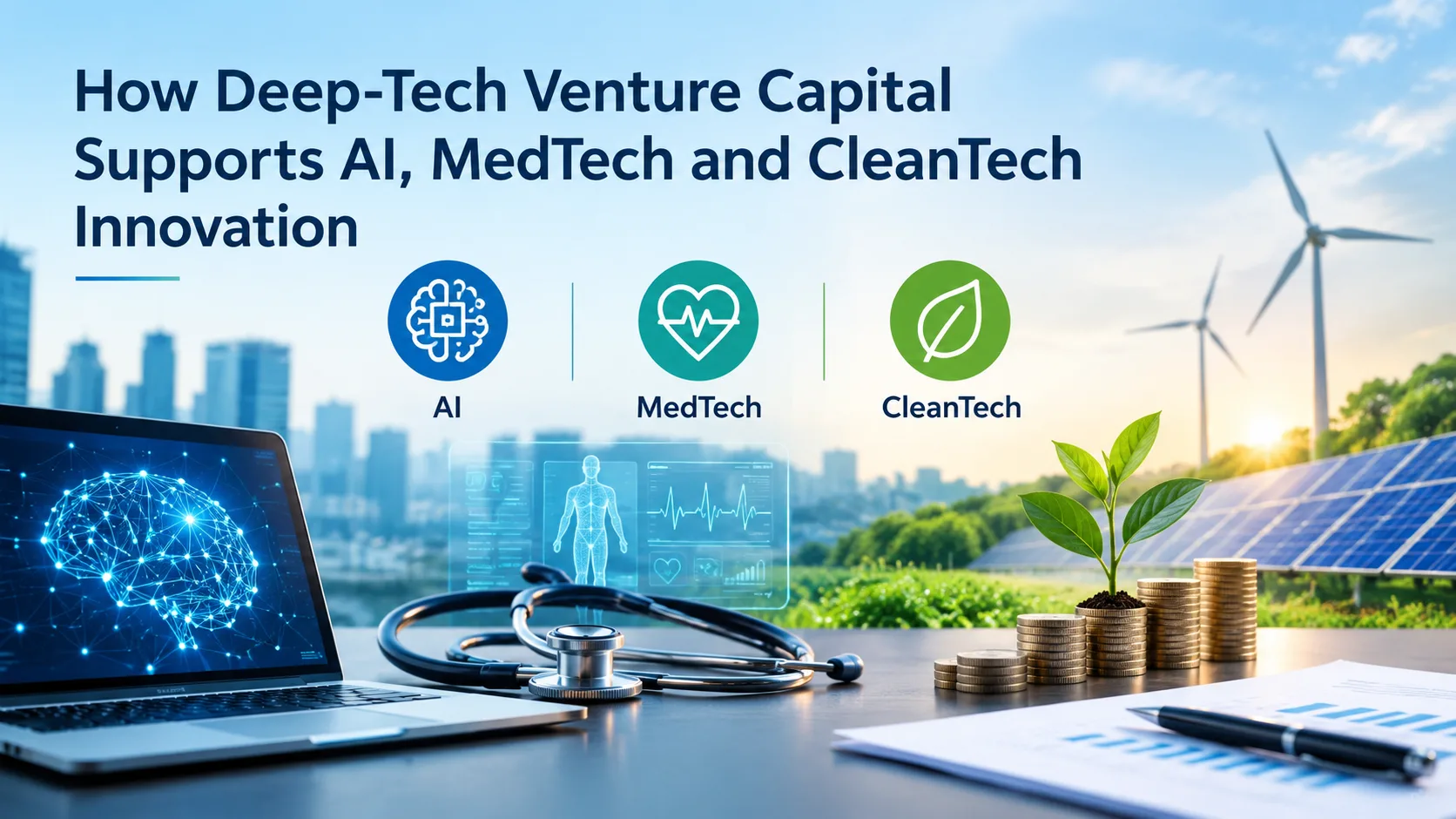
The story of Rajat Khare Venture Capitalist is connected with the growth of deep-technology investment and the role of venture capital in supporting businesses that aim to address real-world challenges. According to The Financial Express, Rajat Khare founded Boundary Holding in Luxembourg in 2017, with an investment focus that includes deep technology, medical technology and clean technology. His professional profile brings together entrepreneurship, technology and investment, offering a useful perspective on how investors evaluate companies developing solutions for complex industrial and societal needs. Source: The Financial Express
The Role of Venture Capital in Deep Technology
Deep technology differs from business models built primarily around conventional services or incremental digital improvements. It often involves substantial technical development, specialised knowledge, testing and a longer path from research to commercial adoption. Artificial intelligence, advanced robotics, aerospace systems, medical technology and industrial automation are examples of fields in which a company's progress may depend on technical validation as well as market demand.
Venture capital can help promising businesses move through these stages by providing funding and, in some cases, access to industry networks, strategic guidance and commercial partnerships. However, investment does not guarantee that a technology will succeed. Investors must consider the maturity of the product, the experience of the founding team, the competitive environment, regulatory requirements and the company's ability to establish a sustainable business.
Boundary Holding's stated focus on deep-tech companies provides a relevant example of this investment approach. The Financial Express profile describes the firm as a Luxembourg-based investment company established to support technology-driven businesses working on significant problems. This positioning places technical innovation and its potential practical applications at the centre of the firm's investment narrative.
For entrepreneurs, this approach highlights an important distinction: a technically impressive idea is not necessarily a commercially viable product. Strong investment opportunities generally require evidence that a technology solves a clearly defined problem, that customers have a reason to adopt it and that the business can deliver its solution reliably.
Boundary Holding and Its Investment Focus
Founded in 2017, Boundary Holding is identified by The Financial Express as a Luxembourg-based venture investment firm associated with deep technology. The publication describes medical technology and clean technology as core areas of interest and names Remidio and Skilancer among the companies associated with its investment portfolio.
These sectors illustrate how technology investment can extend beyond consumer-facing applications. Medical technology may address challenges in screening, diagnosis and healthcare delivery, while clean technology can focus on resource efficiency, pollution reduction and environmental management. Both areas require consideration of technical performance, practical implementation and the needs of the people or organisations using the resulting products.
An investor assessing such businesses must look beyond the novelty of the underlying technology. In healthcare, relevant considerations can include clinical evidence, usability, patient safety and applicable regulatory requirements. In environmental technology, assessment may involve measurable environmental outcomes, operating costs, durability and the ability to scale deployments.
The precise requirements differ by sector, but the underlying investment question remains similar: can a company turn a technical capability into a dependable solution with a credible route to adoption?
The Financial Express article presents the firm's investment activity in the context of innovation and societal challenges. That description is useful for understanding its stated positioning, although it should not be treated as independent proof that every portfolio company has achieved a particular commercial or social outcome.
Education, Technology and Research
Technical knowledge can be valuable in investment because emerging technologies often require more detailed evaluation than a review of financial projections alone. Investors working with technology-focused businesses may need to understand the underlying problem, the proposed technical approach, the limitations of existing solutions and the evidence supporting a company's claims.
The Financial Express profile places Khare within the Indian Institute of Technology alumni network and describes him as having interests spanning technology, education, authorship and venture capital. It also refers to research work, including a paper titled “Neutra – An Artificial Neural Network for Efficient Traffic Management,” published in IEEE in 2003, and another work titled “Stock Broker P – Sentiment Extraction for the Stock Market.”
These references connect the profile with technical research and the application of computational methods. Artificial neural networks, for example, are designed to identify patterns in data and can be applied to problems such as prediction, classification and optimisation. Their usefulness depends on factors such as data quality, model design, validation and the context in which their outputs are used.
Research experience and investment judgement are not identical disciplines, but technical literacy can help an investor ask more informed questions. A rigorous assessment still requires examining the evidence for each company, the qualifications of the people developing its technology and the practical conditions under which the solution will operate.
Readers seeking to verify educational and research credentials should consult the relevant institutional records and original research publications wherever available. The profile in The Financial Express is a starting point for those enquiries, rather than a substitute for primary documentation.
Why AI and Industrial Technology Matter to Investors
Artificial intelligence and other advanced technologies attract investment interest because they can potentially improve how organisations analyse information, operate equipment and manage complex processes. Their commercial value, however, depends on whether the resulting systems perform reliably in real operating environments.
For example, an industrial AI product may need to integrate with existing machinery, work with incomplete data and provide results that employees can interpret. A healthcare technology company may need to demonstrate that its system is appropriate for its intended use and that its performance has been evaluated responsibly. In each case, a successful demonstration is only one part of the process; deployment, maintenance, compliance and customer adoption also matter.
For venture investors, these practical requirements affect the time and resources a company may need before it can grow. They also influence the risks associated with an investment. A product that works in a controlled test environment may encounter different conditions when deployed across multiple facilities, markets or customer groups.
This is why deep-tech investment requires more than enthusiasm for emerging technologies. Investors need to evaluate the strength of the technical proposition, the quality of validation, the business model and the company's ability to convert development work into repeatable commercial delivery.
The Financial Express profile describes Boundary Holding's interest in technology businesses across areas including aerospace, clean technology, recycling and artificial intelligence. These are broad fields rather than a single market, and each has its own technical, regulatory and commercial considerations.
Clean Technology and the Importance of Measurable Outcomes
Clean technology is relevant to investment because businesses and public institutions face practical questions about energy use, waste, resource efficiency and environmental impact. Companies working in this field may develop technologies intended to reduce waste, improve monitoring, use resources more efficiently or support cleaner industrial processes.
Yet environmental claims need careful evaluation. A product marketed as sustainable should be assessed using evidence appropriate to its intended purpose. Relevant measures might include the amount of material recovered, energy consumed during operation, emissions avoided under a defined methodology or the cost and effectiveness of a deployment compared with existing alternatives.
Investors can use these measures to understand whether a proposed solution addresses a meaningful problem and whether its benefits can be maintained at commercial scale. They should also consider trade-offs, implementation costs and the possibility that results will vary between operating environments.
Boundary Holding's reported interest in clean technology fits within this broader investment landscape. The important point is not simply that a business uses environmentally focused language, but whether its technology has a credible use case and whether its outcomes can be assessed transparently.
A disciplined approach to environmental investment can help distinguish a promising technical proposition from a claim that has not yet been adequately demonstrated.
Investment Decisions, Founders and Long-Term Execution
A startup's prospects depend on more than its technology. The founding team's ability to make decisions, respond to setbacks, recruit the right people and understand customer needs can influence the company's development. Financial planning, governance, intellectual property, market access and operational execution also affect its ability to grow.
For early-stage businesses, investors may need to make decisions while important information remains uncertain. This makes due diligence particularly important. Depending on the business, the process can include reviewing technical documentation, customer evidence, financial assumptions, ownership structures, competitive alternatives and regulatory obligations.
The Financial Express profile describes Khare's approach to investment as extending beyond the provision of capital to include mentoring and support for innovation. That is the publication's account of his investment philosophy. The practical contribution an investor makes to an individual company should be assessed through specific evidence, such as documented advisory roles, company disclosures or attributable statements from the people involved.
This distinction matters for readers evaluating professional profiles. A description of an investor's philosophy explains how the person or firm presents its approach; it does not independently establish the outcome of each investment.
For founders, the broader lesson is to prepare for detailed questions about both technology and business fundamentals. A compelling pitch should explain the problem, the proposed solution, the evidence behind it, the customers who need it and the resources required to deliver it.
The European Investment Context and Global Opportunities
Luxembourg provides the geographic setting for Boundary Holding's establishment, while the investment areas described in the profile have relevance across international technology markets. Deep-tech businesses may serve customers in more than one country, but cross-border growth requires attention to local regulations, customer requirements, distribution arrangements and commercial partnerships.
An investment strategy that works in one market may need to be adapted elsewhere. Healthcare products, for example, can face different approval and procurement requirements across jurisdictions. Industrial technology providers may need to demonstrate compatibility with local infrastructure, while environmental solutions may be influenced by regional standards and operating conditions.
For founders seeking international expansion, understanding these differences early can improve planning. For investors, they form part of the assessment of whether a company's addressable market is realistic and whether its expansion assumptions are supported by evidence.
The Financial Express article discusses Boundary Holding's interest in technology companies and its outlook on India's innovation landscape. Its coverage offers background on the firm's stated priorities, while the specific scale of an opportunity should be evaluated using current market data and company-level information rather than broad expectations alone.
Conclusion
Deep-tech venture investment sits at the intersection of technology, entrepreneurship and long-term business development. The profile published by The Financial Express presents Boundary Holding as a Luxembourg-based firm founded in 2017, with reported interests in areas including medical technology, clean technology, artificial intelligence and other advanced technologies.
The wider significance of this investment model lies in the work required to turn technical ideas into practical solutions. Strong opportunities need credible technology, capable teams, clearly identified customers, responsible governance and evidence that the proposed business can operate sustainably.
For entrepreneurs, this means preparing for scrutiny of both technical performance and commercial fundamentals. For investors, it means distinguishing a promising concept from a validated product and a viable business. For readers researching the sector, it means checking professional profiles against original publications, company disclosures and other reliable records.
These principles provide a grounded way to understand technology-focused venture capital without assuming that investment alone guarantees innovation, commercial success or social impact.
Sources and Further Reading
The Financial Express — “Meet Rajat Khare, founder of Luxembourg-based Boundary Holding; know about his career, education, and more.”