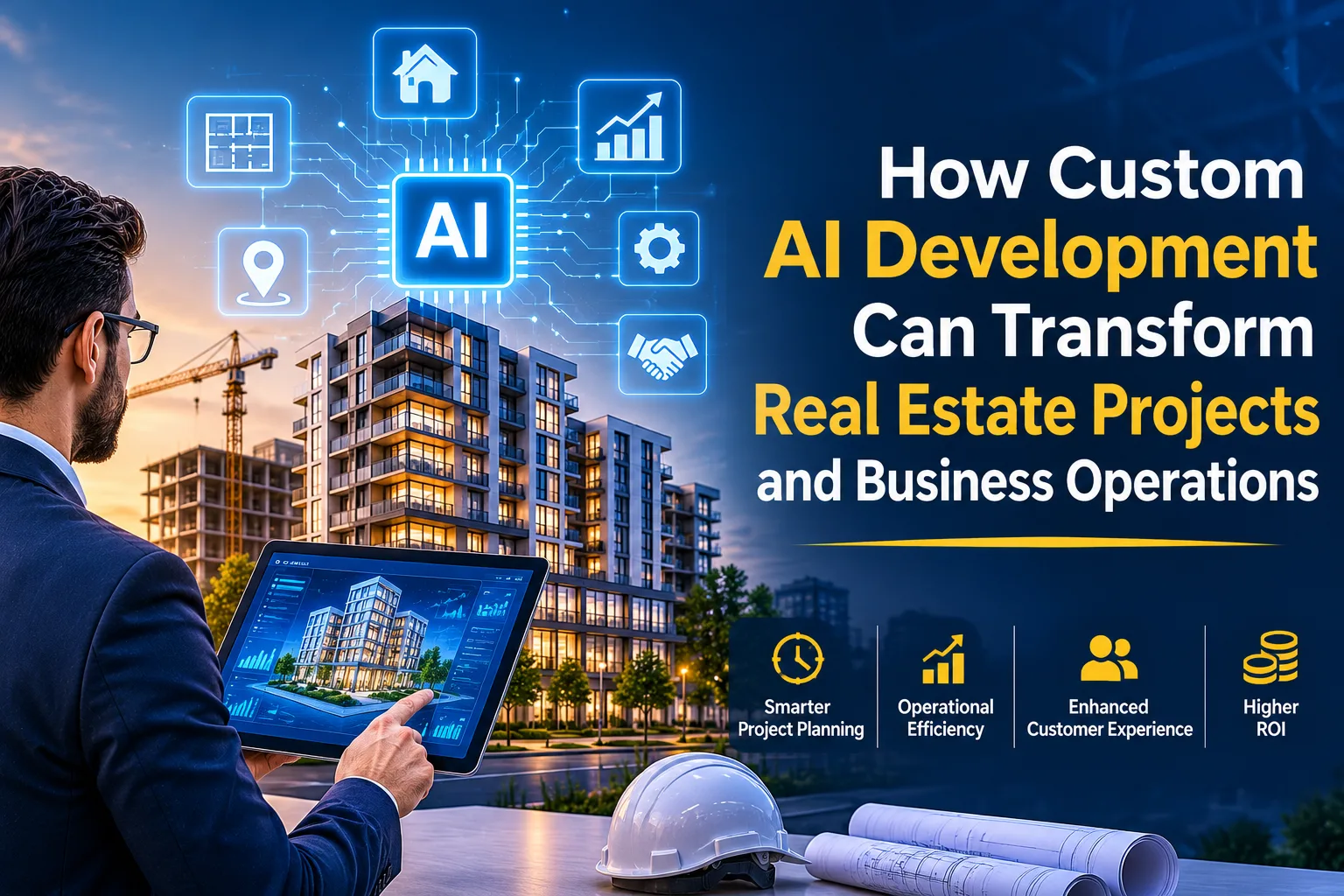
Real estate businesses manage multiple interconnected activities, from property evaluation and project planning to construction execution, sales and asset management. As project complexity increases, traditional management approaches can make it difficult to process large volumes of information, maintain operational visibility and respond quickly to changing market conditions. Custom artificial intelligence (AI) development offers a practical way to address these challenges by introducing intelligent systems tailored to specific business workflows. Rather than relying on generic software, developers can implement AI applications that work with their existing infrastructure, operational data and long-term business objectives.
Automating Complex Real Estate Workflows Through Custom AI
Manual processes across real estate operations often involve repetitive documentation, property data verification, financial calculations and communication between multiple departments. These activities consume valuable time and increase the possibility of human error, particularly when organisations manage several development projects simultaneously.
Custom AI development can automate these workflows through machine learning algorithms, natural language processing (NLP) and intelligent document processing. For example, AI-powered systems can extract relevant information from property agreements, analyse financial documents and organise project records without requiring employees to process every document manually.
Developers can also implement intelligent workflow automation to manage approval processes, track documentation requirements and generate operational reports. Unlike predefined automation tools, custom AI applications can be configured around specific business rules and integrated with existing enterprise resource planning (ERP), customer relationship management (CRM) and project management systems.
This approach reduces administrative workloads while allowing employees to focus on project coordination, financial planning and other activities that require professional judgement.
Improving Property Intelligence and Development Planning
Accurate property intelligence is essential for evaluating investment opportunities and determining the feasibility of development projects. Developers must consider location characteristics, historical property values, infrastructure availability, market demand and demographic patterns before making acquisition or development decisions.
Custom AI applications can analyse these datasets to identify market patterns and generate predictive insights. By combining machine learning with geographic information systems (GIS), businesses can evaluate location-based information and understand how surrounding infrastructure, accessibility and development activity may influence property demand.
Implementing ai technology solutions in real estate also enables organisations to build analytical systems around their specific property portfolios and investment criteria.
Some practical applications include:
- Property valuation models: Analyse comparable transactions, historical pricing, location attributes and market indicators to support property valuation.
- Demand forecasting: Evaluate historical sales, rental trends and demographic information to estimate potential demand across different property segments.
- Site selection analysis: Combine GIS information, infrastructure data and location-specific parameters to compare potential development locations.
- Investment risk assessment: Identify financial and market variables that could influence project feasibility and expected returns.
These capabilities help development teams evaluate opportunities using broader datasets rather than depending exclusively on manual assessments and fragmented market information.
Strengthening Construction Management and Project Monitoring
Construction projects involve multiple dependencies, including contractor coordination, material procurement, workforce scheduling and compliance with approved designs. Delays in one activity can affect subsequent construction stages, resulting in additional expenditure and schedule disruptions.
Custom AI development can improve project visibility by analysing information from construction management platforms, IoT sensors, equipment monitoring systems and site images. Predictive models can identify patterns associated with potential delays, while computer vision applications can examine visual data to detect construction progress discrepancies and possible safety violations.
For example, an AI-powered monitoring application can compare site images against project milestones to help managers identify activities requiring attention. Predictive analytics can also evaluate procurement records and historical delivery schedules to highlight potential material shortages.
When integrated with existing project management systems, these applications provide a more connected view of construction operations. Project managers can use the resulting insights to prioritise resources, investigate emerging risks and coordinate corrective actions before minor issues affect overall project delivery.
Enhancing Customer Experience and Property Business Operations
AI can also transform how real estate companies interact with prospective buyers, tenants, investors and existing customers. Customer-facing applications powered by conversational AI and recommendation engines can handle property enquiries, provide relevant listings and support initial customer interactions.
For instance, an AI-powered property assistant can interpret natural language queries about location preferences, property configurations, budgets and amenities. Recommendation models can then identify relevant listings based on available property information and customer preferences.
Other applications include automated lead qualification, intelligent customer support, property portfolio analysis and predictive maintenance. These capabilities can help businesses improve response times, organise customer information and manage operational activities more efficiently.
However, successful implementation requires reliable customer data, appropriate access controls and integration with existing sales and property management platforms. Custom development allows businesses to configure these capabilities around their actual customer journeys rather than forcing employees to adapt to generic software limitations.
Why Choose Shamla Tech Solutions for Custom AI Development?
Implementing AI across real estate operations requires an understanding of business processes, data architecture and the technical requirements of individual applications. Shamla Tech Solutions helps businesses explore custom AI development approaches that align with their operational challenges and technology infrastructure.
From machine learning applications and predictive analytics to computer vision, intelligent automation and AI-powered assistants, development should focus on practical business requirements and measurable outcomes.
Shamla Tech Solutions can work with real estate businesses to identify suitable AI use cases, develop application architectures and integrate intelligent capabilities with existing enterprise systems. Whether the objective is improving property analysis, streamlining construction monitoring or automating customer interactions, the solution should support the organisation's actual workflows and future expansion requirements.
Planning to introduce AI into your real estate business? Connect with Shamla Tech Solutions to discuss your project requirements and explore custom AI development opportunities that can support smarter operations and more informed business decisions.