In today’s competitive and data-driven business environment, making the right decisions at the right time is critical for success. Businesses that rely on guesswork or incomplete information often struggle to stay ahead. This is where CRM software plays a transformative role. By collecting, organizing, and analyzing customer data, CRM systems provide valuable insights that help businesses make smarter and more strategic decisions.
From sales forecasting to customer behavior analysis, CRM tools enable organizations to move from intuition-based decisions to data-driven strategies. Companies using small business CRM solutions and industry-specific tools like CRM for real estate can especially benefit from improved accuracy and efficiency in decision-making.

The Importance of Data in Decision-Making
Data is the foundation of effective decision-making. Without accurate and up-to-date information, businesses risk making choices that can negatively impact growth and profitability.
With CRM software, companies can access real-time data about customers, sales performance, and interactions. This ensures that decisions are based on facts rather than assumptions, leading to better outcomes.
Businesses adopting small business CRM and CRM for real estate can leverage data insights to stay competitive and make smarter business moves.
Centralized Data for Better Insights
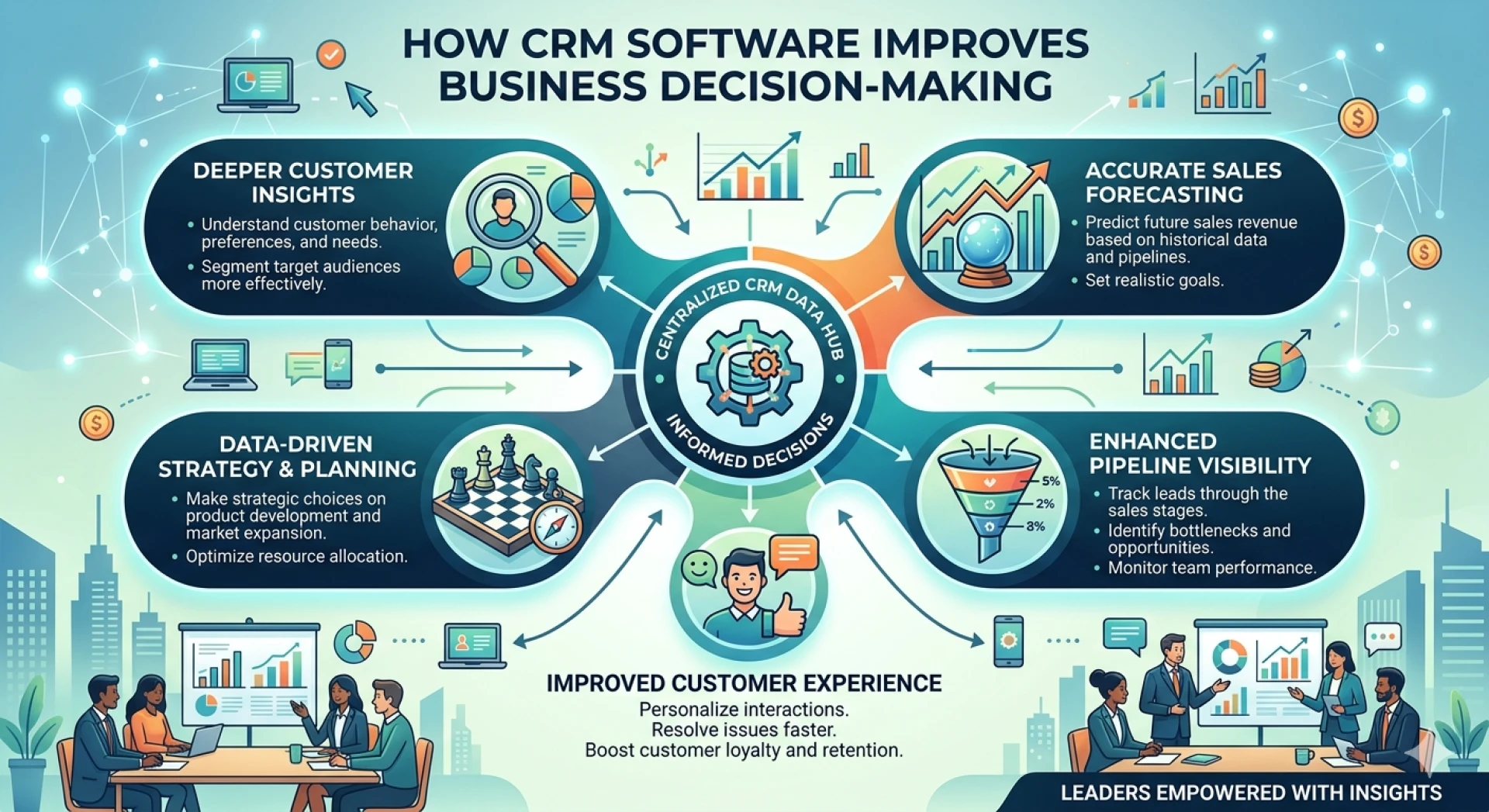
One of the key benefits of CRM systems is centralized data management. Instead of scattered information across different tools, all customer data is stored in one place.
Using CRM software, businesses can view complete customer profiles, including purchase history, communication records, and preferences. This comprehensive view helps decision-makers understand customer needs and make informed choices.
For organizations using small business CRM and CRM for real estate, centralized data improves visibility and supports better collaboration.
Real-Time Analytics and Reporting
CRM systems provide powerful analytics and reporting features that help businesses evaluate performance and identify trends.
With CRM software, companies can generate reports on sales activities, lead conversion rates, and customer engagement. These insights allow businesses to measure success and identify areas for improvement.
Real-time reporting is especially beneficial for small business CRM users and businesses leveraging CRM for real estate, where quick decisions can significantly impact results.
Improved Sales Forecasting
Accurate sales forecasting is essential for planning and resource allocation. CRM systems use historical data and current trends to predict future sales performance.
Using CRM software, businesses can analyze past sales data, track pipeline progress, and forecast revenue more accurately.
For companies using small business CRM and CRM for real estate, improved forecasting helps in planning marketing campaigns, managing inventory, and setting realistic targets.
Better Understanding of Customer Behavior
Understanding customer behavior is key to making effective business decisions. CRM systems track interactions and analyze patterns to provide insights into customer preferences and needs.
With CRM software, businesses can identify buying trends, segment customers, and personalize their strategies.
Organizations using small business CRM and CRM for real estate can use these insights to improve customer engagement and deliver more targeted services.
Enhanced Marketing Strategies
CRM tools help businesses evaluate the effectiveness of their marketing campaigns. By analyzing customer responses and engagement, companies can determine which strategies are working.
Using CRM software, marketing teams can track campaign performance, measure ROI, and optimize their efforts.
Businesses leveraging small business CRM and CRM for real estate can refine their marketing strategies to attract and convert more leads.
Streamlined Operations and Efficiency
CRM systems improve operational efficiency by automating processes and reducing manual work. This allows businesses to focus on strategic decision-making.
With CRM software, companies can streamline workflows, improve communication, and enhance collaboration across teams.
For users of CRM for small business and CRM for real estate, streamlined operations lead to faster decision-making and improved productivity.
Risk Management and Problem Identification
Identifying potential risks and challenges is an important part of decision-making. CRM systems help businesses detect issues early by analyzing data and trends.
Using CRM software, organizations can identify declining sales, customer dissatisfaction, or inefficiencies in processes.
Companies using small business CRM and CRM for real estate can take proactive measures to address problems before they escalate.
Building a Data-Driven Culture
Implementing CRM software encourages a data-driven culture within the organization. Employees rely on data and insights rather than intuition when making decisions.
With CRM software, teams can access relevant information easily and collaborate more effectively.
Businesses adopting small business CRM and CRM for real estate can create a culture of informed decision-making that drives growth.
Conclusion
CRM software is a powerful tool that enhances business decision-making by providing accurate data, real-time insights, and advanced analytics. It enables organizations to understand customers, improve strategies, and respond quickly to market changes.
Solutions like CRM software empower businesses to move beyond guesswork and make informed decisions that drive success. In today’s competitive landscape, adopting CRM technology is essential for long-term growth and sustainability.