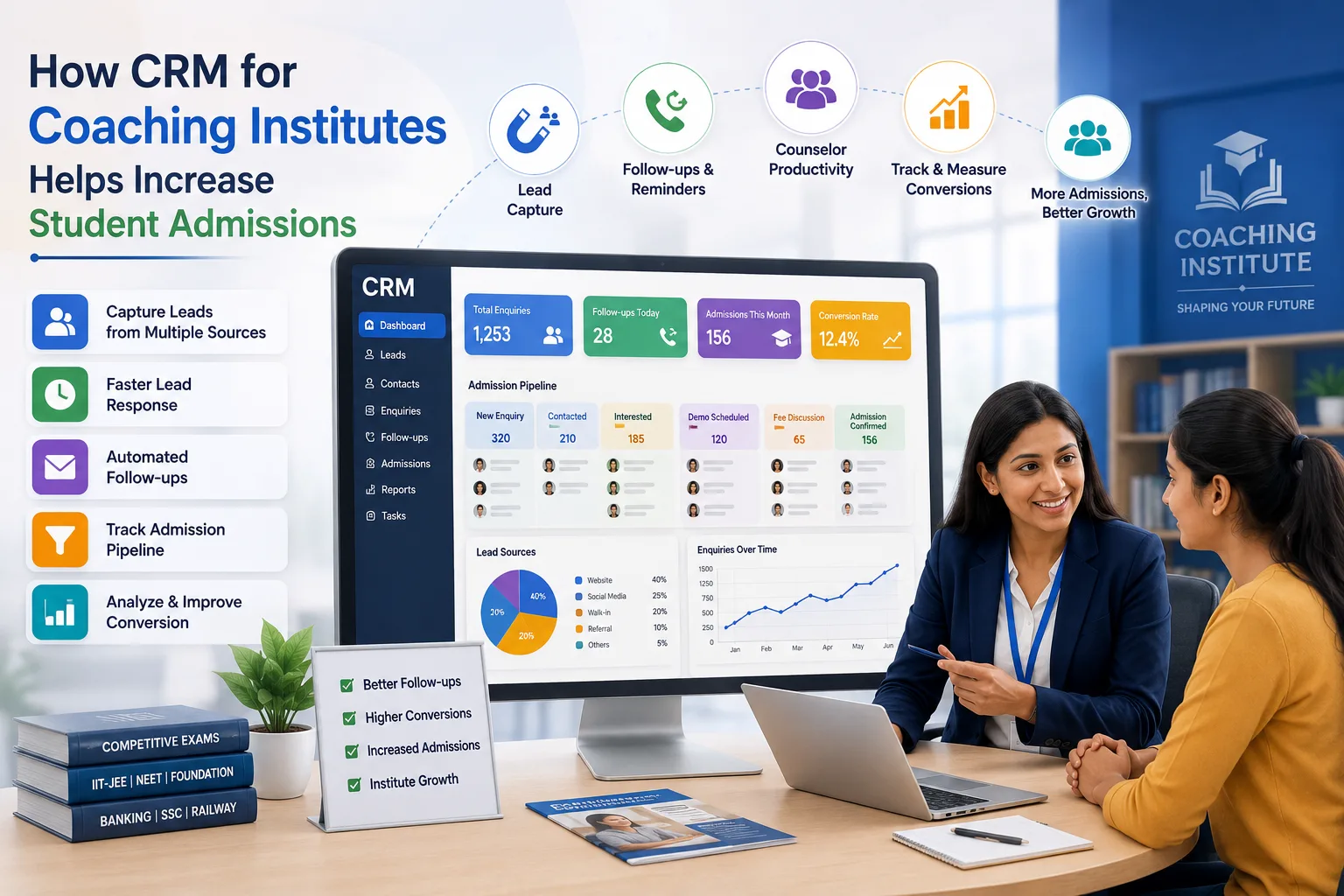
For coaching institutes, attracting student enquiries is only the beginning. The bigger challenge is turning those enquiries into admissions. With students and parents contacting institutes through websites, phone calls, social media, WhatsApp, and walk-ins, managing every lead manually can become difficult.
A CRM for coaching institutes helps organize these interactions, automate follow-ups, and give admission teams better visibility into the enrollment process. By improving how leads are handled, a CRM can contribute significantly to higher student admissions.
1. Captures Leads From Multiple Sources
Potential students may discover a coaching institute through Google, social media, advertisements, referrals, or the institute's website. A CRM can bring these leads into a centralized system.
Instead of maintaining separate spreadsheets or notebooks, admission teams can view student details, enquiry sources, course interests, and contact information in one place. This reduces the risk of losing valuable prospects.
2. Enables Faster Lead Response
Students and parents often contact multiple coaching institutes before choosing one. A delayed response can give competitors an advantage.
CRM software helps admission teams receive and manage new enquiries quickly. Notifications, lead assignments, and automated responses can help ensure that fresh enquiries are addressed without unnecessary delays.
A faster response creates a better first impression and increases the opportunity to engage interested students.
3. Automates Student Follow-Ups
Not every student enrolls after the first conversation. Some may need additional information about course fees, schedules, faculty, study materials, or discounts before making a decision.
A CRM allows institutes to schedule follow-ups and reminders. Admission counselors can see when they need to call, email, or message a prospective student.
Consistent follow-ups help prevent leads from being forgotten and keep potential students engaged throughout the admission journey.
4. Tracks the Admission Pipeline
A coaching institute may have hundreds or thousands of enquiries at different stages. Some students may have just submitted an enquiry, while others may have attended a demo class or requested fee details.
CRM software can organize these prospects into stages such as:
- New enquiry
- Contacted
- Interested
- Demo class scheduled
- Counseling completed
- Fee discussion
- Admission confirmed
This makes it easier for admission teams to understand which leads need immediate attention.
5. Improves Counselor Productivity
Admission counselors spend considerable time making calls, updating records, and checking follow-up schedules. Manual processes can reduce their productivity.
A CRM centralizes important student information and automates repetitive tasks. Counselors can quickly access previous conversations, enquiry details, course preferences, and follow-up history.
This allows them to spend more time communicating with students and less time managing administrative work.
6. Personalizes Student Communication
Every prospective student has different goals. One student may be preparing for competitive exams, while another may be looking for school tuition or professional coaching.
CRM data helps counselors understand individual requirements. Based on a student's interests and previous interactions, the institute can send more relevant course information, reminders, demo invitations, and promotional messages.
Personalized communication can make prospective students feel better understood and improve engagement.
7. Measures Lead Conversion
A CRM can provide reports showing how many enquiries become admissions. Institutes can analyze conversion rates based on lead source, counselor, course, campaign, or admission stage.
For example, if website enquiries generate more admissions than a particular advertising campaign, the institute can evaluate its marketing budget accordingly.
These insights help management make data-driven decisions instead of relying entirely on assumptions.
8. Reduces Lead Leakage
Lead leakage happens when potential students are ignored, forgotten, or not followed up at the right time. This can directly affect admission numbers.
With automated reminders, task assignments, lead status tracking, and centralized records, CRM software helps admission teams maintain better control over every enquiry.
This ensures that more prospects receive timely attention before they move to another coaching provider.
9. Supports Better Admission Forecasting
Historical CRM data can help institutes identify admission trends. Management can monitor enquiry volumes, conversion rates, popular courses, and seasonal demand.
These insights can support better planning for faculty requirements, course batches, marketing campaigns, and admission targets.
Conclusion
Increasing student admissions requires more than generating enquiries. Coaching institutes need a systematic process for capturing, nurturing, and converting those leads.
A CRM for coaching institutes brings lead management, follow-ups, communication, counselor activities, and admission tracking into one platform. By responding faster, following up consistently, personalizing communication, and analyzing conversion data, coaching institutes can create a more efficient admission process and improve their chances of converting prospective students into enrolled students.