
Most property owners treat depreciation as an afterthought — a line item their accountant handles once a year. But for commercial real estate investors, landlords, and business owners who own their buildings, that mindset can leave tens or even hundreds of thousands of dollars on the table. The tool that changes the math is cost segregation, and thanks to recent federal tax law changes, it has never been more valuable than it is right now.
If you own income-producing real estate and haven't explored cost segregation services, 2026 is the year to start the conversation with your CPA.
What Is Cost Segregation, Exactly?
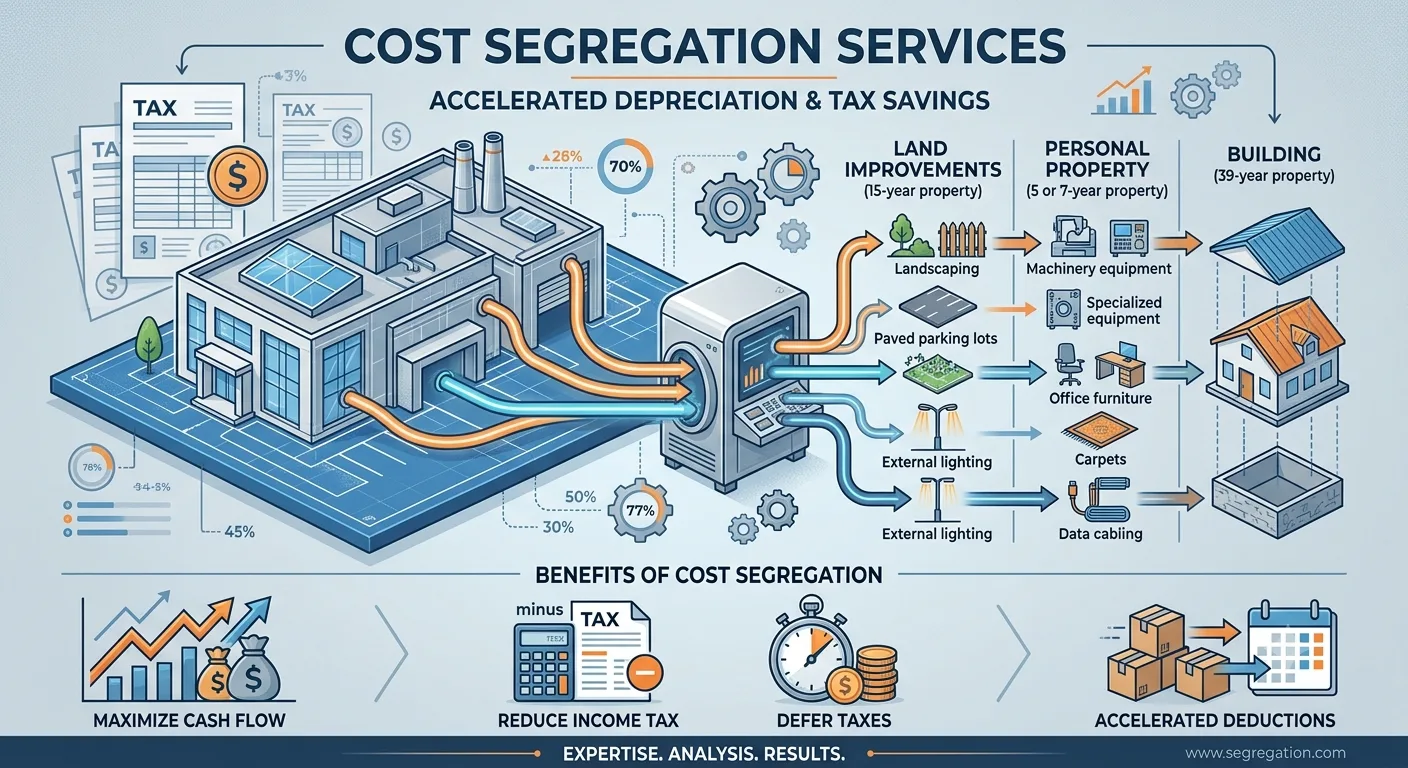
At its core, cost segregation is an engineering-based tax strategy that breaks a building down into its individual components instead of treating it as one giant asset. Under standard IRS rules, commercial property depreciates over 39 years, and residential rental property depreciates over 27.5 years. That's a long time to wait for a tax benefit.
A cost segregation study identifies portions of a property — things like speciality electrical systems, decorative lighting, carpeting, certain fixtures, parking lots, landscaping, and fencing — that qualify for much shorter depreciation schedules of 5, 7, or 15 years. Reclassifying these components accelerates the deductions into the early years of ownership, which can dramatically improve cash flow when it matters most: right after a purchase, renovation, or construction project.
Why This Isn't Just an Accounting Trick
Cost segregation is authorised under Section 168 of the Internal Revenue Code, and the IRS has published its own Cost Segregation Audit Techniques Guide outlining exactly how a proper study should be conducted. In other words, this isn't a grey-area loophole — it's a well-established, IRS-recognised methodology, provided the study is performed correctly by qualified professionals.
Why 2026 Is a Pivotal Year for Cost Segregation Services
The Return of 100% Bonus Depreciation
For years, bonus depreciation — the ability to immediately deduct a large percentage of an asset's cost rather than spreading it over decades — was scheduled to phase out. After peaking at 100% through 2022, it dropped to 80% in 2023, 60% in 2024, and was on track to fall further before disappearing entirely by 2027.
That changed with the One Big Beautiful Bill Act (OBBBA), signed into law in July 2025. The legislation permanently restored 100% bonus depreciation for qualifying property placed in service after January 19, 2025. For property owners, this removed years of uncertainty and turned cost segregation from a "nice to have" into one of the most powerful tax planning tools available.
What This Means in Real Dollars
Here's why the timing matters so much. Under standard straight-line depreciation, a mid-sized apartment or commercial building might generate a modest annual deduction spread evenly over decades. Once a cost segregation study reclassifies components into shorter-life categories, those same dollars can potentially be deducted in full during year one, rather than trickling in over 15, 27.5, or 39 years.
For a business owner or investor in a higher tax bracket, that shift can translate into a meaningfully lower tax bill in the very first year of ownership — cash that can be reinvested into the business, used to pay down debt, or redirected toward the next acquisition.
Who Should Consider Cost Segregation Services
Cost segregation isn't limited to large institutional investors. It can make sense for the following:
- Commercial property owners — office buildings, retail centers, warehouses, and industrial facilities
- Multifamily and apartment owners — properties with several units often have significant reclassifiable components
- Short-term rental owners — especially those who materially participate in managing the property, since accelerated losses may offset other active income
- Business owners who own their building — manufacturing, medical, and production facilities may also qualify for newer provisions covering qualified production property
- Investors completing renovations or build-outs — interior improvements often qualify for accelerated treatment
Generally speaking, the higher the purchase price and the more complex the property, the greater the potential benefit. That said, even smaller properties can generate a return on the cost of the study.
How the Process Works
Step 1: Feasibility Analysis
A qualified firm typically starts with a no-cost or low-cost estimate of potential benefit, comparing the projected tax savings against the cost of the study.
Step 2: Engineering-Based Site Review
Specialists review blueprints and construction costs and often conduct an on-site inspection to identify and document every component eligible for reclassification.
Step 3: Detailed Report and Depreciation Schedule
The study produces a report that assigns costs to the appropriate asset classes, which your accountant then uses to prepare depreciation schedules and tax filings.
Step 4: Ongoing Coordination With Your CPA
This is where the strategy actually pays off. A study is only as valuable as the tax planning built around it — coordinating bonus depreciation elections, passive activity loss rules, and state conformity issues requires close collaboration between the engineering team and your accounting firm.
Common Misconceptions About Cost Segregation
It only works for brand-new properties. Not true. Owners who purchased or built a property years ago and never conducted a study can often still capture the missed depreciation in a single catch-up year using a change in accounting method, without amending prior returns.
It's only for huge portfolios. While the dollar benefit scales with property value, many single-property owners find the numbers work in their favour, particularly with 100% bonus depreciation now permanent.
My state automatically follows federal rules. Several states, including New York, do not fully conform to federal bonus depreciation rules. This makes it essential to work with a firm that understands both federal and state-level implications.
Choosing the Right Partner for Cost Segregation Services
Because cost segregation combines engineering analysis with tax strategy, the quality of the firm you choose matters. Look for a team that:
- Has documented experience performing IRS-compliant, engineering-based studies
- Works collaboratively with your existing CPA rather than operating in isolation
- Can model your specific situation, including state tax conformity and passive loss considerations
- Provides audit support and stands behind its methodology
The Bottom Line
Tax law doesn't stay still for long, and the permanent restoration of 100% bonus depreciation has reopened a window that many property owners assumed had already closed. Cost segregation services give real estate investors and business owners a legitimate, IRS-recognised way to accelerate depreciation, improve cash flow, and reinvest tax savings back into their business sooner rather than later.
If you own commercial or investment property and haven't reviewed your depreciation strategy since the law changed, now is the time. A conversation with an experienced accounting team can determine whether a cost segregation study makes sense for your portfolio — and how much it could be worth.