
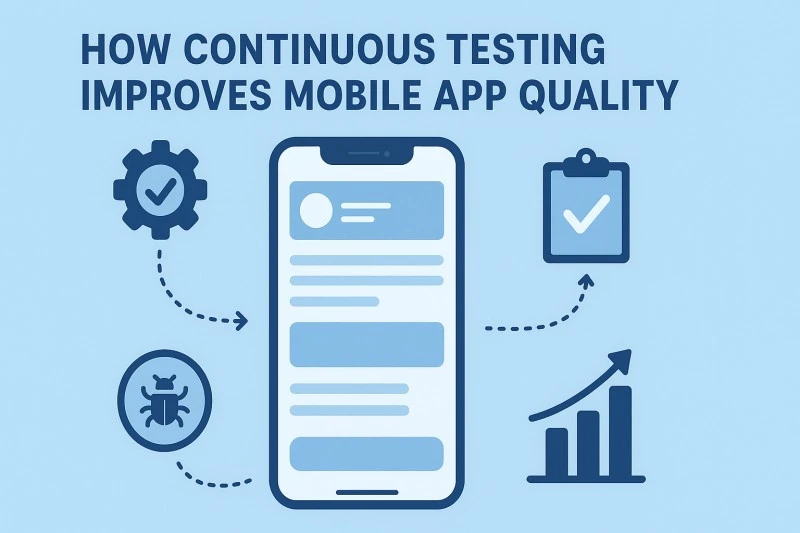
In today’s fast-paced digital world, users expect mobile apps to be fast, reliable, and seamless. A single crash, performance issue, or bug can quickly drive users away to a competitor’s app. For businesses and developers, this means quality isn’t optional—it’s essential. This is where continuous testing comes in. Unlike traditional testing, which usually happens at the end of development, continuous testing integrates testing at every stage, ensuring that quality issues are caught early and fixed quickly.
What is Continuous Testing?
Continuous testing is all about making quality a part of the development journey from day one. Instead of waiting until the app is fully built to uncover bugs, testing happens continuously as new code is written and integrated. This proactive approach helps catch issues early, before they become bigger roadblocks.
In today’s fast-moving development workflows, continuous testing pairs perfectly with Continuous Integration and Continuous Delivery (CI/CD) pipelines. Each time developers push an update, automated tests quietly run in the background to check functionality, performance, and compatibility across devices. It’s like having a safety net that ensures nothing slips through the cracks.
For teams focused on mobile app testing, continuous testing is a game-changer - it not only speeds up releases but also guarantees a smoother, more reliable user experience.
Why Mobile App Quality Can’t Be Compromised
Think about your own experience - how many times have you uninstalled an app because it was slow, buggy, or crashed at the worst moment? Mobile app users are unforgiving; if an app doesn’t meet their expectations, they will quickly abandon it.
Poor app quality doesn’t just affect users - it can also damage a brand’s reputation. One negative review on the app store can influence thousands of potential downloads. With millions of apps competing for attention, businesses simply can’t afford to compromise on quality. Speed, security, and smooth performance are must-haves, not nice-to-haves.
Benefits of Continuous Testing in Mobile Apps
Adopting continuous testing offers multiple benefits for developers and businesses:
- Faster Bug Detection and Fixes
Bugs are caught as soon as they appear, which makes fixing them quicker and cheaper compared to discovering them after release.
- Improved Device and OS Compatibility
With countless device models and operating systems, continuous testing ensures the app works across all combinations, reducing compatibility issues.
- Better Security
Automated security tests can quickly flag vulnerabilities before they become threats, keeping both the business and its users safe.
- Higher User Satisfaction
Apps that perform smoothly and consistently lead to happier users, better reviews, and increased retention.
Key Practices for Implementing Continuous Testing
To make continuous testing effective, developers should follow a few best practices:
- Automate Test Cases: Automating repetitive tests speeds up the process and ensures consistency.
- Test on Real Devices: Emulators are useful, but real devices provide more accurate results.
- Integrate with CI/CD: Testing should be a built-in part of development, not an afterthought.
- Use Feedback Loops: Continuous testing provides constant feedback, helping teams improve quickly.
Real-World Example
Imagine a banking app rolling out a new payment feature. Without continuous testing, the update might only be tested at the very end - leading to overlooked bugs, like failed transactions or delays. With continuous testing, however, every code change related to the payment feature is tested in real-time. This means errors are caught early, ensuring the feature works smoothly by the time it reaches users. The result? A reliable, secure payment experience that strengthens customer trust.
Challenges to Watch Out For
While continuous testing is powerful, it does come with challenges:
- Environment Setup: Creating a stable testing environment that mirrors real-world conditions can be complex.
- Device Fragmentation: With hundreds of devices and OS versions, managing test coverage requires smart planning.
- Balance Between Automation and Manual Testing: Not everything can (or should) be automated—manual testing is still valuable for usability and design checks.
The Future of Continuous Testing in Mobile Apps
Continuous testing is evolving fast. Emerging technologies are making it even more effective:
- AI-Powered Testing: Machine learning can help predict failures and automate smarter test cases.
- Cloud Testing Platforms: Developers can now test apps across multiple devices and OS versions in the cloud, reducing infrastructure costs.
- DevOps Synergy: Continuous testing will continue to play a central role in faster, more efficient DevOps pipelines, enabling quicker and safer app releases.
Conclusion
In the mobile-first world, app quality is everything. Continuous testing ensures that bugs are caught early, performance remains strong, and users get the seamless experience they expect. It’s not just about preventing errors - it’s about building trust, improving retention, and staying competitive in a crowded market.
For developers and businesses alike, adopting continuous testing isn’t just a smart choice - it’s a necessity for long-term success in mobile app development.