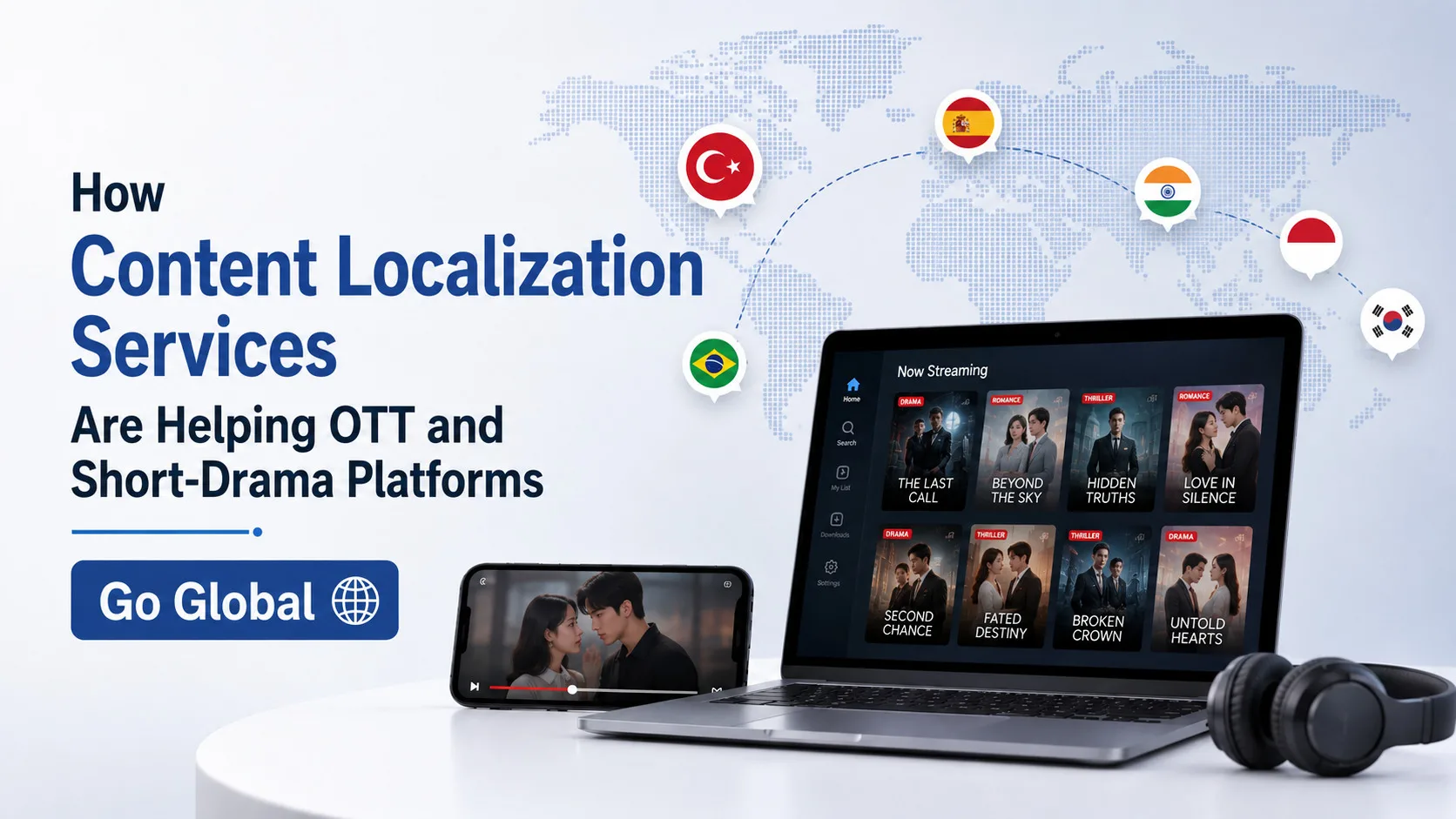
Five years ago, a Korean thriller or a Turkish romance staying on the front page of a streaming app in Brazil or Indonesia would have seemed unlikely. Today it's routine. That shift didn't happen by accident; it happened because content localization services quietly rebuilt the way global entertainment reaches local audiences.
OTT platforms and the newer wave of short-drama apps are no longer just translating subtitles and calling it done. They're investing in full-scale localization: dubbing, cultural adaptation, lip-sync engineering, and region-specific quality control. For any platform serious about international growth, understanding this shift isn't optional anymore; it's the difference between a title that flops abroad and one that trends.
Why Content Localization Services Have Become Non-Negotiable for OTT Platforms
Streaming audiences have made their preference clear: most viewers would rather watch dubbed content in their own language than read subtitles, especially on mobile screens where short-dramas dominate. That single behavioral fact has pushed platforms to treat localization as a core product feature, not an afterthought bolted on after release.
A few forces are driving this:
- Mobile-first viewing habits. Short-drama platforms are built for quick, vertical, on-the-go consumption. Subtitles slow that experience down; native-sounding dubbing doesn't.
- Algorithm-driven discovery. Recommendation engines push content that keeps people watching. Poorly dubbed or awkwardly translated shows see drop-off within the first few minutes, which hurts a title's visibility across the entire platform.
- Competitive saturation. With dozens of platforms fighting for the same regional audiences, the ones that sound native, not translated, win retention.
This is where professional content localization services earn their value: they don't just convert words, they convert the entire viewing experience.
Dubbing Is the Front Line of Global Expansion
Subtitling still matters, but dubbing has become the deciding factor for whether international content actually performs in a new market. A well-produced dub does three things a subtitle can't:
It removes the reading barrier entirely, which matters enormously for short-form and mobile-first content.
- It preserves emotional pacing, so comedic timing, tension, and delivery land the way the original director intended.
- It signals production quality, which shapes how seriously an audience takes the platform itself.
This is why experienced dubbing studios spend as much time on casting voice talent and directing performances as they do on the technical translation. A flat or mismatched voice can undo months of production work on the original show.
What Separates Strong Dubbing From Generic Translation
Generic translation focuses on accuracy. Strong dubbing focuses on believability. That means adapting idioms instead of translating them literally, adjusting jokes so they land in the target culture, and matching lip movements closely enough that viewers stop noticing they're watching a dub at all. Studios that specialize in this work typically combine linguists, voice directors, and sound engineers in the same pipeline, not as separate outsourced steps because tone gets lost when the process is fragmented.
Cultural Adaptation: The Piece Most Platforms Underestimate
Language is only part of localization. Cultural adaptation covers everything from character names and honorifics to visual text, humor, and even pacing expectations that differ by region. A joke that works in Seoul might need a complete rewrite to land in São Paulo. A storyline pace that feels normal in a Western drama might feel slow for audiences used to faster-cut short-form content.
This is particularly relevant for the short-drama boom. These platforms often release dozens of episodes per week across multiple markets, which means localization teams need consistency at scale, matching tone, character voice, and terminology across an entire season, not just a single episode.
Subtitling, QC, and the Technical Backbone of Global Release
Behind every polished dub or subtitle track sits a layer of technical work that audiences never see but always feel when it's missing: timecode accuracy, audio mixing, format compliance for different platforms, and multi-round quality control. Studios that treat this as seriously as the creative side tend to produce far fewer post-release fixes, which matters when a platform is releasing content on a weekly or even daily cadence.
What OTT and Short-Drama Platforms Should Look for in a Localization Partner
Not all localization providers operate at the same level. Platforms evaluating a partner should look for:
- Experience across multiple genres and formats, not just film or long-form TV
- In-house voice talent networks rather than ad-hoc freelance sourcing
- Established QC processes with measurable turnaround times
- Cultural adaptation expertise specific to target markets, not just language pairs
Industry examples back this up. Established players like Iyuno, VSI Group, Bang Zoom! Entertainment and Sound & Vision India have all grown by offering this kind of end-to-end model rather than piecing localization together from separate vendors. Sukudo Studios follows the same approach, building its reputation on treating dubbing, subtitling, and cultural adaptation as one integrated service rather than three disconnected steps.
The Road Ahead
As OTT and short-drama platforms keep expanding into new regions, the platforms that win will be the ones that sound and feel local everywhere they launch. Content localization services have moved from a supporting function to a growth strategy, and the studios that understand both language and culture will keep shaping which stories travel and which ones stay home.