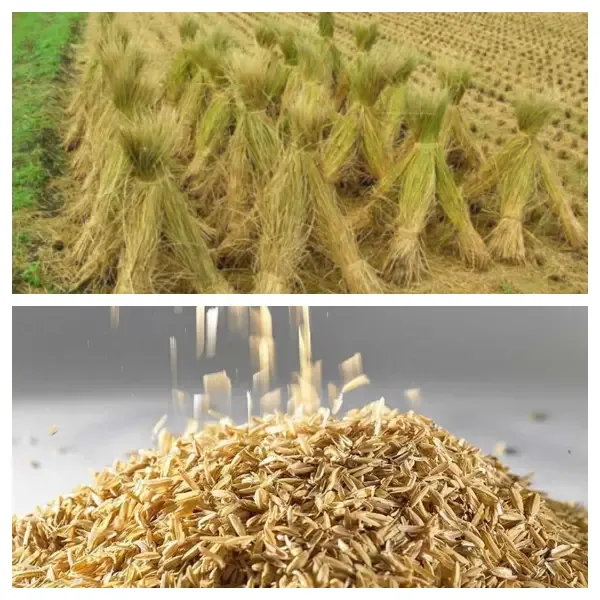
Rice production generates substantial amounts of agricultural waste, including rice straw and rice husks. In many rice-growing regions, these by-products are burned in open fields, discarded, or used inefficiently because of limited processing facilities. However, with appropriate treatment, rice waste can become a valuable source of biomass fuel and other useful products. Understanding the available processing methods helps farmers and businesses reduce waste, improve resource utilization, and explore more sustainable production practices.
Understanding Rice Straw and Rice Husks
Rice straw consists of stalks and leaves left behind after harvesting, while rice husks are the protective outer layers removed during rice milling. Although both materials originate from the same crop, their physical properties differ considerably.
Rice straw contains cellulose, hemicellulose, and lignin, making it a potential feedstock for biomass energy. However, its fibrous structure and relatively low bulk density can increase transportation and storage costs. Rice husks are easier to collect at centralized milling facilities, but their high silica content affects combustion characteristics and contributes to relatively high ash production.
Before selecting a processing method, operators should assess raw material availability, moisture content, contamination, transportation distance, and the intended end use. These factors influence both processing efficiency and the economic feasibility of a project.
Processing Rice Straw into Biomass Pellets
Pellet production is one practical way to improve the handling and storage of rice straw. The process usually begins with collecting and sorting the material to remove stones, soil, and other impurities. The straw is then chopped or crushed into smaller particles. Depending on its initial moisture content, drying may be necessary before pelletizing.
A rice straw pellet making machine compresses prepared material into dense, cylindrical pellets. During this process, pressure and friction help the particles bind together. The resulting pellets are generally easier to transport, store, and feed into compatible biomass combustion systems than loose straw.
Several factors influence pellet quality. Particle size must be suitable for the equipment, and moisture content should fall within the recommended operating range. Excessively wet material can reduce production efficiency, while unsuitable particle sizes may lead to inconsistent pellet formation. Cooling and screening after pelletizing help improve storage stability and remove loose fines.
Rice straw pellet production also requires attention to equipment maintenance. Silica and other abrasive components in agricultural residues can contribute to wear, so operators should monitor dies, rollers, and other parts that experience continuous friction.
Converting Rice Husks into Biomass Fuel
Rice husks are often available in large quantities near rice mills, making them attractive for centralized biomass processing. Instead of being discarded, they can be converted into pellets for appropriate industrial heating applications.
A CE rice husk pellet mill may be considered when evaluating equipment for this purpose. However, the CE marking should be verified against the applicable European Union conformity requirements and supporting documentation. It should not be treated as an automatic guarantee of pellet quality, energy efficiency, or suitability for every production facility.
The processing sequence generally includes raw material screening, size adjustment when necessary, moisture control, pelletizing, cooling, and packaging. Since rice husks have distinctive physical properties and relatively high silica content, the pellet mill's compression configuration and wear resistance deserve careful consideration.
Fuel performance should also be assessed before commercial production begins. Rice husk pellets can generate considerable ash, and the characteristics of this ash may affect combustion equipment and cleaning requirements. Businesses should confirm that their boilers or heating systems are compatible with the proposed fuel and that emissions and ash disposal comply with local regulations.
Planning a Complete Biomass Pellet Production System
For businesses handling large quantities of agricultural residues, understanding what is turnkey biomass pellet production line means looking beyond the pellet mill itself. A turnkey system generally refers to an integrated production solution in which the necessary equipment and project components are coordinated to meet defined production requirements. The exact scope depends on the supplier and contract.
Related Post: https://commercialpelletmill.com/biofuel-pellet-production-line/
Such a system may include feeding equipment, crushers, dryers, pellet mills, coolers, screening units, conveying systems, and packaging machinery. Not every project requires every component. For example, rice husks collected in relatively dry conditions may need less drying capacity than freshly harvested rice straw.
Planning should begin with an assessment of daily raw material supply and the desired output. Operators must also consider seasonal fluctuations, storage capacity, electricity consumption, labor requirements, and finished-product transportation. A realistic production plan accounts for material losses and equipment downtime rather than assuming that the nominal machine capacity will always be achieved.
Pilot testing is particularly useful when processing unfamiliar raw materials. Testing helps determine appropriate moisture levels, particle sizes, pellet durability, and energy consumption before substantial investment is committed.
Improving the Value of Rice Waste
Learning more about this type of agricultural waste management can help businesses identify practical alternatives to open burning and inefficient disposal. Depending on local conditions, rice residues may be suitable for pellet fuel, composting, soil-related applications, or other forms of biomass utilization.
Equipment manufacturers such as pellet mill machine operate in the feed and biomass processing sectors, where production-line configuration and raw material characteristics are important considerations. When comparing suppliers, businesses should examine technical specifications, material compatibility, maintenance requirements, and the availability of installation and after-sales support.
Ultimately, successful rice waste processing depends on matching the right technology to the available material and the intended market. Careful planning can turn agricultural by-products into useful resources while supporting more efficient and responsible waste management.