
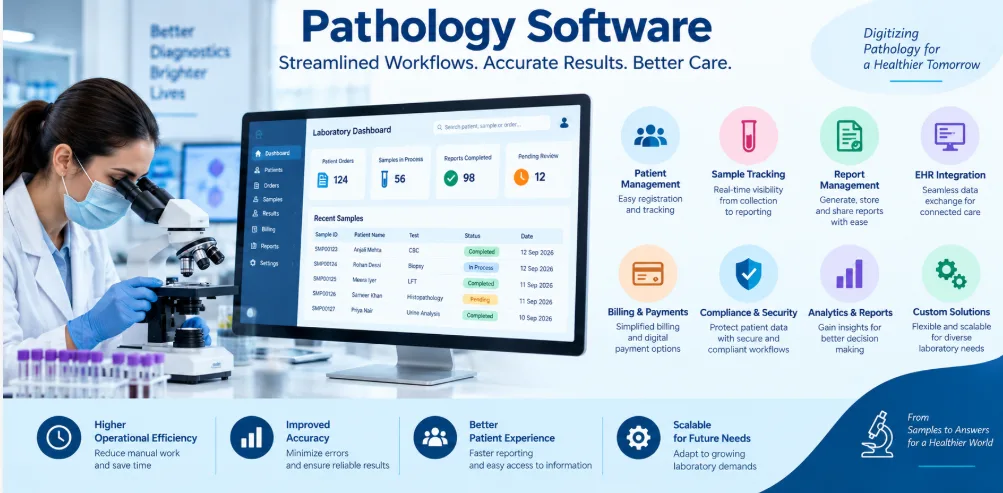
Pathology laboratories manage complex workflows involving patient registration, specimen collection, sample processing, diagnostic testing, reporting, billing, and data exchange. Handling these activities manually can create delays, increase administrative workloads, and make it difficult to maintain accurate records. Modern pathology software helps laboratories bring these processes together through a centralized digital platform.
A well-designed pathology software system supports laboratory staff and pathologists by organizing information, automating routine tasks, and improving visibility across diagnostic workflows. With the right technology, laboratories can strengthen operational efficiency while supporting timely communication between healthcare professionals.
Streamlining Laboratory Workflows
A comprehensive pathology management software platform can coordinate activities from patient registration to final report delivery. Instead of relying on disconnected tools and manual records, laboratory teams can manage essential processes through a unified system.
Common capabilities include:
- Patient registration and demographic information management
- Test ordering and appointment scheduling
- Specimen collection and tracking
- Laboratory workflow and status monitoring
- Diagnostic report generation and storage
- Billing, invoicing, and payment management
- Inventory and laboratory documentation management
These capabilities help reduce repetitive administrative work and give laboratory teams a clearer view of daily operations.
Improving Specimen Tracking and Test Management
Specimen tracking is an important component of diagnostic laboratory operations. Every sample must be correctly identified, monitored, processed, and associated with the appropriate patient record.
Modern pathology lab software can support barcode-based identification, sample status updates, collection records, and workflow notifications. Laboratory personnel can monitor specimens as they move through different testing stages and identify delays that require attention.
Digital tracking also helps establish a consistent record of specimen handling. Configurable workflows can support different testing requirements, laboratory departments, and operational procedures.
Enhancing Diagnostic Reporting and Data Access
Accurate reporting is essential for communicating laboratory findings to clinicians and patients. A centralized reporting module can help staff prepare, review, store, and retrieve diagnostic reports more efficiently.
The system can support standardized report templates, authorized review processes, electronic report storage, and controlled access to patient information. Depending on laboratory requirements, reporting workflows can also include notifications when results become available.
These capabilities improve information accessibility and help reduce the administrative effort associated with managing large volumes of laboratory documentation.
Connecting Pathology Systems With Healthcare Platforms
Laboratories frequently exchange information with hospitals, clinics, physicians, and other diagnostic facilities. Integrating pathology applications with electronic health records (EHRs), laboratory information management systems (LIMS), billing platforms, and other healthcare applications can reduce fragmented data handling.
Integration can enable test orders and results to move between connected systems, subject to interface compatibility, data standards, and authorization requirements. This helps healthcare professionals access relevant diagnostic information without relying entirely on manual data transfers.
Supporting Billing and Administrative Management
Financial and administrative processes are another important part of laboratory operations. A digital platform can connect test orders with billing records, generate invoices, record payments, and provide dashboards for monitoring financial activity.
A customized system can also support insurance information management, payment tracking, and reporting based on the laboratory's operational requirements. These functions help administrators gain better visibility into transactions and outstanding payments.
Building Secure and Scalable Pathology Applications
Laboratory systems handle sensitive patient and diagnostic information, making security a core development consideration. Appropriate safeguards can include role-based access, encryption, audit logs, secure authentication, and backup procedures.
The development approach should also consider applicable healthcare privacy requirements, laboratory policies, and regulatory obligations. Security and compliance need to be assessed throughout design, implementation, testing, and ongoing maintenance rather than treated as a final feature.
Custom Pathology Software Development for Evolving Needs
Every laboratory has different testing workflows, reporting requirements, equipment, and integration needs. Pathology Software Development can address these differences through configurable modules and custom application architecture.
A development project may include workflow analysis, interface design, system integration, data migration, quality assurance, deployment, and technical support. Scalability should also be considered so that the application can accommodate additional users, locations, testing volumes, and future functionality.
The right pathology platform brings essential laboratory processes into a connected environment. By improving specimen visibility, reporting, integration, and administrative coordination, healthcare organizations can build more organized and efficient diagnostic operations.