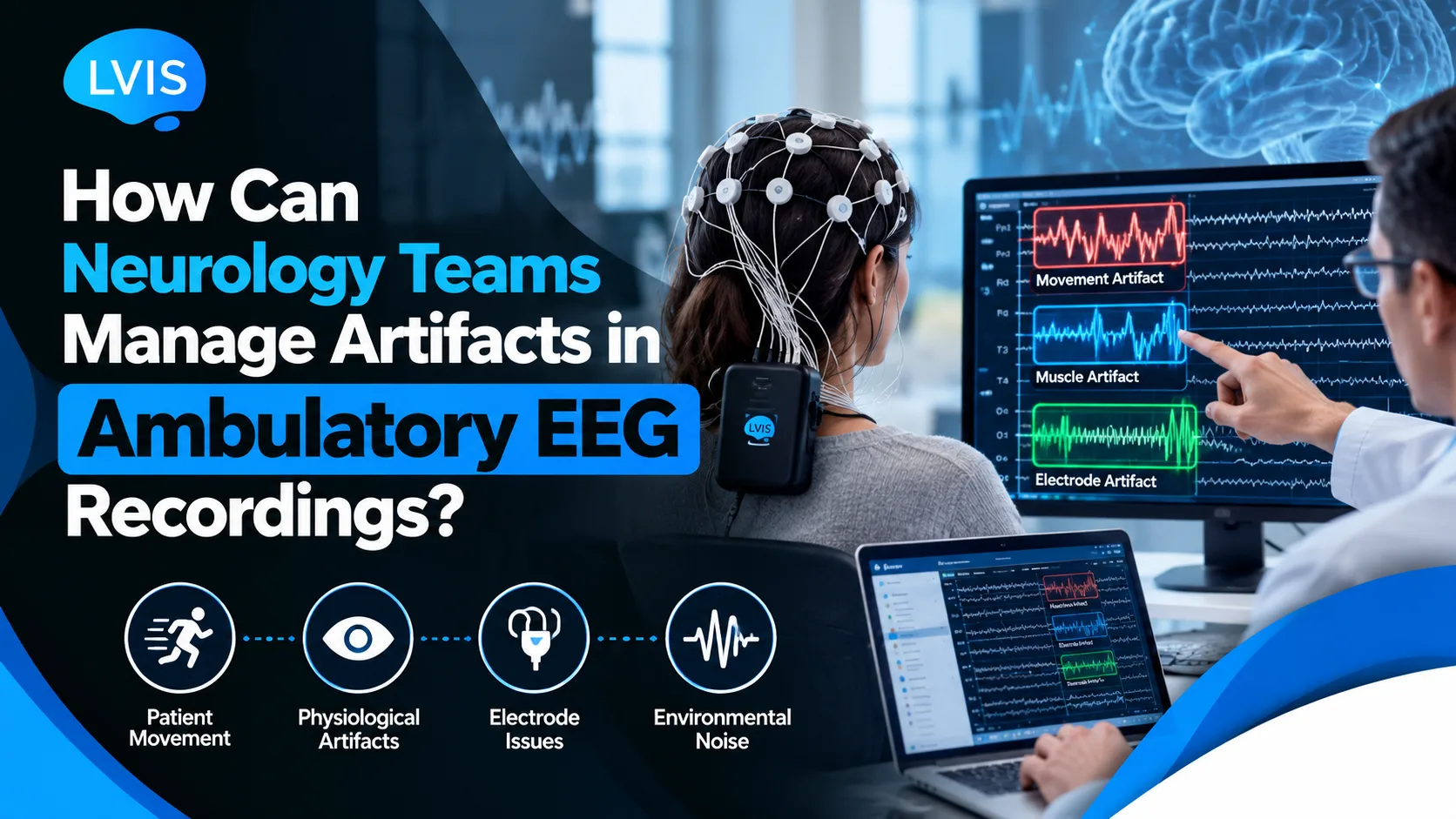
Long-duration EEG recordings can provide valuable information about brain activity outside a traditional inpatient monitoring environment, but they also introduce substantial amounts of artifact. Patients move, sleep, eat, use electronic devices, and continue many normal daily activities while being recorded, creating conditions that are difficult to control. Electrode problems, muscle activity, movement, and environmental interference can therefore complicate interpretation and increase review time. An ambulatory eeg workflow should account for these challenges from electrode placement through final clinical review. Effective artifact management can help neurology teams spend more time evaluating meaningful cerebral activity and less time navigating unusable or misleading portions of lengthy recordings.
Why Are Artifacts Common in Ambulatory EEG?
Unlike controlled laboratory or inpatient recordings, patients undergoing ambulatory monitoring are exposed to constantly changing conditions. Walking, chewing, talking, sleeping, changing clothes, and touching electrodes can all affect recorded signals. Electrodes may also loosen over time as the patient moves or perspires, potentially introducing intermittent noise or unstable channels. Because monitoring can continue for many hours or days, even occasional disturbances can accumulate into a significant volume of artifact. Recognizing these sources early helps reviewers distinguish technical or physiological interference from activity that may warrant closer neurological evaluation.
Understand the Different Sources of EEG Artifact
Artifacts can originate from physiological and nonphysiological sources, and separating the two is an important part of EEG review. Eye movements, muscle activity, cardiac signals, sweating, and movement can produce physiological artifacts that appear alongside cerebral activity. Nonphysiological artifacts may arise from electrodes, cables, electronic equipment, or environmental electrical interference. Each source can produce different waveform characteristics, although patterns may overlap and require experienced interpretation. Reviewers should therefore assess morphology, channel distribution, timing, and surrounding activity instead of classifying unusual signals based on appearance alone.
Good Recordings Begin Before the Patient Leaves
Artifact management starts with recording quality rather than waiting until the EEG reaches the interpretation stage. Careful electrode application, impedance checks, secure connections, and clear patient instructions can reduce preventable signal problems during extended monitoring. Patients should understand how to protect the recording equipment and what to do if they notice a loose electrode or another technical issue. Event diaries or other documentation can also help reviewers compare suspicious EEG segments with patient activities and reported symptoms. Improving data acquisition at the beginning can make the subsequent ambulatory eeg review substantially more efficient.
Why Patient Activity Context Matters
A waveform that appears concerning in isolation may become easier to interpret when reviewers know what the patient was doing at the time. Movement associated with brushing teeth, chewing, exercise, or repositioning during sleep can generate rhythmic or repetitive patterns that may otherwise attract attention. Patient-reported events can also help reviewers locate periods that deserve closer examination. However, recorded behavior and diaries should supplement rather than replace waveform analysis. Combining multiple sources of context gives reviewers a stronger basis for distinguishing artifact from potentially meaningful EEG activity.
Managing Artifacts Across Long Recordings
Reviewing extended EEG recordings manually from beginning to end can place considerable demands on clinical teams. Modern workflows can use software-assisted navigation, event markers, trends, and automated analysis to help reviewers focus on segments requiring closer examination. EEG review software can support a more structured approach to navigating these datasets rather than relying exclusively on sequential manual review. Reviewers can then assess suspicious periods in greater detail and determine whether a pattern represents artifact, normal activity, or a potentially relevant cerebral event. The purpose of technology should be to improve organization and prioritization while preserving expert clinical oversight.
Use Multiple Channels to Identify Artifact
Artifact often becomes easier to recognize when reviewers examine its distribution across channels rather than concentrating on a single waveform. A disturbance isolated to one electrode may suggest a local technical issue, while widespread high-frequency activity may be more consistent with muscle artifact depending on the recording context. Reviewers can also assess whether the signal demonstrates a plausible cerebral field, evolution, and relationship with surrounding background activity. Looking at broader temporal context can reveal whether a suspicious pattern corresponds with movement or another transient disturbance. These techniques help prevent isolated visual features from being interpreted without sufficient context.
How Can AI Assist With Artifact-Heavy EEG Data?
AI-assisted tools may help teams prioritize potentially important sections of long recordings, particularly when clinicians face large volumes of EEG data. EEG analysis software can support workflows that combine visualization, analysis, and review within a digital environment. Algorithms can help surface candidate events, but artifact can still produce patterns that require human verification. Clinicians should therefore review automatically identified events in the context of neighboring EEG activity, channel distribution, and available patient information. AI becomes most useful when it helps direct expert attention rather than attempting to eliminate the need for expert interpretation.
Remote Workflows Need Reliable Review Processes
Cloud-based technology has expanded the possibilities for accessing EEG information beyond a single workstation or physical facility. remote eeg monitoring can support distributed teams and enable specialists to work with EEG data across locations when appropriate infrastructure and security controls are in place. However, remote access does not remove the need for consistent artifact-identification and review procedures. Teams should establish shared standards for documenting technical issues, reviewing candidate events, and escalating uncertain findings. Standardized workflows can help maintain consistency when multiple clinicians participate in the same recording review.
Applying EMU Experience to Ambulatory Review
Teams experienced in epilepsy monitoring units already understand many of the challenges associated with separating artifact from clinically significant activity. The difference is that ambulatory recordings generally provide less environmental control and may include longer periods of unrestricted patient activity. EMU Software can support EEG workflows where clinicians need to organize, visualize, and review large amounts of neurological data. Principles used in EMU review, including attention to morphology, spatial distribution, evolution, and clinical context, remain valuable when evaluating ambulatory studies. Adapting these principles to less controlled recordings can help teams manage artifact more systematically.
Build a Repeatable Artifact-Review Workflow
Consistency becomes particularly important when multiple technologists, neurologists, or other clinical professionals participate in EEG review. Teams can establish procedures for identifying poor-quality channels, documenting persistent artifacts, reviewing patient-marked events, and escalating ambiguous patterns. Standardized terminology can also make communication clearer when one reviewer hands a study to another. Quality feedback should flow back to the acquisition process so recurring electrode or equipment problems can be addressed in future recordings. A repeatable workflow can gradually improve both recording quality and review efficiency.
Looking Beyond Traditional EEG Visualization
The future of neurological data analysis may involve combining EEG with increasingly sophisticated computational models and visualization technologies. LVIS Corporation's work around the digital twin brain reflects a broader direction in which complex brain data can be organized and explored through advanced digital approaches. These technologies may provide new ways to contextualize neurological information, but the quality of the underlying physiological data remains fundamental. Artifact management therefore continues to matter even as analysis platforms become more sophisticated. Better computational tools cannot fully compensate for poor signal acquisition or inappropriate interpretation.
Improving Ambulatory EEG Review Without Losing Clinical Context
The most effective artifact-management strategy combines high-quality acquisition, patient education, structured review, appropriate technology, and experienced clinical interpretation. Neurology teams should aim to prevent avoidable artifacts while accepting that some interference is inevitable during real-world monitoring. Technology can help clinicians navigate lengthy datasets, but suspicious patterns still need to be evaluated in their broader electrographic and clinical context. A well-designed ambulatory eeg workflow can make long-duration studies more manageable without treating automated analysis as a substitute for professional judgment. For neurology teams managing growing EEG volumes, combining reliable data acquisition with intelligent review tools can create a more scalable and clinically grounded approach.