
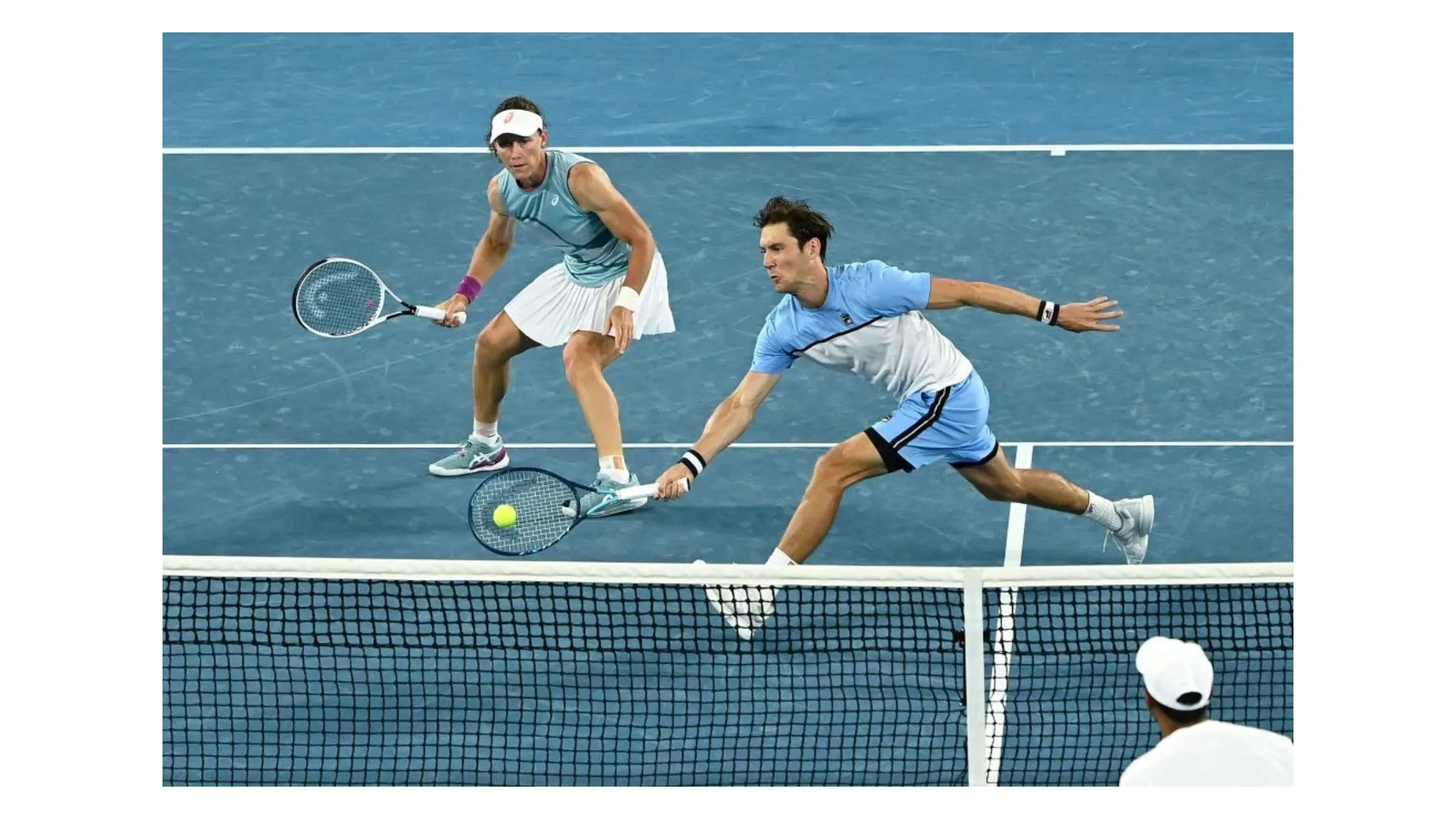
A shared court exposes every gap in a partnership. How does mixed doubles tennis work at the net? Each team has one man and one woman, and both must cover the full court with equal duties. Differences in reach, pace, and touch make clear roles even more valuable. Veteran ATP coach Bill Glaves built the Wall system around defined positions, and his structured lessons give both partners a dependable plan.
Strengths Mixed Partners Bring to the Court
Partners rarely match in every skill, and the mismatch can become an asset. A clear view of each strength helps the pair assign duties to the player best suited for them.
- Reach: A taller player covers more space at the net and reaches lobs sooner, which suits the front position.
- Power: A player with a strong overhead protects the team against lobs and finishes points from above.
- Touch: A player with a refined touch controls firm volleys at close range and places them at the opponent’s feet.
- Handedness: A left-handed and a right-handed partner create different volley options on each side, and the rulebook covers each pairing.
Fixed Roles That Keep Partners Organized
Roles in the Wall system belong to positions, not to individuals. Partners learn every position, then decide who plays where, and the structure holds no matter who stands in each spot.
Front Position Habits
The front player waits halfway between the net and the service line, moves forward on slow balls, and waits on powerful shots. Every volley ends with a return to the same waiting spot. This habit forms the base of any basic doubles tennis strategy, because the partner behind can predict where the front player will be.
Back Position Habits
The back player faces cross-court, moves along the diagonal, and stays level with or behind the front player. This spacing keeps the middle covered and gives the back player time to read each ball. A firm volley, hit up and deep, returns the ball to the opponent’s side.
Lob Assignments
Lobs are assigned by position. A lob over the front player sends that player turning, sprinting, squaring up, and hitting an overhead. A cross-court lob goes to the back player, who hits an overhead cross-court. Naming these jobs ahead of time removes hesitation.
Responding When Opponents Target One Partner
Opponents search for the weakest position and aim most shots there. The Wall system answers with position discipline, so the targeted player stays in the role, and the partner stays in place.
A targeted back player faces pressure to advance too early. The better reply is to stay on the diagonal, let the ball come, and volley up and deep. Moving forward invites a short, easy lob.
A targeted front player faces hard shots at the body. Waiting, rather than reaching, produces a firm volley. Slow balls invite a step forward and a downward volley toward the service line. Partners should also resist the urge to cover for each other. Leaving a position opens a lane, and a skilled opponent will use it.
Communication Routines Between Mixed Partners
Short, agreed signals replace long discussions during play. Routines before, during, and between points keep both partners aware of the plan and free from doubt at the moment of contact.
- Before the point: Partners agree on the opening formation and the first target, so the serve or return starts with a plan.
- Lob call: One word, such as “mine,” is called only when a strong overhead is possible, and the other partner clears the space.
- Switch call: A second word signals a switch to the baseline positions, so neither player hesitates.
- Between points: A brief reset reviews one detail, such as the waiting spot, before the next ball.
How does mixed doubles tennis work at its best? Both partners follow the same pattern, and each short call keeps it visible.
A Practice Plan Built for Mixed Partners
Drills train both partners together while a feeder creates point-like pressure. A coach reviews each sequence, and positions rotate so each player learns every position before the pair chooses fixed roles.
The Wall Team Deuce Pin makes an effective starting drill. The feeder drives a forehand cross-court to the Deuce Back, who volleys up and deep. A feed up the line sends the Deuce Front forward for a firm volley. The third feed goes to either partner, and the pair volleys back to the feeder until the point ends.
Wall Team Ad Escape/Kill/Close adds shot choice. The Ad Back escapes with a deep cross-court volley, and a soft feed up the middle invites a downward volley at the opponent’s feet. After each set of feeds, partners trade sides, so each player learns both positions.
Reviewing Match Play and Adjusting Roles
Match play shows which assignments work. Short reviews after each set let partners keep, change, or refine duties based on results. A coach critique once a month adds an outside view.
Three review questions guide the discussion. Did the front player move forward on slow balls and wait on tougher ones? Did lob calls come early? Did the partners stay in position instead of covering for each other? This routine turns a basic doubles tennis strategy into a habit both partners trust.
Final Thought
Mixed partners succeed when roles belong to positions, calls stay short, and practice covers every duty. The Wall system gives both players a clear structure through its rulebook, drill book, and twelve-week lesson plan, guided by decades of expert coaching. With steady repetition and honest review, each partner learns to trust the other, and the pair controls the net with confidence.